
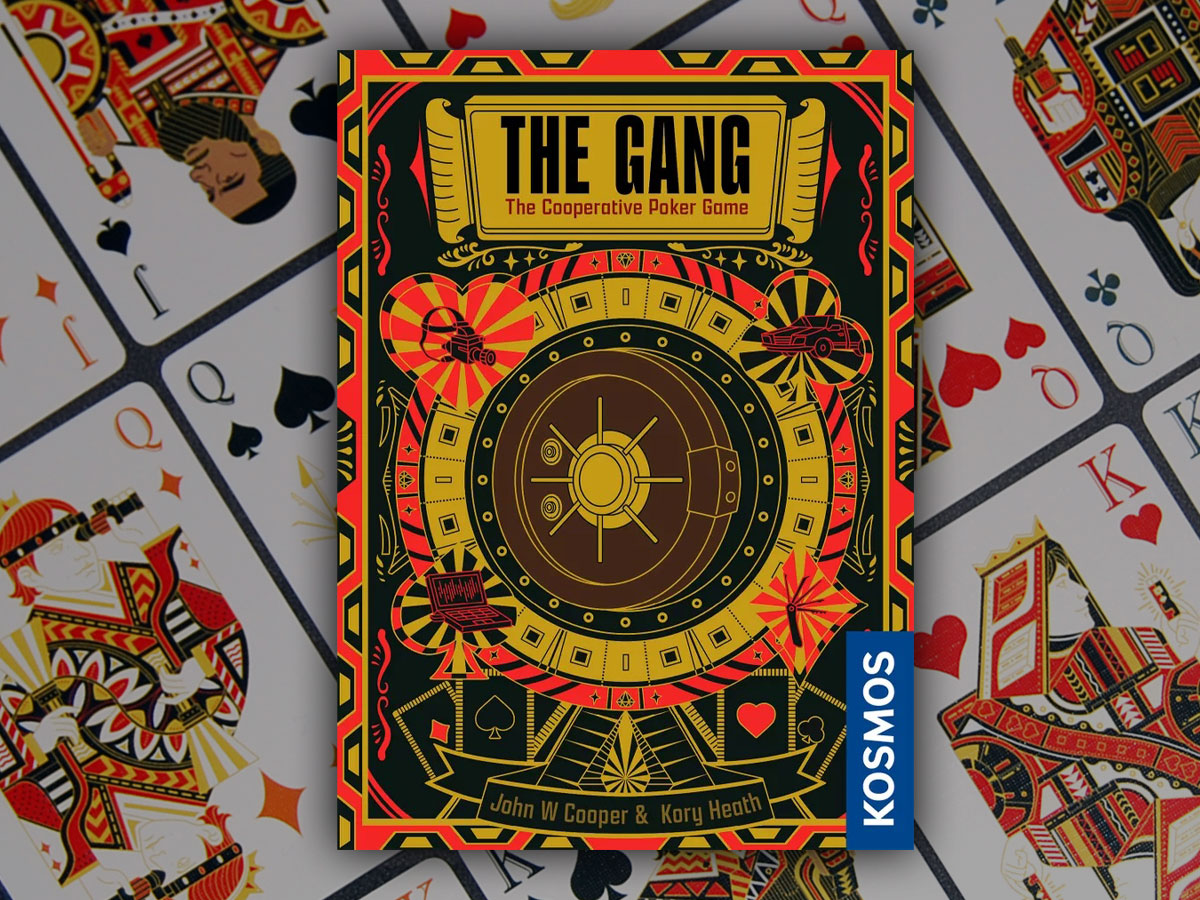
Your gang is attempting to pull off a series of bank heists—put on your poker faces!
What Is The Gang?
The Gang is a cooperative poker-based game for 3 to 6 players, ages 10 and up, and takes about 20 minutes to play. It retails for $15.95 and is available in stores and directly from Kosmos. The game uses a Texas Hold ‘Em style of poker, and is suitable for anyone who is able to handle the basic concepts of poker—but with no bluffing necessary.
The Gang was designed by John Cooper and Kory Heath and published by Kosmos, with illustrations by Fiore GmbH.

The Gang Components
Here’s what comes in the box:
- 3 Vault cards
- 3 Alarm cards
- 10 Challenge cards (advanced mode)
- 10 Specialist cards (advanced mode)
- 52 Playing cards
- 12 Player Aid cards
- 24 Poker chips (6 each in 4 colors)

The playing cards are a standard 52-card deck, though with a custom design. The cards have indices in all four corners and the traditional layouts for the number cards, and the face cards are all unique illustrations that have the flavor of traditional poker cards but also include some modern heist-related elements.

The poker chips come in four colors: white, yellow, orange, and red, and each color has chips with 1 to 6 stars on them. The reverse side of the chips are black, used in some of the challenges in advanced mode. The chips are nice quality and fun to stack and slide.

There are two player aid cards per player. One has a hand ranking for poker, which is always nice to have especially for players who are still new to poker, and the other shows the gameplay procedure.
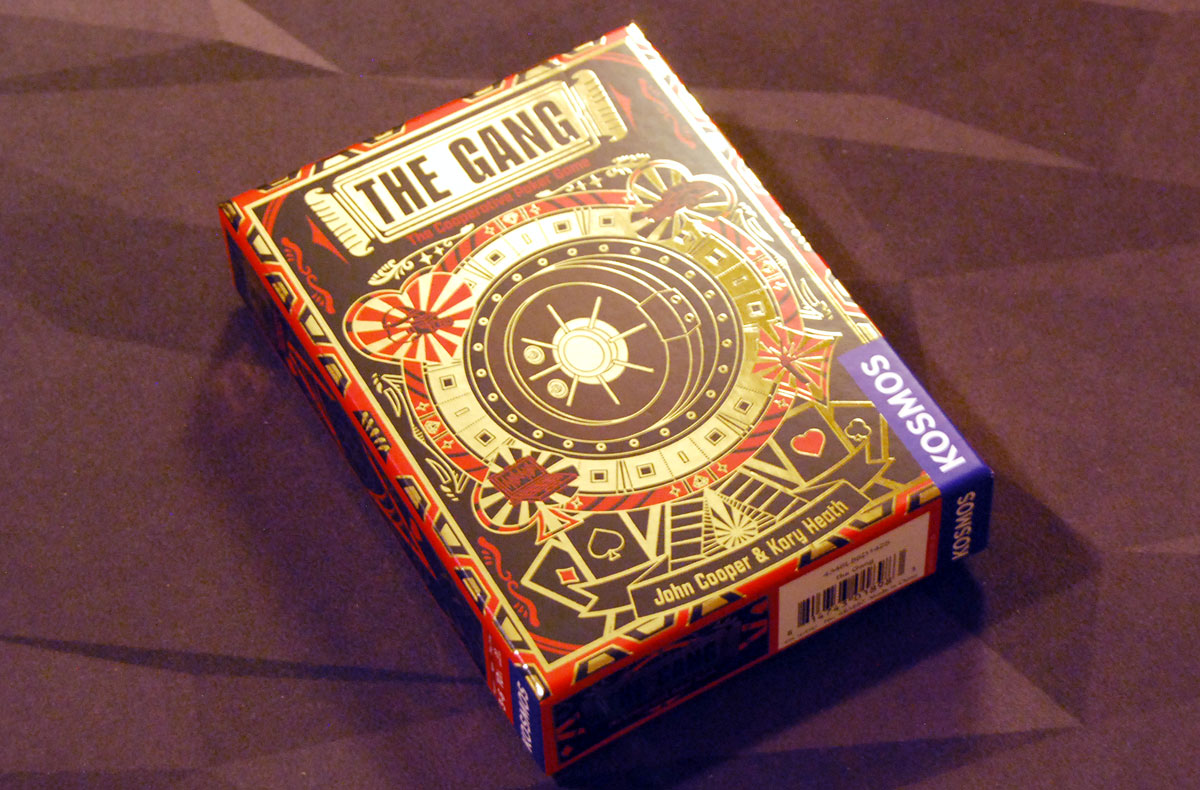
The actual box cover has gold foil on it, making it very shiny!
How to Play The Gang
You can download a copy of the rulebook here.
The Goal
The goal of the game is to complete three successful heists before failing three heists. The game is cooperative so everyone wins or loses together. Communication is limited to using the poker chips—you are not allowed to say anything about the cards in your hand or reveal them to other players.

Setup
Lay out the three vault cards and the three alarm cards with the colorful sides face-down. Set out the poker chips arranged by color and number, leaving out any chips with more stars than the number of players. Shuffle the playing cards.
(The challenge cards and specialist cards are only used in the advanced game; more on those later.)
Gameplay
The game will take place over a series of three to five heists, with each heist corresponding to playing one hand of poker. Each heist has four rounds, after which players will take chips to indicate their hand strength. The chips indicate how strong you think your hand is compared to other players: the 1-star means you think you have the lowest hand, and the highest number means you have the strongest hand.
There is no turn order—players may freely take chips as they see fit. When you take chips, you may take any chip for that round, and you may even take a chip from another player, but you may not ever give a chip to another player. You may only have one chip at a time of each color, and you may put a chip back into the center if you don’t want it.

Round 1 “Pre-Flop”: Deal 2 cards to each player—these are the “pocket” cards. After everyone has looked at their cards, everyone takes a white chip. As soon as every player has a chip in front of them, the round ends.
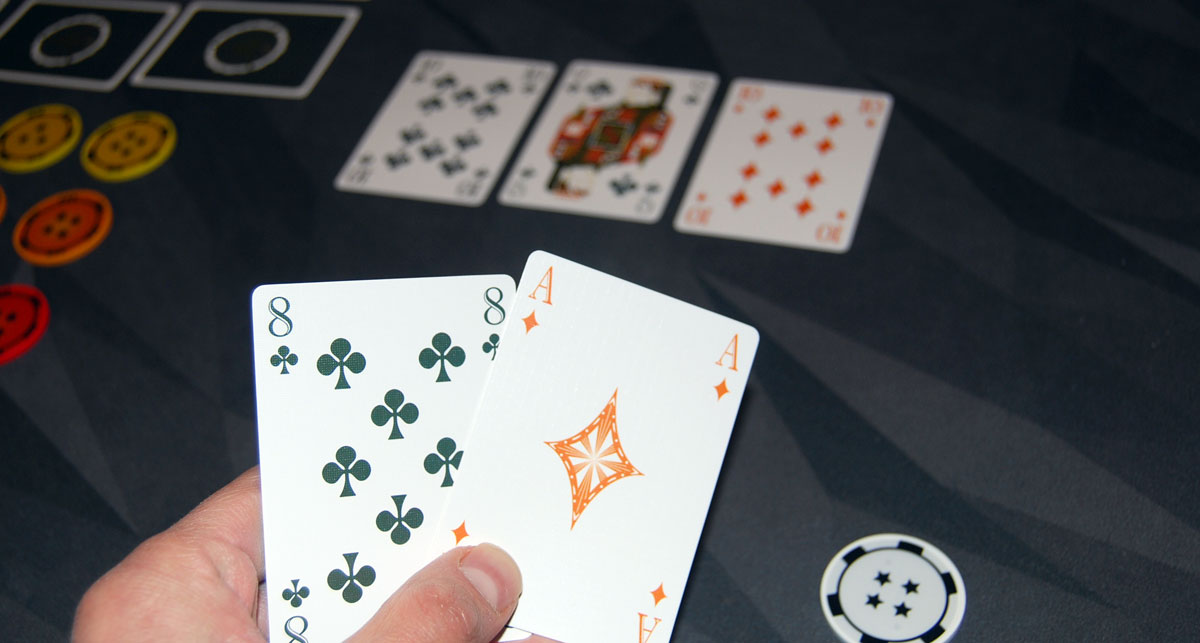
Round 2 “The Flop”: Deal 3 cards face-up to the table as community cards. Every player may include community cards in their poker hand, with a maximum of 5 cards total between community cards and pocket cards. Everyone takes a yellow chip.
Round 3 “The Turn: Deal 1 more face-up community card. Everyone takes an orange chip.
Round 4 “The River”: Deal 1 last face-up community card. Everyone takes a red chip.
Once everyone has a red chip, the hands are revealed in order from lowest to highest red chip, with each player declaring the best poker hand they can create using a combination of the 5 community cards and their 2 pocket cards.

If everyone’s hands are in the correct order, the heist succeeds! Reveal a vault card. (Note that if two players have equally ranked hands, then their order doesn’t matter.)
If any hands are in the incorrect order, the heist fails. Reveal an alarm card.
Game End
The game ends when you have revealed all three vaults (you win!) or all three alarms (you lose!).

Variants
There are a couple variant rules.
Advanced Mode
First, you can introduce the challenge cards and specialist cards. The first time you use these, they should be in numerical order. Place these face-down next to the vault and alarm cards.
If you succeed at a heist, reveal the next challenge card: this changes the rules of the next heist and makes it a little harder. If you fail, reveal the next specialist card: it gives an ability that can be used during the next heist (and only the next heist).
(The rules recommend going through the cards in order over multiple sessions so you can see all of them in play, and only when you’ve gone through all 10, you can then shuffle them up and have them in random order from then on.)
Professional Mode
Remove the #1 challenge card from the stack, and then reveal a random challenge during setup. This challenge is in play for the whole game. You still reveal additional challenge or specialist cards as in the advanced mode.
Master Thief Mode
Remove the #1 challenge card from the stack, as well as 1 alarm card. Do not use specialist cards. Reveal 2 random challenge cards during setup.
In this mode, you lose if you set off 2 alarms.
After each heist, discard the lowest numbered challenge card and reveal a new challenge card, so there are always 2 challenges active for each heist.

Why You Should Play The Gang
The Gang was originally released in 2024, but I didn’t manage to play it until 2025 (and only received a copy this fall). With the recent news that there will be an expansion coming next year that accommodates up to 10 players—and also adds some chips that will make the game easier at higher player counts—I figured it was a good time to highlight it in case you missed it.
I don’t play a whole lot of poker. I know the basic concepts and I can follow along, but I’m far from the level of being able to read other players to know when to hold ’em and when to fold ’em. I probably enjoy movies about poker more than actually playing it myself. One of the great things about The Gang is that it uses poker mechanics, but by making it a cooperative game, it trades in the bluffing element for a tricky communication puzzle. You’re still trying to read the other players, but now people want to be read.
For each heist, the only chips that really matter are the red ones in the last round—those determine your final answer for ranking everyone’s hands, and you either succeed or fail based on those chips. So what are the other three colors for? Well, they’re the historical record of how everyone felt about their hands leading up to the River. If somebody picked a high number in the first round and then started dropping lower in round two, maybe they just had a high card but now they don’t even have a pair. On the other hand, somebody who had nothing for the first two rounds but then grabbed the highest chip as soon as a third diamond was revealed might have a flush. Of course, the other thing we’ve found is that sometimes it’s just hard to get even a pair—something to keep in mind, because if you’ve got face cards or a single ace in your pocket, you might very well have the highest hand anyway.
You’re trying to gauge, based on everyone’s reactions to the community cards, who might have what in their pocket, and then how your hand compares to theirs. Pretty often, we’ll have at least two players taking the same chip from each other back and forth, until one of them finally gives in—but then what? Depending on the direction they’re going, that might set off a chain reaction of other players taking chips from each other.
Generally, though, the game’s difficulty increases the more players you have: three players is significantly easier than six. (Which makes me think that the 10-player expansion must add some new rules to keep it from being impossible!) I’ve gotten to play some 6-player games of The Gang and beating the game with that many people is a thrill—loud cheers go up as each player reveals their hand in ranking order.
I really like playing with advanced mode because it introduces some fun variety to the heists. If you succeed, it gets a little harder. If you fail, the game cuts you some slack. There are challenges like skipping a round of taking chips so there’s a little less information to go on, and specialists that allow players to share a little bit of information with each other. I’ve yet to tackle professional mode or master thief mode, but in the future I may try those if I have only 3 players just to spice things up a bit.
In short, if you enjoy cooperative games, whether you’re a poker expert or not, The Gang is a fun challenge. Find out more about the game from the Kosmos website.
Click here to see all our tabletop game reviews.
 To subscribe to GeekDad’s tabletop gaming coverage, please copy this link and add it to your RSS reader.
Disclosure: GeekDad received a copy of this game for review purposes.


