Explore a mysterious castle with moving walls and collect the treasures inside—but beware of the Guardians!
What Is Gachijo: Four Ninja and the Castle of Treasures?
Gachijo: Four Ninja and the Castle of Treasures is a moving maze game for 2 to 4 players, ages 10 and up, and takes 15 to 90 minutes to play depending on the map used and the difficulty level. It’s currently seeking funding on Kickstarter, with a pledge level of ¥6,100 (about $39USD) for a copy of the game, or ¥10,800 (about $69USD) to include the deluxe version with additional maps and other bonuses.
Gachijo: Four Ninja and the Castle of Treasures was designed by Martin Nedergaard Andersen and published by Banana Moon Studio Sapporo, with illustrations by Richard Zimba.
UPDATE: Unfortunately, the publisher felt the Kickstarter campaign was not getting enough traction and has canceled the campaign for now. If there is a relaunch later, I’ll share an update at that time!
New to Kickstarter? Check out our crowdfunding primer.

Gachijo: Four Ninja and the Castle of Treasures Components
Note: My review is based on a prototype copy, so it is subject to change and may not reflect final component quality. The exact component count may be affected by stretch goals.
Here’s what comes in the game:
- Main board
- 2 Stage sheets
- 3 Transparent sheets
- Treasure Den board
- 12 Treasure tokens
- 18 Crystals
- 4 Specter standees
- 4 Mission cards
- 4 Player boards
- 4 Ninja standees
- 4 Base flags
- 20 Status Markers (4 sets of 5 types)
- 4 Reference cards
- 18 Tool tokens
- 12 Weapon tokens
- 20 Kaeru chips
- 16 Shinobi/Summon chips
- 8 Summon cards
- 20 Gacha cards
- 2 Cloth bags
The deluxe set will include some upgraded components like a 3D treasure den and metal coins for the treasure tokens, but the primary gameplay difference is the 4 additional stage maps.

The key component to Gachijo is the game board, which is made up of several components: a square base holds a printed map, and then two transparent sheets are layered on top of that, depicting various walls, and then it’s topped off with another transparent sheet that has treasures and other items. The base has four raised pillars that hold the map and top layer in place, while the two sheets with walls can be moved, creating a playing area where the walls can move around but the player pawns and items remain stationary. It’s a clever system, though because of the size of the wall sheets, it makes for an unconventional box size: it’s a wide, shallow rectangle that probably won’t play nicely with your Kallax game shelves.
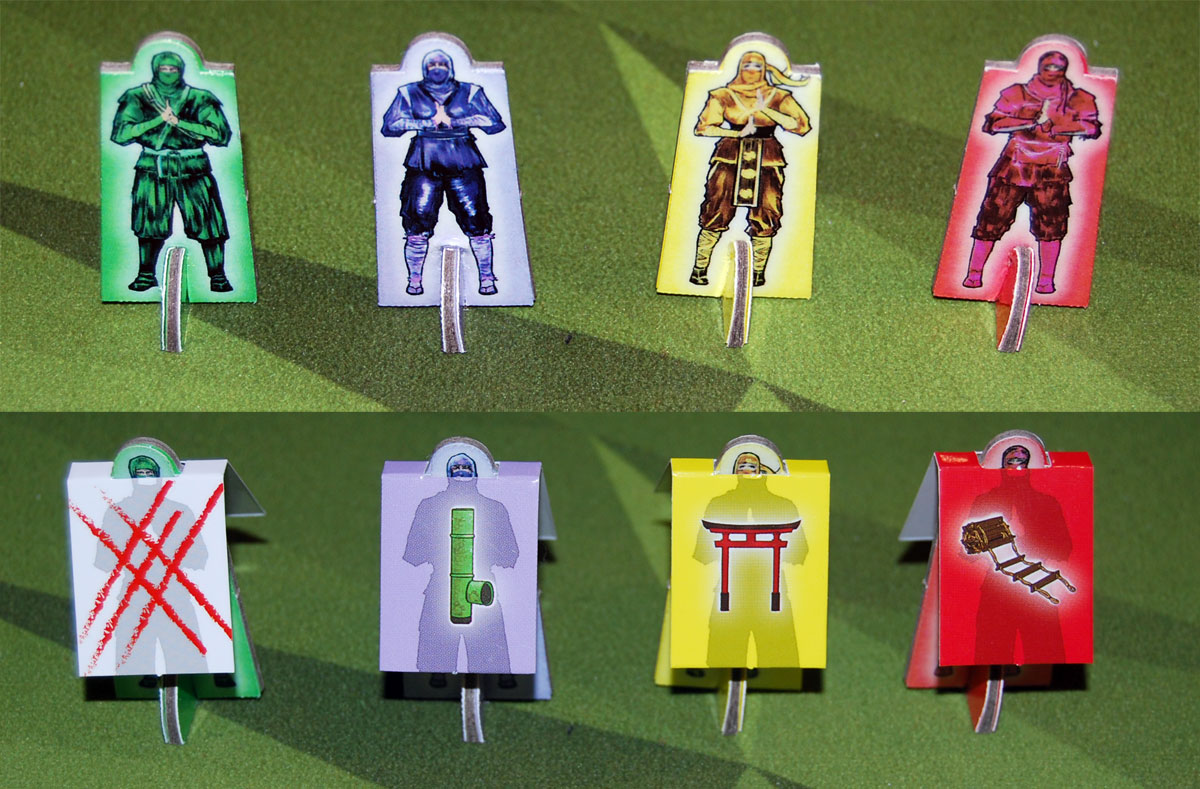
The ninja pawns are small cardboard standees, and the status markers indicate which tool you are currently using: they’re a small piece of folded cardstock with a hole that fits over the ninja, almost like it’s wearing a sandwich board. It’s a simple concept but notable simply because it’s not something I’ve seen much in games before.
Each player also has a base flag, another interesting component: it’s a small paper flag on a thin dowel mounted on a small wooden block. It’s used to indicate that you have completed the mission goals and are on your way back to your base, like calling “Uno” when you’re down to one card in Uno.

The treasure den is a small board that just holds the four types of treasures, and has spaces for the four specter standees—it’s not entirely necessary since it’s mostly just a supply, but it’s a fun visual representation of a vault-like room where the good stuff is stored.
The rest of the components are fairly standard stuff: cardboard tokens, some cloth bags, and some cards—all of the cards have both English and Japanese text on them, along with some iconography to help illustrate the effects. One nice touch is that the publisher, Banana Moon Studio Sapporo, did a lot of research into the theme. The four ninja are based on actual Japanese warlords from history, and the tools and weapons are based in reality, with the Japanese names for them used in the rulebook as well. I did have some initial reservations about a ninja-themed game from a Danish designer, but it does seem like the publisher has done a lot of the work on the theming and further development of the game as well.
How to Play Gachijo: Four Ninja and the Castle of Treasures
You can download a copy of the rulebook here. I believe the printed rulebook for the game will be a shorter, simplified version, and the more detailed version linked here will just be provided digitally.

The Goal
Your goal is to have the most points when somebody completes the mission. Each mission card has its specific goals, but generally you need to acquire a certain number of treasures, crystals, and Shinobi or summon tokens, and then return to your base. Note that it’s possible to complete the mission but lose to another player who has more points.

Setup
Choose a map and a difficulty level and layer the board as described above. Put the tool tokens and weapon tokens in their cloth bags. Turn the Kaeru tokens face-down and mix them up to form a supply, and place these nearby with the Shinobi/summon tokens and the crystals. Shuffle the Gacha cards and the summon cards. Place the treasure tokens in the treasure den, and place the four specter tokens on the corners of the den.

Each player takes their ninja, flag, status markers, and a player board, along with one tool (face-up) and one weapon (face-down) drawn from the bags. The green player goes first!
Gameplay
On your turn, you get 3 actions. Each action can either be sliding one of the transparent sheets 1 space in either direction or moving your ninja, but you must do at least one of each. You may also do any number of free actions—using tools, weapons, and summoning a specter.
When moving your ninja, you may move as far as you like as long as you do not make any U-turns within a single space. If you move onto or through crystals, tools, and weapons, you take the corresponding items and place them on your board. To collect a treasure, you must end your movement on the treasure space.

If you collect 5 crystals, you must immediately discard them and take a treasure token if available. (You cannot have more than one of any treasure type.) If there are no treasure to take, you just lose the crystals—don’t be greedy!

Depending on the map, there may be rooftop spaces and water spaces—if you spend the right tools (rope ladder and bamboo breathing tube) then you may move into those spaces, and you put the status marker onto your ninja until you are back on ground level. You may also climb over walls if you spend a grappling hook tool for each wall you climb over.
There are a few secret passages on the map. If you end your movement on one, you may enter the passage and exit from any other passage, and then stop movement. Some of the passages have a flower icon on them—if you exit from one of these, you also draw a Gacha card, which provides an immediate effect that may or may not help you!

If you have the right weapon, you may also attack another ninja: the tsume (claw) can damage one orthogonally adjacent space, the katana can damage one diagonally adjacent space, and the shuri can be thrown any distance in a straight line if the target is at least one space away. The tsume and katana cannot attack through walls, but the shuri can be thrown over low walls (dotted lines). The attacked ninja loses a tool, crystal, or treasure, puts the injured status marker on their ninja, and goes back to their home base, and the attacker gains a Shinobi token. There’s one weapon, a smoke bomb, that can be discarded to teleport away from an attack, and there is also a camouflage tool that makes you immune to ninja attacks until your next turn.
Injured ninja only get 2 actions on their next turn, and then the injury is removed. There is a medicine tool that lets you heal the injury at the start of your turn so you don’t lose an action.

There are also ways to summon the specters, the Guardians of Treasures—in a 3- or 4-player game, this happens when you form the red-and-blue yin-yang over the center of the map. You’ll get to draw a summons card, place that guardian on the summon space, and then take a number of actions to attack another ninja. The captured ninja loses a treasure and is placed in the treasure den, and will start at the summoning point on their next turn, and the specter is returned to the treasure den. (In a 2-player game, you instead summon by paying a crystal, and the summoned specter remains on the map and is just replaced by whichever specter is summoned.) There is a magical barrier tool that protects you from specter attacks for one round. If you successfully capture a ninja, you gain a summon token.
The Kaeru tokens have little frogs on them—any time you get injured or captured, you take one of the tokens and place it on your board face-down without looking at them. They are worth from 0 to 15 points at the end of the game.
Game End
As soon as you have collected all of the required items shown on the mission card, you stand your flag up to indicate that you are ready to return to your base. (If you lose any required items before you get to base, lay your flag back down.) The game ends immediately when a player has their flag raised and is on their base and is uninjured—and you can even raise the flag and return to your base on the same turn.
Then, everyone adds up their points:
- 20 points per treasure
- 10 points per Shinobi/summon token
- 5 points per crystal
- 2 points per tool/weapon
- 0–15 points per Kaeru token
- 30 points for returning to base successfully
The player with the most points wins!
Why You Should Play Gachijo: Four Ninja and the Castle of Treasures
Playing Gachijo reminded me a little bit of the classic game Labyrinth (which I still refer to under the title I first learned: The aMAZEing Labyrinth). In both games, you manipulate a maze and then travel through it to collect items. Also, both games allow for unlimited movement through the maze: the only restriction is how well you set things up to open up a path to your destination, so spatial reasoning skills are very important. You want to study the map and see how paths will change when you slide things in one direction before you make your moves.
In Labyrinth, you manipulate one row or column of the maze at a time, so it feels a little bit easier (not to mention there aren’t other players or guardians that can harm you!). In Gachijo, each of the transparent sheets controls a whole set of walls all over the map: one sheet has red walls all running in one direction, and the other has blue walls all running in the perpendicular direction. So when you shift a layer one space, you move all of the horizontal or vertical walls all at once (not counting the black walls printed on the stage sheet itself)! There have been many times where I thought I was making a very clever move to open up a path, only to find that I’d closed off a different section that I hadn’t been paying attention to.

Gachijo adds some new wrinkles as well: if you get within range of another player, you have a chance to attack them, and you can also summon the guardian specters to attack other players. Since every mission requires at least some number of Shinobi/summon tokens, that means the game isn’t over until at least a few successful attacks have taken place, so there’s no peaceful co-existing here.
It’s not just about getting those tokens, either. There are only 3 copies of each treasure, and at the highest difficulty level you need all four types—which means at a full player count, there’s not enough to go around. Expect there to be a lot of gaining and losing treasures over the course of the game—which also means more of those Kaeru tokens, which I’ll get to in a little bit.
And then there are the various obstacles. The easiest map just has a ground floor, but many of the other maps include rooftops or water, which can open up new pathways for travel if you have the right tools. Since tools are all face-up and public knowledge, you can use this to your advantage: create a path that requires going over a roof because you know your rivals don’t have rope ladders, or dive into the water to escape somebody you suspect will try to attack you soon. Since you can only have one status marker at a time, you also have to decide the right time to use your protective tools—and do you hide yourself from other ninja or from the guardians?
One of the things that struck me while playing Gachijo is just how different it feels from many of the other games I play, most of which are from European or American publishers. From the unusual box size to the unconventional components to the format of the rulebook to little details in the gameplay, you can tell that there it’s working from a different set of assumptions about how games work. I appreciate that it’s not just a veneer of theme, but that you can see how there are contrasting sensibilities at play.
For instance, take the Kaeru tokens that you get when you are attacked or captured: the values on the chips are 0, 1, 5, 10, and 15. That’s a big spread! Considering that you only get 10 points for successfully attacking/capturing another player, that means it’s possible that you have just given them more points than you earned. The highest single-scoring token is a treasure (worth 20 points), so these are a decent consolation prize for the potential loss you suffer. But nobody knows how many points they’re worth—not even the player who has them—until the end of the game!

The Gacha cards that you get from using certain hidden passages are also a funny mix. How useful a card is often depends on your circumstances, but there’s a wide range of effects and it can be pretty entertaining to take a gamble. You might get teleported to anywhere on the board, gain crystals, get extra actions … or you might lose items, swap tools or weapons with another player, or slide the walls. Some players will really love taking a risk just to see what will happen, and others won’t like that there’s such a random element thrown into the game. It can feel a little out of place in a game where you’re meticulously plotting out a route to just then throw caution to the wind, but I have to admit I was often tempted to try the Gacha cards, even after they disrupted my own plans more than once!
If you like shifting mazes and figuring out the optimal path (and you don’t mind a bit of random chance), you’ll probably enjoy Gachijo. I like the use of the transparent sheets for the moving walls, and the different maps and difficulty levels allow you to easily adjust the length of the game. I do kind of wish there were an option to get just the additional maps without the other deluxe items, partly because the maps would fit in the base game box but I don’t think there’s room in it for all the other items, which would mean two separate boxes (that aren’t the same footprint), but I do think there’s a good amount of variety just in the base game box as it is.
For more information or to make a pledge, visit the Gachijo: Four Ninja and the Castle of Treasures Kickstarter page!
Click here to see all our tabletop game reviews.
 To subscribe to GeekDad’s tabletop gaming coverage, please copy this link and add it to your RSS reader.
Disclosure: GeekDad received a prototype of this game for review purposes.