The year is 1958 and you are a group of dedicated researchers beginning an unprecedented experiment on animal domestication. You will be breeding several generations of domesticated foxes by selecting pairs of fox parents and then rolling dice to determine the traits of their pups, which will in turn become the fox parents for the following round. Find the right combination of traits to complete your different studies, please your patrons, and breed the friendliest pups on your way to becoming the world’s foremost scholar in genetics.
What Is The Fox Experiment?
The Fox Experiment is a competitive dice drafting, roll-and-write game with a dash of resource management for 1-4 players that takes about 20-30 minutes per player. The base game retails for $59.95 and is available at your local game store and online via Pandasaurus Games’ website. There is also a 5-6 player expansion that was made available as part of the Kickstarter campaign but that one is a bit more difficult to track down. The Fox Experiment has a pretty wide spread of mechanics that it utilizes and also has a pretty dense rulebook, so the suggested 14+ age range seems accurate.
The Fox Experiment was designed by Elizabeth Hargrave (of Wingspan fame) and Jeff Fraser, with art from Joe Shawcross, and was published by Pandasaurus Games.

The Fox Experiment Components
- 1 Main Board
- 4 Player Mats (one of each player color)
- 4 Dry Erase Markers
- 48 Blank fox cards (12 per player)
- 36 Parent fox cards (18 male, 18 female)
- 4 Reference cards
- 24 Study cards
- 6 Patron cards (double-sided)
- 30 Science cards
- 1 Score card
- 40 Fox meeples (10 per player)
- 4 Gear tokens (1 per player)
- 64 Trait dice (16 per trait type)
- 136 Trait tokens (34 per trait type)
- 16 Friendly dice
- 28 Friendly tokens
- 12 Point tokens
- 24 Supply tiles
- 4 Turn order tokens
- 12 A.I. Study cards (for 2p and solo mode)
- 6 A.I. Selection cards (for 2p and solo mode)
The production of The Fox Experiment is well done, with nothing that stands out as too flimsy or too gaudy. The Fox meeples and the Gear tokens are of good quality and the dice are chunky and easy to read. There are a few areas where a little extra thought would have made a big difference, such as making the Player mats dual-layered cardboard. As it stands, it’s very easy to mess up your board with an errant swipe of the hand but other than that and a few color matching issues between the Trait dice, Trait tokens, and Fox cards, the game is right at the level that board gamers have come to expect these days.
The iconography in The Fox Experiment is also nicely done and really straightforward which definitely allows you to navigate the rulebook and the board with ease. That being said, the 35-page rulebook can be a bit daunting at first due to the sheer size and quantity of information it contains. However, in my plays of the game, I mostly used the Reference cards for the teach and only referred the rulebook when a specific example was needed, so once you get through the initial slog of learning the concepts of the game, this minor inconvenience won’t bother you.
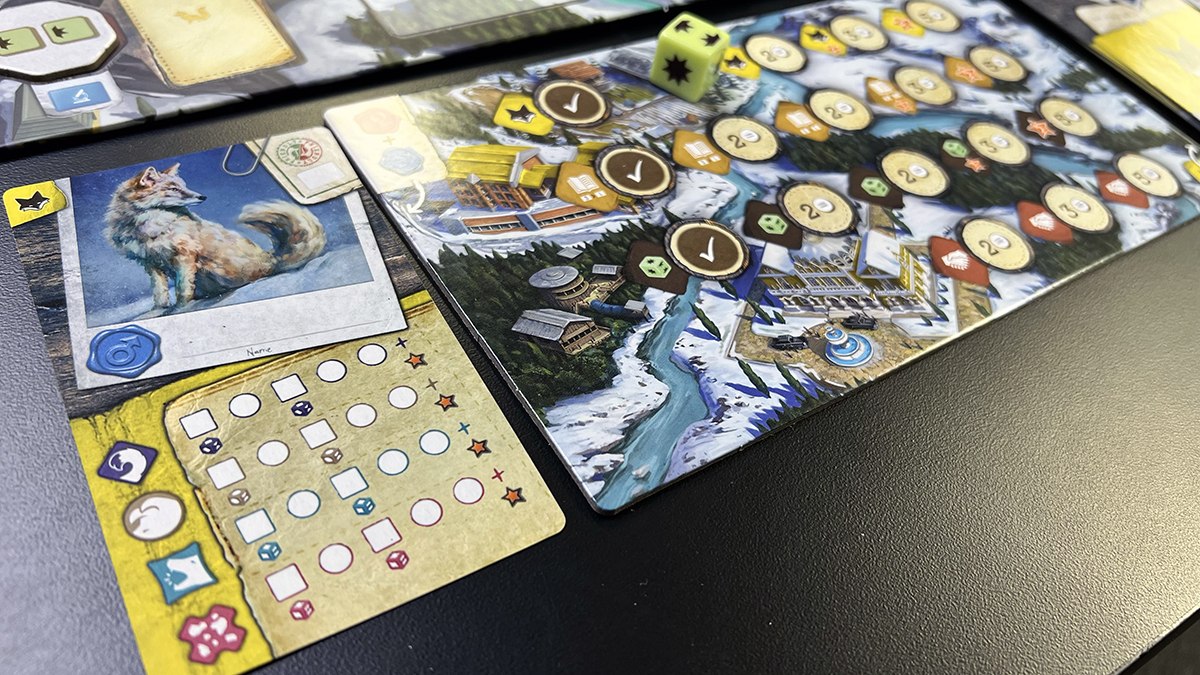
Overall, The Fox Experiment comes in at your industry average when it comes to production and while they may have over-indexed on the amount of tokens and tiles in the game, I would always rather have more components than not enough. The beautiful art and the immersive theme however really tie the whole game together—but the real question is: how does it play?
How to Play The Fox Experiment
You can download a copy of the rulebook here.
The Goal
The goal of The Fox Experiment is to become the most accomplished researcher and you’ll do so by scoring the most points over five generations of fox breeding. There are several ways to score points, including:
- Completing different levels on your personal Study cards
- Pleasing different patrons acquired throughout the game
- Upgrading your Player mat to conduct more thorough research
- Breeding the friendliest pup in a single generation
You will also score points for any leftover Point tokens, Science cards, and Trait tokens you have and at the end of five rounds (representing five generations of foxes), players will tally up their totals and whoever has the most points wins!
Setup
To set up The Fox Experiment, first lay out the Main Board with the 1-4 player side face up. Then, you’ll shuffle the Science cards and the Study cards separately and place them on their corresponding spaces in the middle of the board. Next, you’ll shuffle the stack of 24 Supply tiles and add them one at a time to the Supply Track in the top corner of the board, making sure to leave the first space (indicated by a crossed out gear) blank. Fill in tiles until you reach the appropriate player count as indicated at the top of the final two spaces and then add four more tiles to the Patron Spaces on the left side of the board. These four tiles will remain here for the rest of the game.

Once Supply tiles have been placed on the Patron spaces, shuffle the 6 Patron cards and draw four of them. Place the first two Patron cards on the first two spaces with Side A facing up, and the second two cards on the remaining spaces with Side B facing up, to provide a variety of end game objectives. Next, you’ll sort all the public components into individual piles and set them near the board. Public components include Trait dice, Friendly dice, Trait tokens, Friendly tokens, and Point tokens.
Next, it’s time to create the Fox Kennel, the market from which you’ll be drafting male and female parent foxes. Shuffle the male and female fox decks separately and then deal out one more card than the number of players in each row, so in a three player game, you would have a draft row of 4 males and 4 females. Once the rows are complete, place the fox decks to the side and make sure to leave room at the end of each row for a discard pile.

Once the board is set up, give each player a Player mat, a Gear token, 10 Fox meeples, 12 Blank fox cards, all in their chosen player color, as well as a green Friendly dice, a dry erase marker, and a player aid. Each player will then shuffle their Blank fox cards and set them on the right side of their Player mat.
Whoever has the friendliest pet gets to take the 1st player token (or you can choose randomly, but where’s the fun in that?) and the remaining Turn Order tokens are distributed in clockwise order. If you are 2nd or 3rd in turn order, you’ll also get to take a green Friendly token from the supply and if you’re 4th, you get to take two as a consolation for going last. Finally, you’ll each draw a Study card from the deck and place it face up near your player mat—if this isn’t your first game, you can also draw three Study cards, pick one, and discard the other two. Make sure to consult your chosen Study card before the first round begins so you know what kind of Traits you should be going for at the start.
If all the aforementioned boxes are checked, you’re now ready to get experimenting!
Gameplay
The Fox Experiment starts as a slow burn but builds to a blaze by the end with players routinely chucking two handfuls worth of dice in pursuit of the friendliest pups. The game is played over five rounds, or generations, and each round is divided into four phases.
The first phase is the Selection phase and this is the phase in which the turn order matters the most. Starting with whoever is first in turn order, players will take turns selecting one of three items in the order of their choosing. After three turns, players will have chosen a male parent Fox card, a female parent Fox card, and a supply track position, although the order of selection is subject to change. When a player chooses a supply track position, they will place a Gear token on their chosen space, which will also determine their turn order in the following round. This then explains the empty space at the front of the supply track—if a player really wants to guarantee the first draft pick in the next round, they can forgo a Supply tile and simply place their Gear token on this empty space. After all selections have been made, you’ll have an opportunity to unlock upgrades on your Player mat, but since this is impossible to do after the first selection phase, we’ll cover this action later.

Phase 2 is the Breeding phase which also marks the beginning of simultaneous play. Each player will begin by drawing a number of Blank pup cards from their personal deck equal to the amount of Pup upgrades they’ve unlocked (at the beginning of the game, everyone draws one). Then everyone will gather dice based on the dice symbols indicated on their selected male and female parent foxes. Then you’ll collect all your Trait dice, add your Friendly dice to the pool, and roll away!

Once the Trait dice have been rolled, you’ll now want to arrange these dice in the most efficient way to reveal as many full symbols as possible. Each Trait die has sides that show full symbols, half symbols, and combinations of the two. You can also use the green Friendly die as a wild to help you gain a trait of your choice or even complete symbols for two different traits. If you’ve acquired any Friendly tokens, you can also use them during this phase to finish off any straggling symbols on your die, but use them wisely because they are one time use only.

Once the dice have been cast and the completed symbols arranged, players will now take their dry erase marker and record their results on their first Blank pup card. For every full symbol rolled, mark a spot on the corresponding trait track on your pup card. You may notice that some of the spaces are boxes and others are circles. This indicates a key difference when recording your symbols—every box filled out gives a Trait die of that type to the player who drafts this pup next, and every circle filled out gives a Trait token of that type to the player that bred this pup. Once all symbols have been recorded, you can now count up your total symbols on your pup card. This represents a pup’s Friendliness score which will come in handy later on. Then once you’ve taken on the all-important task of naming your pup, you can repeat this process for any other pups you may have drawn this round until all pups have been accounted for.

The next phase is the Research phase which also happens simultaneously. Each player will evaluate the pup(s) that they just bred and see if any of them meet the requirements to complete a new level of study. If a pup has the spaces marked on it that match one of your Study cards, then you’ll be able to mark that by placing a Fox meeple on your card. Study cards must be completed from left to right and each pup you breed can only complete one level of a Study card per turn even if they would satisfy multiple levels. After resolving studies, you’ll collect Trait tokens based on how many circles you marked off on your pups this round. It should also be noted that if you’re breeding multiple pups, you can only take Trait tokens from a single pup for each trait track, which means the most Trait tokens of a single type you can get on a turn is three.

Once the Trait tokens have been collected, you’ll now have another chance to unlock upgrades on your Player mat. Upgrades must be taken from left to right but you can start on any track you’d like. In order to unlock upgrades, you will pay the number of matching Trait tokens as indicated on the different spaces of your Player mat. At the beginning of the game, you’ll only need a pair of Trait tokens to do the job, but as you get further along on the track, the upgrades become more expensive. When paying for an upgrade, reserve one Trait token to place as a marker on your board and then discard the rest.
When unlocking upgrades, there are four tracks that you can progress on. The top track allows you to breed more pups over turn. The second track allows you to draw three new Study cards and choose one to keep. The third track allows you to add extra Friendly dice to your pool. The fourth track allows you to acquire a Patron, which will give you both a one time Supply tile bonus and some extra end game scoring conditions. When you acquire a Patron, you’ll place one of your Fox meeples on the corresponding space and immediately gain the resources on the Supply tile next to the Patron card. You will not however remove the Supply tile, meaning that multiple people can (and likely will) acquire the same Patron cards throughout the game.

Once all players have finished upgrading, you’ll enter the fourth and final phase: Administration. This is essentially a glorified upkeep phase where players will flush the remaining foxes in the kennel, add their new pups to the appropriate male and female rows, and fill in any extra spaces with Fox parent cards from their respective decks. After this, players will compare the Friendliness score of all the pups that were bred in this round and whoever has the friendliest pup, i.e. the most symbols acquired, will get to place one of their Fox meeples on the space of the Friendliness track that corresponds to the round. If multiple players qualify for the friendliest pup, they both get to place a Fox meeple on the track and will score full points for it at the end of the game. If however you don’t have the friendliest pup in the round, you’ll win a consolation prize of a Friendly token or two depending on the round to help you out with your breeding in future generations.

After the Friendliness track has been resolved, players will reset the turn order based on the order of their Gear tokens on the supply track, making sure to pass along the correct Turn order tokens to the correct players. Once all Gear tokens have been returned to their owners, you’ll refill the supply track according to your player count and then begin the next round!
Game End
At the end of five generations, players will fish out the dry erase Score card and start tallying their points in several different categories. The first category is completed levels of Study cards and this will likely be your highest scoring category so don’t underestimate the importance of finishing off those different levels, as you can score a maximum of 10 points per card. Next, you’ll resolve any points gained from Patrons you acquired throughout the game and any points you received from unlocking upgrades on your Player mat. Next is points from the Friendliness track and points from any Science cards and Point tokens in your supply.

Science cards are one-time bonuses that can be acquired through Supply tiles or by acquiring a Patron. They can be played at any time, although they will often tell you when to activate them to gain their special ability. If you did not or chose not to play a Science card during the game, it’ll be worth one point per card at game’s end. Point tokens are acquired by rolling more than five full symbols on a single Trait track when breeding a pup. You will gain one star-shaped Point token for each symbol you go over and each token is worth one point at the end of the game.

Once everything else is tallied, you’ll count up any Trait tokens and Friendly tokens you had remaining in your supply and score half of that total, rounded down. Then once the math has been mathed and the dust has cleared, whoever has the most points wins!
Why You Should Play The Fox Experiment
When you design an evergreen classic like Wingspan, I can imagine it is immensely difficult to follow in its proverbial footsteps, but I think Elizabeth Hargrave has done a great job with The Fox Experiment by making another deeply thematic experience that tests out some new mechanics and ultimately creates a game in the oversaturated roll-and-write genre that feels fresh and unique.
Overall, the way that The Fox Experiment distills breeding and genetics down to its simplest form is fantastic and it is so cool to see how the different traits in different pups begin to merge and multiply over multiple generations. The gameplay is super thematic and that makes every action feel really intuitive so even if it’s your first time playing, you’ll never feel too far out of the loop. It reminded me in some ways of another genetics-themed game Genotype, another title that was really dedicated to capturing the theme, but in some ways, it felt even more immersive. Personally, I think it’s because you have to name all of your pups and then you can’t help but get attached to them!
And then there’s the dice chucking. Personally, I love the feeling of just unloading a maelstrom of dice onto the table and by the time you get to the fifth generation, every fox that you draft is likely to have four, five, or even six dice associated with it, so double that and you’ve got a veritable fistful of Trait dice to unleash. Plus with the multiple pup upgrades (can I call them pupgrades?) that you can add to your Player mat, you’ll get to chuck that load of dice multiple times—how fun is that?!
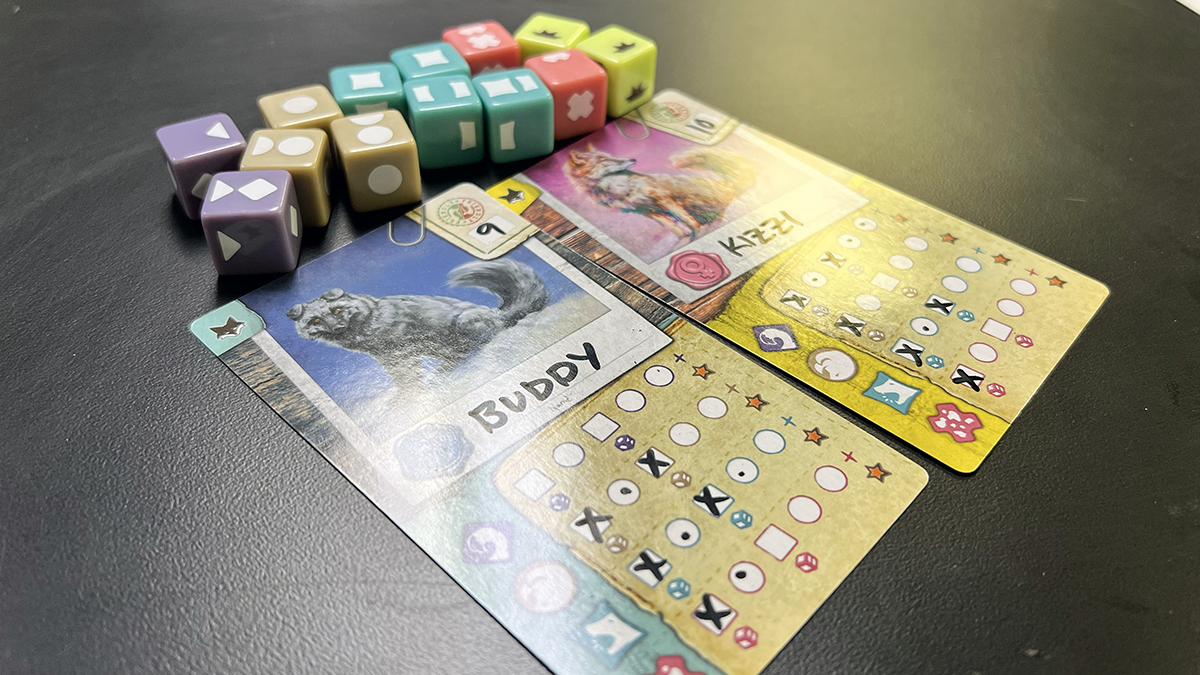
I also love the fact that this game is deceptively puzzly. There’s definitely some optimization that can happen between rolling for traits, completing your Study cards, and collecting new Trait tokens to boost your upgrades and if you can find the perfect synergy between those actions, then you’ll be comboing off like crazy. I love a roll-and-write that encourages a good combo engine, and The Fox Experiment certainly falls square into that category.
Now I will say, although I enjoyed both my plays and my teaches of The Fox Experiment, there was a word that continued to come up in describing the game that I couldn’t help but agree with, and that word was: finicky. Compared to most roll-and-writes, this game has a significant amount of bits and bobs and when they’re all laid out on the table and every player is also rolling ten dice on their turn, the play space can feel a bit overwhelming. In my opinion, it makes the game look more complicated than it actually is, which can be a positive or a negative depending on who you talk to. But overall, I feel like this game could have benefited a bit from some trimming of the fat, although since I don’t really have a proposal for how they would do that, I suppose my opinion is moot.
All in all, The Fox Experiment is a clever game that derives its mechanics from a deep knowledge of the subject matter, where every move feels thematic and every choice counts. Despite the density of its rulebook and the complexity of its appearance, this game follows a simple thread through until the end which leaves players intrigued and excited to play again. So if you’re looking for a unique take on a roll-and-write that brings a strategic puzzle to the table while simultaneously teaching you a lesson (in science and in history!), then might I suggest: The Fox Experiment?
For more information about The Fox Experiment, visit Pandasaurus Games’ website.
Click here to see all our tabletop game reviews.
 To subscribe to GeekDad’s tabletop gaming coverage, please copy this link and add it to your RSS reader.
Disclosure: GeekDad received a copy of this game for review purposes.