

Lucy and her dad have inherited an old mansion, along with an ominous letter, from her aunt. Can she solve the mystery and succeed where her aunt failed?
What Is Flashback: Lucy?
Flashback: Lucy is a cooperative investigation game for 1 to 4 players, ages 8 and up, and takes about 40 minutes to play. It retails for $24.99 and is available in stores and from Hachette Games in the U.S. While the box says 1 to 4 players, the game itself feels like a solo experience that multiple players can work together to solve, much like some escape room games—it does not require more players and there aren’t turns, but there are not multiple characters to play. In terms of the age rating, the game uses the same system as Flashback: Zombie Kidz, but the setting is a little creepier: instead of silly-looking zombies, there is a many-eyed Shadow that haunts the mansion; I think the box cover is a pretty good benchmark for judging whether your kid will be delighted or scared by the story.
Flashback: Lucy was designed by Gabriel Durnerin, Baptiste Derrez, and Marc-Antoine Doyon, and published by Scorpion Masqué, with illustrations by Laure de Châteaubourg, Jennifer Mati, and Jiahui Eva Gao. It is distributed in the U.S. by Hachette Games, who provided a copy for review.

Flashback: Lucy Components
Here’s what comes in the box:
- 61 Vision cards (divided into 4 visions)
- 64 Mini cards (Runes, Questions, and Greebo the cat)
- Some surprises!
Because of the nature of the game, I won’t show too many detailed photos to avoid spoilers—I’ll only show images from the very beginning of the first chapter.
Unlike Flashback: Zombie Kidz, this one does not have gizmos included, but it does have some surprises in store, and incorporates the rulebook in a creative way as well. The back of the rulebook also has a sealed section that you only open up when you’ve solved the final puzzle.

The vision cards are large cards, each depicting a scene from a particular point of view; any characters whose eyes are visible in the image will also be labeled with a number, allowing you to find that card to see what they’re seeing at the same moment in time. As with the original Flashback game, this is the secret sauce to the game: each chapter is a single frozen scene, and the way you “move” around the scene is by jumping into the perspective of somebody who was present. To answer the various questions, you’ll need to find the right perspective, because nobody can see everything, and some things can only been seen from a particular angle. I’m once again impressed by the level of planning required to set up the scenes and make all of the illustrations consistent with each other, as well as figuring out how to convey the information in this limited way.

Occasionally there are some other features to watch for: an eye icon means that you can zoom in on something by finding the corresponding “zoom” card with the same number; a rune means you look for that rune card—if it has a cat paw on it you set it aside under the Greebo card until later; a small numbered card box means you find the matching small card, often a question you must answer to complete that particular vision. The one downside to the zoom feature is that you can tell from the card backs which ones have something to zoom in on, because the card backs just share a number (and are originally arranged in numerical order). Obviously you should try not to cheat, but it’s hard not to see them as you’re sifting through the deck to get the card you need.
Although the components list is just two sizes of cards, there are some interesting features on the cards themselves that I feel is best left as a surprise—just note that there’s more than initially meets the eye here, which is also fitting for the theme.
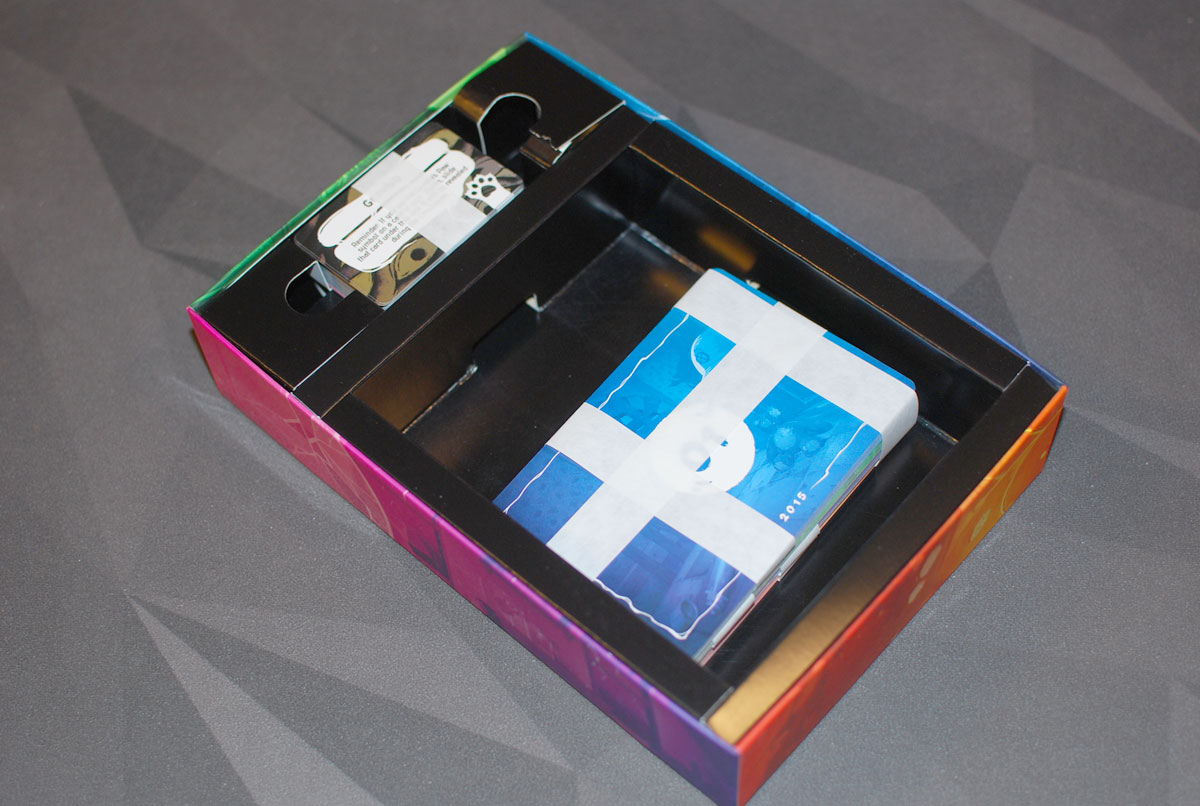
This time Scorpion Masqué opted for a simple cardstock box insert instead of the egg-carton type, with just large well for the large cards and a small well for the mini cards. Each one came wrapped in paper bands, so I appreciated the reduction in plastic, though it does mean that unless you bag up your cards, they’ll just be loose in that large well after you open it up.
How to Play Flashback: Lucy
You can download the rulebook here, but don’t read too far past the instructions (or look at the back cover) or you’ll get some spoilers!
The Goal
The goal of each chapter is to explore the scene, find all of the questions, and successfully answer them.
Setup & Gameplay
For each chapter, the rulebook has an introductory comic book section that sets the scene—sometimes you’ll have additional instructions within the comic about finding a specific rune card; there are also some runes that will need to be assembled, and when you complete a rune, then you draw that card.
The Greebo card just shows an illustration of your cat—any rune card with a paw on it is placed under Greebo until the end of the chapter, and then revealed. Otherwise, you can reveal it as soon as you draw it.

Eventually, you’ll get a card that tells you to start the vision itself, taking Card 1 from the corresponding deck.
When you look at a vision card, you can collect any small cards based on the icons you see, but most importantly you can draw additional vision cards when you see a number next to a character. These let you jump into that perspective and get a new angle. You continue until you have drawn all of the vision cards (and found all of the corresponding rune and question cards) and look for all of the answers—usually specific details about things that happened.
Game End
When you think you know all the answers, you turn to the back of the rulebook, which lists all of the answers—check your answers to see how you did! (If you missed something, you can just go back and look for the clues you missed, because then you’ll know the answer already.)
Finally, you reveal all of the rune cards stored under the Greebo card: usually these will give the conclusion to the chapter, and some of them will get added into album pages in the rulebook, which has little notches to hold the cards.
Repeat the process to complete all 4 chapters, and then you’ll have one more task to complete at the end.
Why You Should Play Flashback: Lucy
I really enjoyed playing Flashback: Zombie Kidz with my youngest, and then ran the game again for a friend and my teenager, so I’ve been excited about playing another entry in the series. This one did feel a little more spooky, though not so much to put off my 10-year-old. We played the first chapter soon after it arrived, and then a few days later played through the next three in one sitting because we didn’t want to wait any longer!
The story in Flashback: Lucy is that she has an unusual ability: if Lucy holds an object that belongs to somebody who disappeared, she is pulled into their last vision. Lucy and her father receive a cryptic letter from her aunt, leaving them the ancestral family home and apologizing that she can no longer take care of it. When Lucy and her dad are moving in, sure enough: she finds a baseball cap and is thrown into a vision, kicking off the first chapter. In each chapter, Lucy is drawn into an earlier time period—a lot of people, it seems, have gone missing in and around this house.
I like the way that the game uses the comic book sections to flesh out the story a little—it gives a little more room for the narrative, and some more places for the game to give you little puzzles to solve. The photo album cards also include little bits of information about characters from the past as you discover their secrets. The overall gameplay is very similar to the first Flashback: find the questions you need to answer, and then study all of the illustrations to look for clues. Some of the questions are pretty easy to answer once you’ve found all of the vision cards, but I found several questions in the game that required a bit of inference: not only did you have to find the visual clues, but you had to do some reasoning to piece together what happened. I appreciated that added bit of challenge—it wasn’t just about finding things, but figuring out what they meant.
I mentioned at the beginning that the game is kind of a solo game—you all just play as Lucy no matter how many players there are—but it’s definitely one that is fun to share with somebody, the same way that an escape room game is fun when you have other friends working with you. Sometimes other people will spot things you didn’t, and you can bounce ideas off each other when answering the questions. Since I was playing with my daughter, I usually kept the deck of vision cards, sorting through them to find a card that she requested: that prevented her from seeing which card numbers were left, and in particular which card numbers had zoom icons on them. In a sense, I acted a little bit as a GM for her: we were both looking at the cards and studying them, but I mostly let her “drive” the decisions about where to go next, and she got to do so without knowing specifically what else was in the deck.
If you like haunted houses and search-and-find games, check out Flashback: Lucy! For more information, visit the Scorpion Masqué website.
Click here to see all our tabletop game reviews.
 To subscribe to GeekDad’s tabletop gaming coverage, please copy this link and add it to your RSS reader.
Disclosure: GeekDad received a copy of this game for review purposes.


