

The naval war in the Pacific during WWII was like no other before. There were battles where the opposing ships were hundreds of miles away from each other. The battleship, which had ruled the waves for almost half a century was eclipsed by the aircraft carrier as the most important vessel in a fleet. The US and Imperial Japanese navies attacked each other using dive bombers and torpedo bombers while fighters protected the ships as well as the bombers. Now you can take on the roles of these brave pilots, outmaneuvering your opponent to send them into the sea, in Fighters of the Pacific.
What Is Fighters of the Pacific?
Fighters of the Pacific is an aviation wargame set in the Pacific Theater during WWII for 2 players, ages 14 and up, and takes about 120 minutes to play. Players command groups of individual aircraft as well as surface ships and anti-aircraft artillery. It’s currently available from some local game stores as well as online from Amazon. It sells for $60 for a copy of the game.
Fighters of the Pacific was designed by Frank Garibaldi and Didier Dincher and published by Capsicum Games and Don’t Panic Games, with illustrations by Alexandre Bonvalot and Antoine Schindler. The English version of the game is distributed by Ares Games.
Fighters of the Pacific Components
Here is what you get in the box:
- 97 Aircraft tokens
- 4 Aircraft carriers tokens
- 4 Destroyers tokens
- 95 Game tokens
- 8 maps tiles for modular game board
- 4 Reference sheets
- 2 Score boards
- 1 Turn tracking board
- 1 Initiative tracking board
- 1 Scenario book
- 1 Rulebook
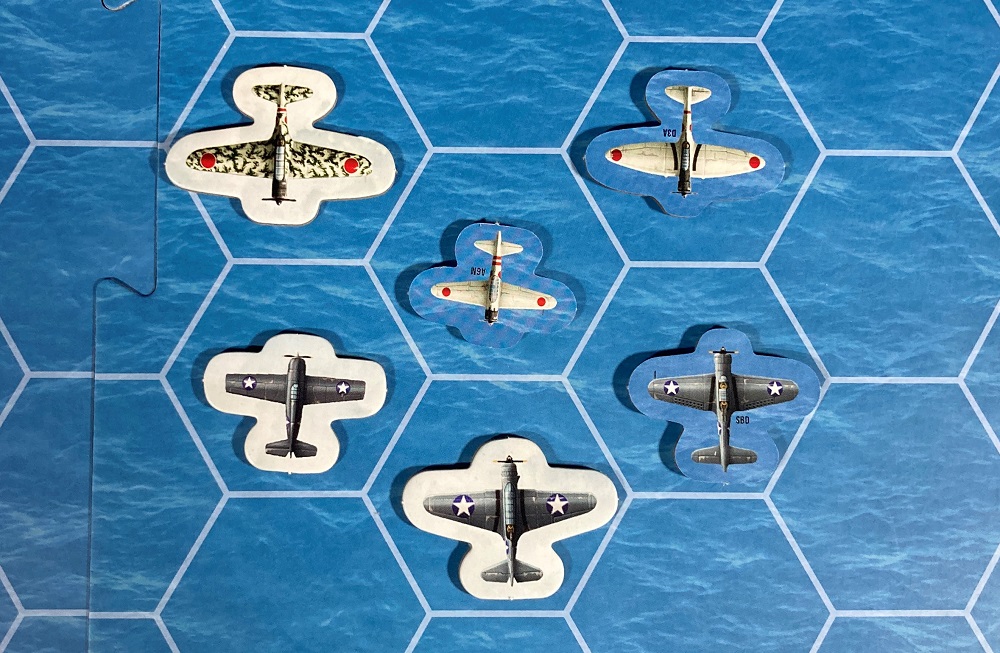
Each player has a number of aircraft tokens that each represent a single aircraft. The tokens are double-sided with one side having a white outline around the plane to show it is at high altitude while the other side with a blue outline designates the plane is at low altitude. The American player has 18 F4F Wildcat fighters, 22 SBD Dauntless dive bombers, and 10 TBD Devastator torpedo bombers while the Japanese player has 17 A6M Zero fighters, 18 D3A Val dive bombers, and 12 B5n Kate torpedo bombers.

Several of the scenarios feature aircraft carriers and destroyers which must either be attacked or defended. The American side has the USS Enterprise and USS Hornet while the Japanese side has the Akagi and Kaga. There are also four destroyer counters which are double sided with one side as an American destroyer and the other side a Japanese destroyer. Ships can be moved by the controller player and are also armed with anti-aircraft artillery to help protect themselves.
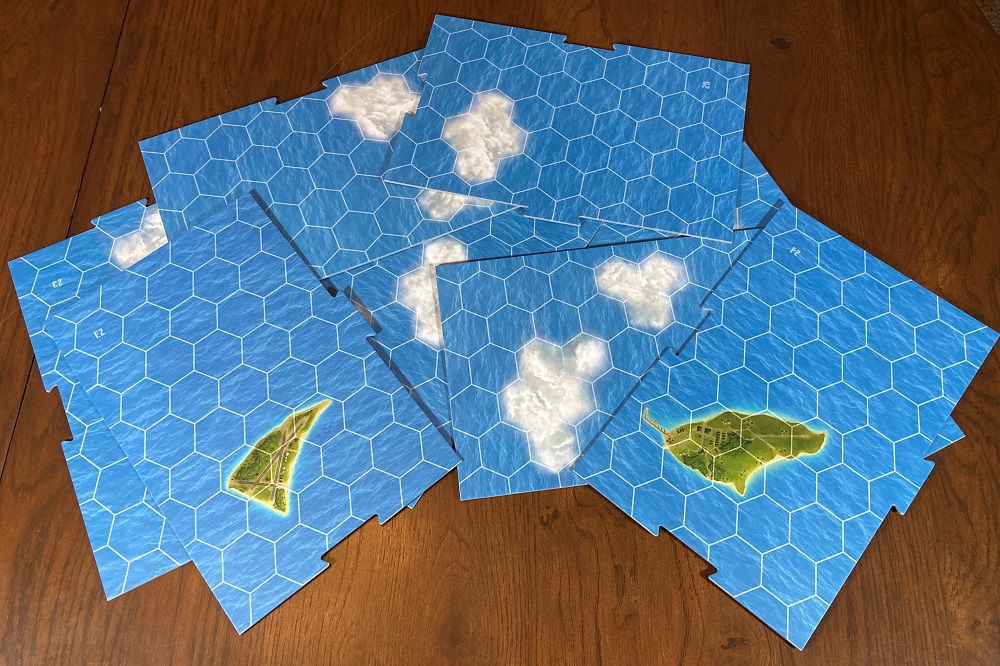
The 8 map tiles are assembled together to form the game board. The tiles are double sided with one side having open ocean while the other side has either clouds or islands. Each scenario provides directions on how the tiles are put together to create the map for that game.

Fighters of the Pacific comes with lots of tokens that are used to keep track of information as well as represent torpedoes and bombs as well as anti-aircraft artillery, barrages, and damage.
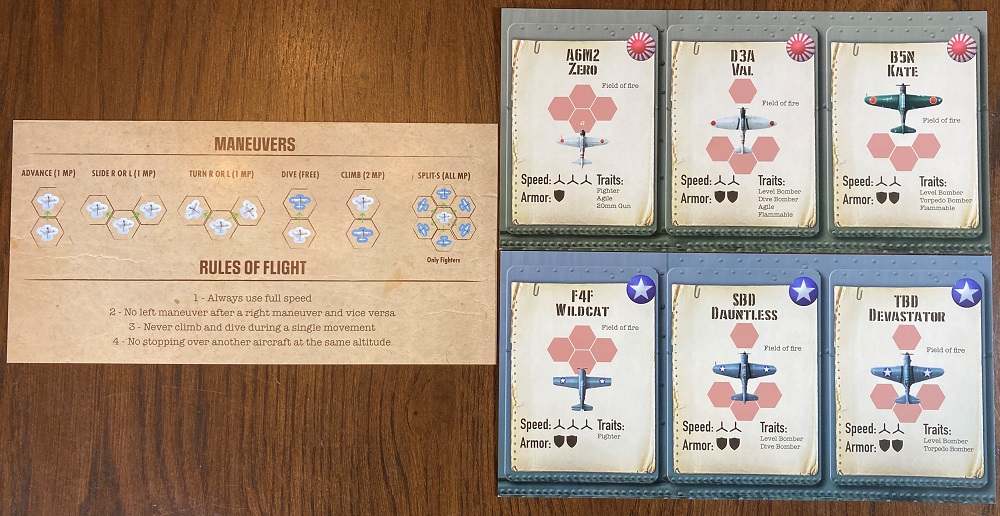
Players are each given two reference sheets. One shows the maneuvers and rules of flight while the other provides the attributes of the different types of aircraft.
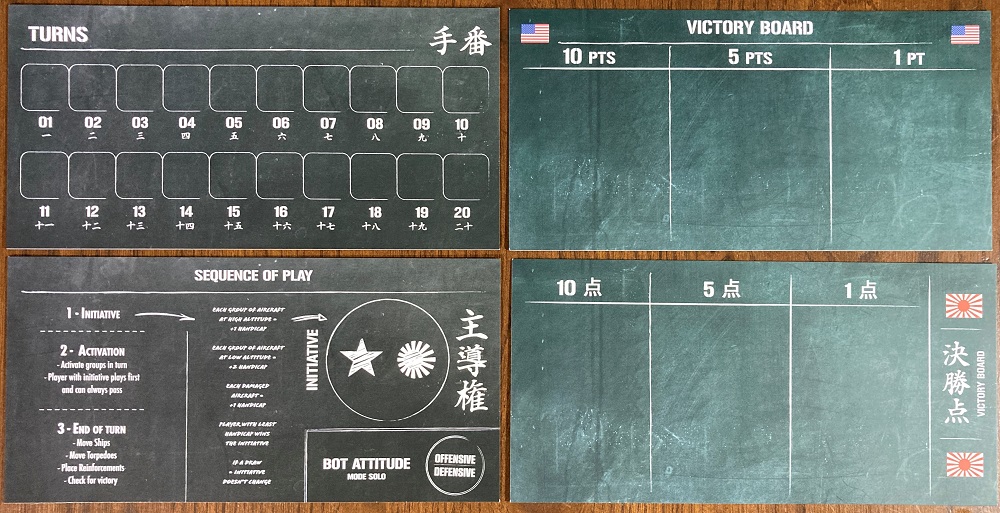
Along with the reference sheets, the initiative tracking board contains rules for determining imitative as well as the steps in each turn. The turn tracking board keeps track of progress through the game as well as when reinforcements arrive and the game ends. Each player also gets a score board where they place enemy planes they have shot down as well as torpedoes and bomb tokens to represent successful hits on the enemy.

The scenario book contains all the information you need to play a game. It shows how the map is assembled and the types of planes and ships each side gets as well as where to place them. It also lists the objectives for each side and the scoring.
How to Play Fighters of the Pacific
You can download a copy of the rulebook here.
The Goal
The goal of the game is score the most victory points by completing scenario specific objectives by the end of the game.
Setup
Once players select one of the 10 scenarios, the scenario book shows how to assemble the tiles to form the map. The scenario book is then placed between the two players so each can read their own objectives and other information that pertains to their side. Players each take their matching score scoreboards and two reference sheets. Place the initiative tracking board with the initiative token on it and turn tracking board with reinforcement, turn and end of game markers on it where both players can see them. Position the aircraft, ship, and anti-aircraft artillery tokens on the map as shown in the scenario book. Finally, place the rest of the tokens where players can reach them. You are now ready to play Fighters of the Pacific.

Gameplay
Fighters of the Pacific is played in turns with each turn divided into three phases: the Initiative Phase, the Activation Phase, and the End of Turn Phase. Let’s take a look at each in order.
Initiative Phase
During this phase, players determine who has the initiative. Initiative is important since it provides an advantage to the player who has it. Players first determine their airplane groups. An airplane group, or AG, is a set of airplanes belonging to the same player which are adjacent to each other by at least one side, at the same altitude, and facing in the same direction. A single airplane forms an airplane group of its own. Players calculate their handicap for the turn by adding 1 point for an AG at high altitude, 2 points for an AG at low altitude, and 1 point for each damage plane. The player with the lowest handicap score has the initiative for the turn. Place the initiative token with that players symbol up on the initiative tracker. In case of a tie, the player who already has the initiative keeps it.
Activation Phase
This phase has players alternately activating either one of their AG or anti-aircraft artillery (AA). The player with the initiative goes first. However, they can choose to let the opposing player go first. The player with initiative can then activate one of their AG or AA or again pass. Only the player with the initiative can pass and could allow the opponent to activate all of their AA and AG before they begin activating. When an AG is activated, the player moves an airplane and then resolves an attack if able. They then move another plane in the AG and attack until all have been moved. When a plane it moved, it must spend all of its movement points or MP. There are various maneuvers an aircraft can make including diving from high to low altitude or climbing from low to high altitude.
Each plane has a field of fire shown on the reference sheets. If an enemy aircraft is in its field of fire and at the same altitude at the end of its movement, the aircraft will attack. If the target has already been activated, then it takes damage. There is no rolling dice. If the damage is equal to the aircrafts armor value, then the plane is shot down and the attack takes the token and places it on their score track. If it survives, place a damage token under it. However, if the target has not been activate, it must dodge and attempt to escape the damage. Dodging is mandatory. The plane must move one space with an advance, slide, or turn move. It can also add a dive maneuver if it is at high altitude. If the aircraft is able to get out of the field of fire, it does not take any damage. When a plane dodges, it may actually move to a position where it can attack an enemy aircraft. That could force that plane to dodge. This could set off a chain of dodging and attacking. Finally, if a plane survives an attack, it can retaliate as long as the attacker is in its field of fire.

Aircraft with bombs or torpedoes can use these to attack ground targets as well as ships. Players can also activate their AA to attack enemy aircraft in the same or adjacent spaces. Both carriers and destroyers have AA and AA can also be found on islands depending on the scenario. This phase continues until all AG and AA have been activated.
End of Turn Phase
This phase occurs at the end of the turn. During this phase, ships are moved followed by torpedoes in the water. Then activation tokens on aircraft are removed. Reinforcements scheduled for that turn are now deployed to the map. Finally players check to see if victory conditions have been met. Once this is all done, the turn marker is advanced and players determine initiative as the next turn begins.
Game End
The game ends when no planes or ships for one side remain on the map or when the last turn is concluded. Players then add up their score based on their objectives. The player with the highest score is the winner.
Why You Should Play Fighters of the Pacific
I have played a variety of tabletop aviation themed games over the past few decades. Some used counters or tokens while other used miniatures. While I enjoy this genre of game, there is often a lot of stats players have to keep track of an the need to plan out all of the maneuvers for your aircraft at the start of a turn. I am very impressed by the differences in Fighters of the Pacific. The player reference sheets are there to remind you of the stats and any information you need about the planes and ships are represented right on the game board. There are only two altitudes and flipping an aircraft token is all you need to do if you dive down to low altitude or climb up to high altitude. If you plane takes damage, place a damage token under it or remove it from the board if it is destroyed. Even combat is simple, if the enemy is in your field of fire and can’t dodge to get away, it takes a damage. No need to roll dice and consult combat tables. This simplicity allows players to really focus on the strategy and tactics without being bogged down with record keeping.

I like how movement is fairly simple as well. Fighters have a speed of 3 while the bombers only have a speed of 2. Aircraft have to spend all of their move points each turn. All planes can do most of the same maneuvers. The only exception is that fighters can also perform a Split-S which uses all of the plane’s move points in a dive that lets the aircraft face in any direction. Two of the Japanese planes also have the agility ability which lets them change their facing one hex side at the end of their movement. In addition, the bombers can make level bombing attacks and then either a dive bomb or torpedo attack. These come into play when their are ships or ground targets on islands and provide objectives for the player’s bombers. Players can maneuver their ships as well as use their AA to try to shoot down the enemy’s bombers. These all make for some exciting games.
While initiative can play a role in some games, usually determining who goes first, in Fighters of the Pacific it is very important. I like how the player with initiative can let the other player go first, one Air Group at a time. This forces the other player to activate their planes so when the player with initiative attacks, they can’t dodge and try to escape. However, the player with initiative should not always let the other player go first. If the other play can attack, then that puts the player with initiative on the defensive as they must react and dodge. Plus an attack must be careful to not end up in the defending aircrafts field of fire since it can respond with damage if it survives the attack. There is even strategy to get the initiative. Since you want to have the lowest handicap score, you need to keep your aircraft in as few AG as possible and at high altitude preferably. At times you have to consider whether to keep your planes in a group or send them out on their own to attack.
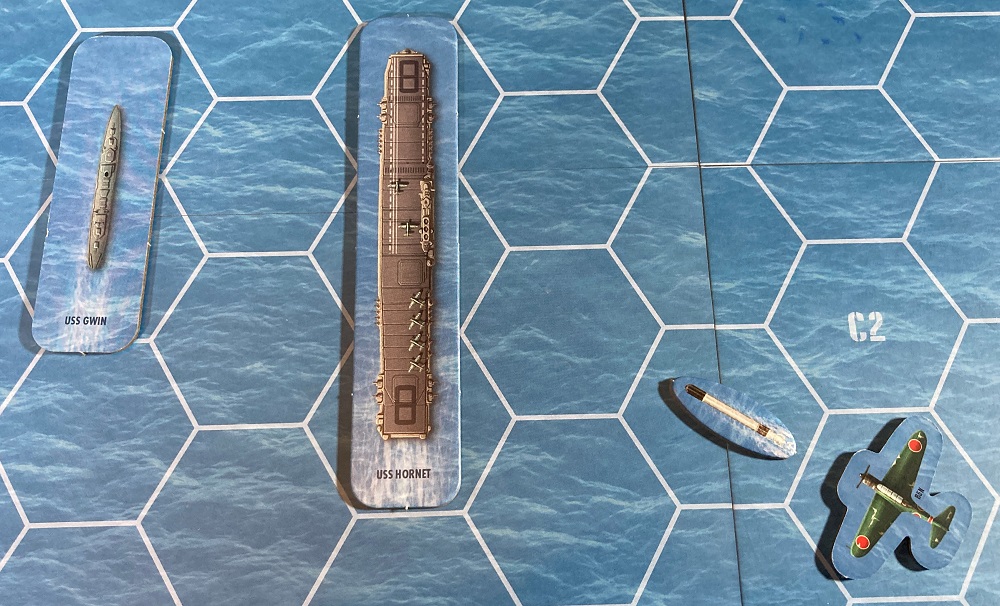
I not only enjoy the gameplay of Fighters of the Pacific, I also like the quality of the components. The aircraft and ship tokens are thick cardboard and printed on both sides. Plus the artwork on them is accurate and looks good. The game even comes with plastic bags to help keep all of your aircraft and tokens organized. The game also includes rules for solo play that work quite well. First you determine whether the AI side will have an offensive or defensive attitude depending on their status for the battle, then check if they are a target or an attacker, and then follow the directions in a table. Fighters will usually attack the closest enemy aircraft, possibly prioritizing enemy bombers if they are defending ships, while bombers will focus on their target and once they release their bomb or torpedo, make their escape off of the board.
Fighters of the Pacific is one of my favorite aviation themed games. It is easy to setup and play as well as easy to teach to new players. By following the scenarios in order, you add some rules as you progress allowing for a shallow learning curve. In fact, most of the rules you would need to look up are on the reference sheets in front of you. I like playing Fighters of the Pacific so much that I even pledged for the second game in the series, Fighters of Europe, which is currently on Kickstarter. This game takes place during the Battle of Britain as German bombers attack the United Kingdom. The campaign also includes expansions for the Battle of France and Defense of the Reich. The latter adds the Americans with their B-17 Flying Fortress bombers and P-51 Mustang fighters as well as the German Me 262 jet fighters. If you like aerial combat and are looking for something you can get to the table regularly and play without having to read lots of rules, then I highly recommend Fighters of the Pacific.
For more information, visit the Fighters of the Pacific webpage!
Click here to see all our tabletop game reviews.
 To subscribe to GeekDad’s tabletop gaming coverage, please copy this link and add it to your RSS reader.
Disclosure: GeekDad received a copy of this game for review purposes.


