
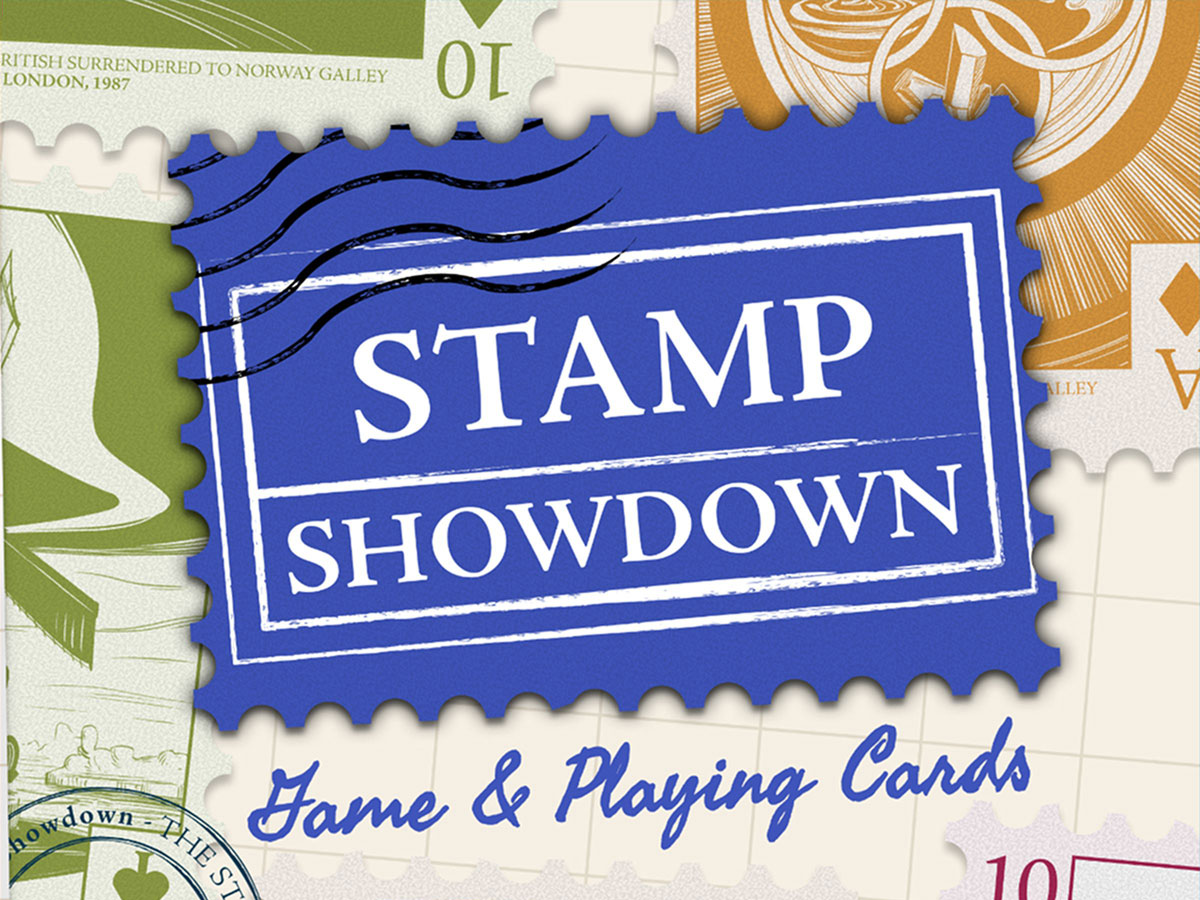
Swap stamps in the market to build the best collection!
What Is Stamp Showdown?
Stamp Showdown is a card game for 2 to 6 players, ages 10 and up, and takes about 20 minutes to play. It’s currently seeking funding on Kickstarter, with a pledge level of €15 (about $18USD) for a copy of the game; there are also other tiers for a print-and-play version or a deluxe edition.
Stamp Showdown was designed by James Ernest and published by Four Suit Studio, with illustrations by Rixt Heerschop.
New to Kickstarter? Check out our crowdfunding primer.
Stamp Showdown Components
Stamp Showdown is played with a standard poker deck, so I received draft rules for the game but did not get an actual prototype. The Kickstarter edition of the game is a custom deck of cards with stamp artwork, but you could play this with any regular card deck. You’ll need to provide some way of keeping score.
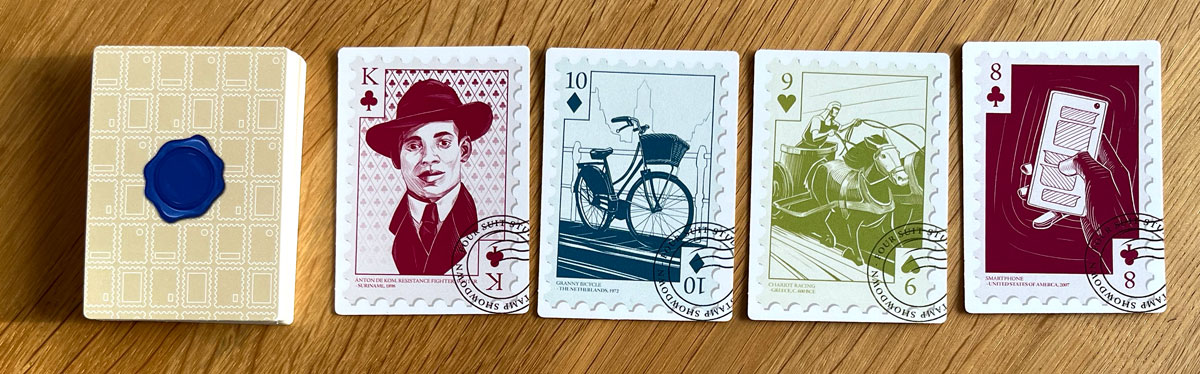
What you get in the box is a 54-card deck plus rules and two player aid cards, all in a small tuckbox. The deluxe edition will also include a larger box that has an unfolding magnetic flap that also serves as the market board and a scoreboard (with included dry-erase marker).

How to Play Stamp Showdown
You can download a copy of the rulebook here.
The Goal
The goal of the game is to score the most points by forming poker hands, made from swapping stamps with the market.
Setup
Shuffle the deck, removing certain cards if there are fewer than 6 players.
Deal 4 cards to each player, and 4 cards face-up in the center as a market.
Gameplay
The game will consist of 4 rounds, each of which lasts 7 turns.
Each turn, every player selects a card from their hand, and then everyone reveals their cards together. The player with the highest-ranked card will go first, and then turns follow in rank order. (Aces are high, and in the case of ties, the ranking of suits is spades, hearts, diamonds, clubs.)
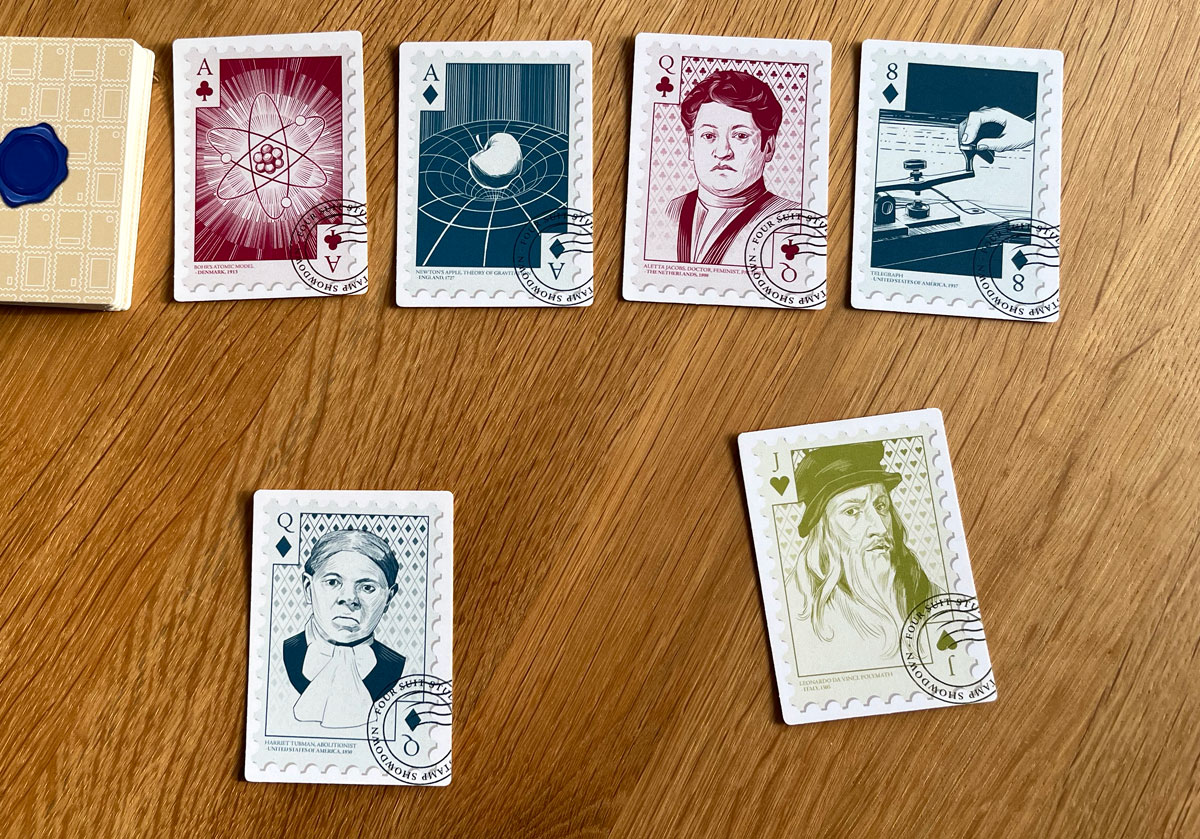
When your number comes up, you swap the card you played with the market: you take all of the cards that match either the suit or the rank of your card, and then you add your card to the market. For instance, in the photo above, the player with the Queen of Diamonds will take three cards: the Ace of Diamonds, the Queen of Clubs, and then the 8 of Diamonds.
If your card does not match any of the cards in the market, then you choose one card to take, and then add your card to the market. (In the photo above, the Jack of Hearts will not match anything, so the player could choose either the Ace of Clubs or the Queen of Diamonds, which was added to the market by the previous player.)
Once every player has made a swap, the rest of the market is discarded and a new set of four cards is dealt for the next turn.
Round End
After 7 turns, there will be no more cards in the deck and it’s time for the showdown! Everyone makes their best 5-card poker hand from the cards they have, and then players score. First place gets 1 point per player, and each subsequent player scores one less, except for last place, which scores 0. (For example, in a 5-player game, scores would be 5-4-3-2-0.)
Then, collect all the cards and shuffle for the next round.
Game End
The game ends after four rounds—the highest score wins!
Why You Should Play Stamp Showdown
Stamp Showdown is another poker-adjacent game from Four Suit Studio, which delivered River Rats last year after a successful Kickstarter campaign in 2025. Where River Rats had players working together to build a single poker hand to defeat the titular bosses, Stamp Showdown is a competitive game, with each player trying to make the best hand. But where poker hands are usually built by random chance—with scoring based on betting and reading your opponents—in Stamp Showdown the hands are built through a series of swaps that make for some really intriguing decisions.
You start with only four cards in hand, which means that if you’re trying to build a hand that requires 5 cards (a full house, a straight, or a flush), then you really need a swap that gets you more than one card at once. And, of course, the more cards you manage to accumulate by the showdown, the better your chances are of building a good hand. So how do you get more than one card? Well, by matching multiple things at once.

In the photo above, the player on the left played a 10 of Spades, hoping to collect three cards (all of the Spades) at once. However, the player on the right played a Jack, which means they get to go first—and with no matches, they can take any single card. If they take the King, the other player still gets three cards, so it may make more sense for them to take one of the Spades, simply to reduce the number of cards the second player will get.
In many instances, you may have to make difficult choices about which card to play, not only because it determines which cards you can swap with but also because it determines the player order. The higher the card you play, the earlier you’ll get to swap—but that means somebody else might potentially swap for that high card, making their hand better than yours. Trying to dump your low cards means that you go late, which makes for a totally unpredictable market. You might just end up with another low card, but sometimes a better card gets swapped in that nobody else is able to take.
The nature of the swaps makes some things particularly hard to do. For instance, getting a four-of-a-kind is hard because you can never swap away any of the other three that you’ve collected, and you need to have the right suit to swap for the fourth. Also, you’re always required to swap one card, so ideally you want to get at least 6 cards in hand—there have been games where I had a full house, but then had to break it up because I needed to swap one of the cards!
The game feels really simple and doesn’t take long to explain, but I’ve played several times and I really love the way it tickles my brain, pondering which card in my hand to swap and hoping that the turn order works out in my favor. It’s just a very intriguing system, and most of the times when I’ve taught the game to people, I could see them having some “aha!” moments throughout the game as things started to click.
I like discovering new games that can be played with traditional poker decks, and this is certainly one that you could just play with whatever deck you have lying around. But if you want to support Four Suit Studio and more games like this, it’s also a pretty reasonable price for a cute custom deck of cards that fits the theme of the game.
For more information or to make a pledge, visit the Stamp Showdown Kickstarter page!
Click here to see all our tabletop game reviews.
 To subscribe to GeekDad’s tabletop gaming coverage, please copy this link and add it to your RSS reader.


