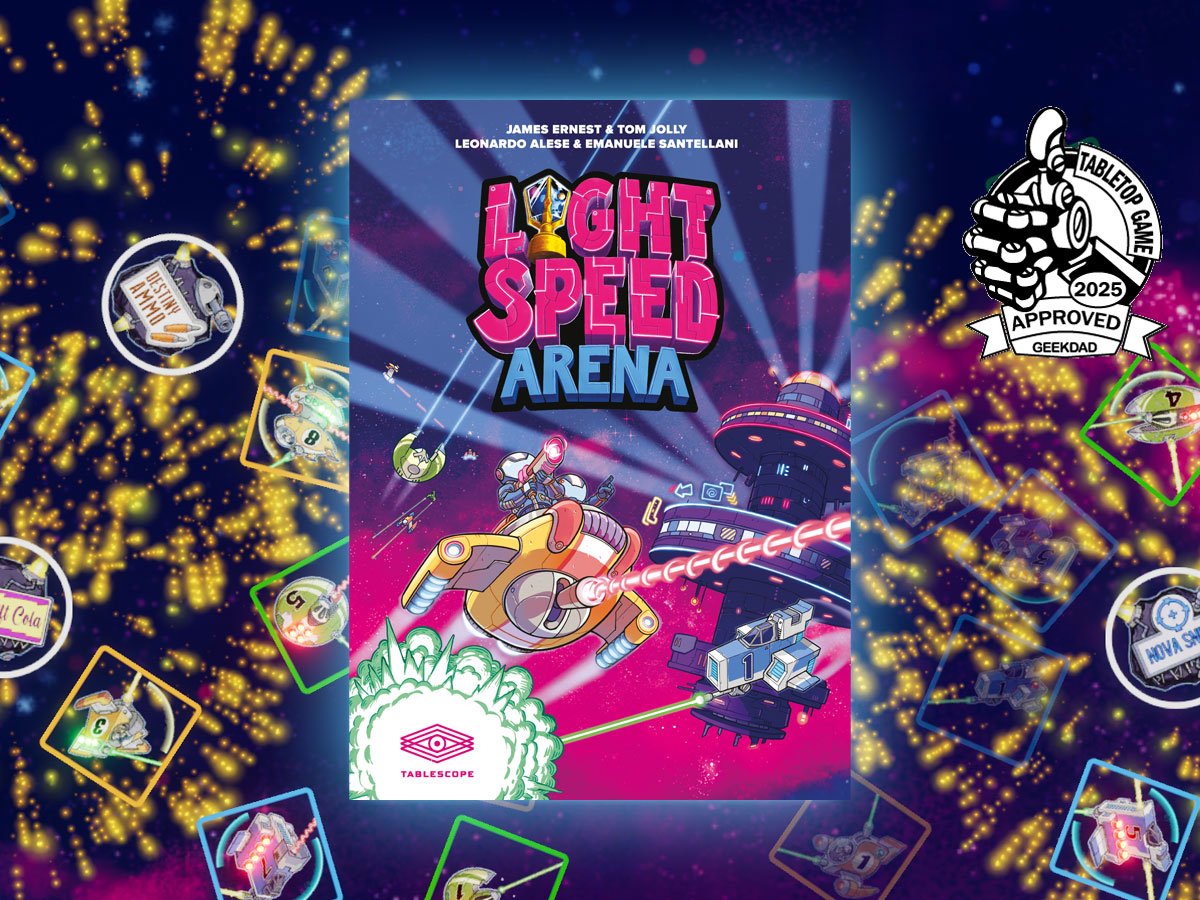
Get ready for a high-speed space battle: with only seconds to place each of your ships, take aim quickly and try not to hit your own ships!
In “Reaping the Rewards,” I take a look at the finished product from a crowdfunding campaign. Light Speed: Arena was originally funded through Kickstarter in the spring of 2024, and was delivered to backers in the summer of 2025. This post is based on my original Kickstarter Tabletop Alert, updated to show the finished product.
What Is Light Speed: Arena?
Light Speed: Arena is a fast-paced battle game for 1 to 4 players (up to 6 with optional expansions), ages 8 and up, and takes about 5 to 10 minutes to play. It retails for about $25 and is available through online retailers and some game stores, though stock may be low. (There should be a new shipment arriving in the US in early March.)
Light Speed: Arena was designed by Tom Jolly and James Ernest and published by Tablescope, with illustrations by Marco Salogni. It is based on Jolly and Ernest’s 2003 game Light Speed, but with some tweaks to the rules and a new app-driven scoring system.
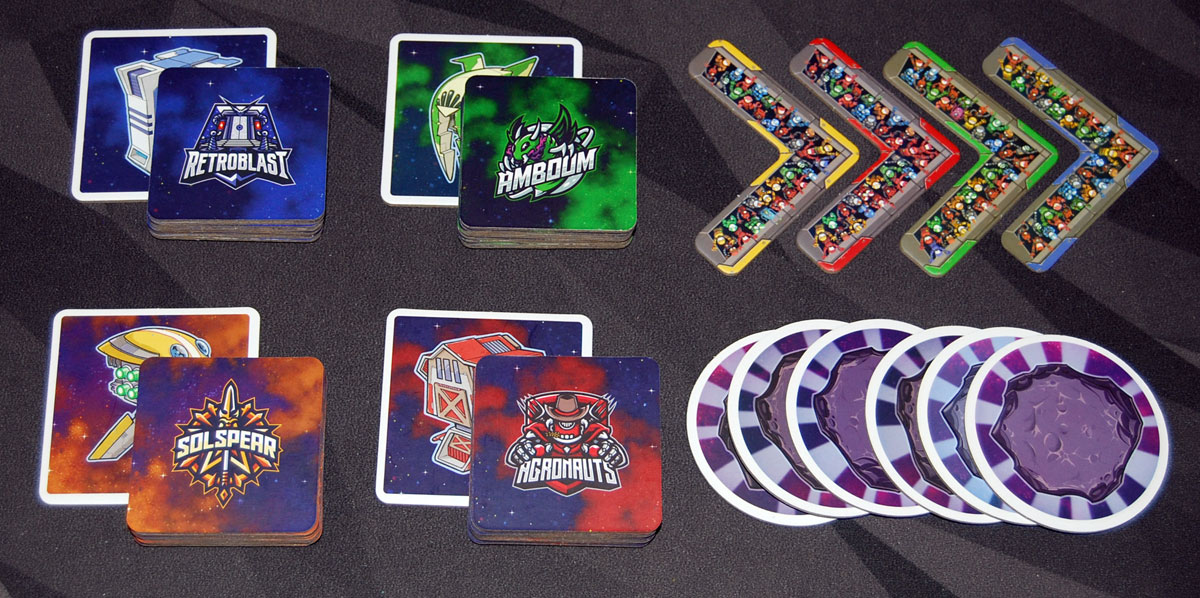
Light Speed: Arena Components
Here’s what comes in the box:
- 4 Mothership tiles
- 32 Spaceship tiles (8 per faction)
- 6 Asteroid tiles
- 4 Corner tiles
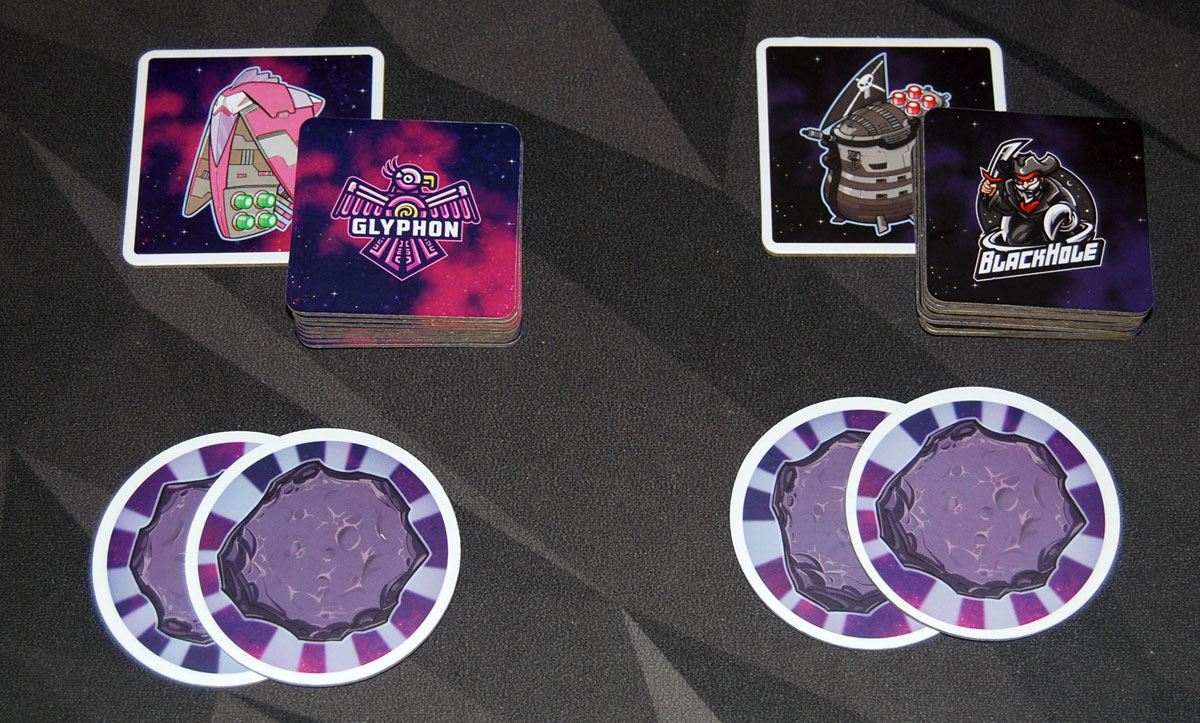
So far there are two mini-expansions. Each includes:
- 1 Mothership tile
- 8 Spaceship tiles
- 2 Asteroid tiles
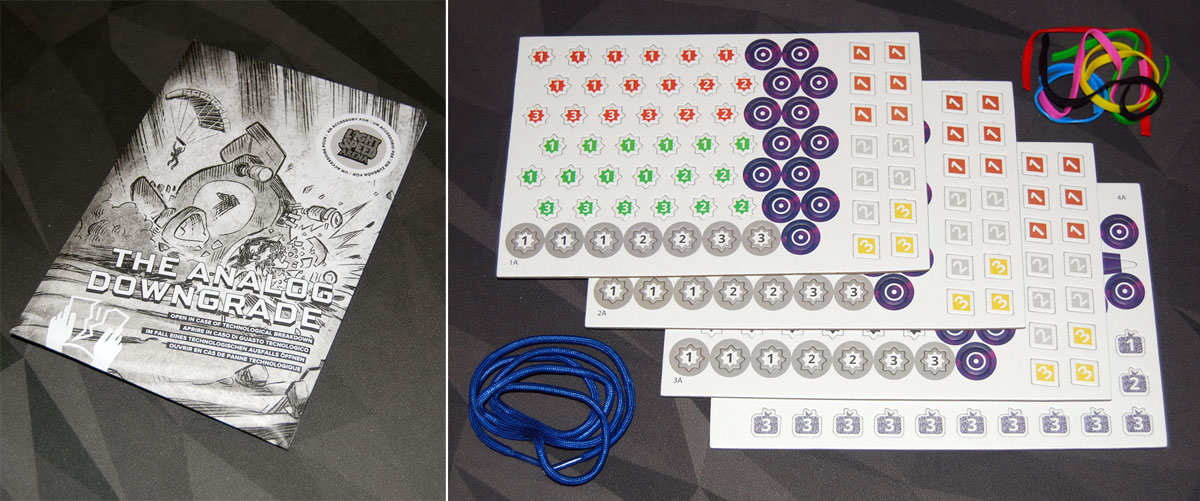
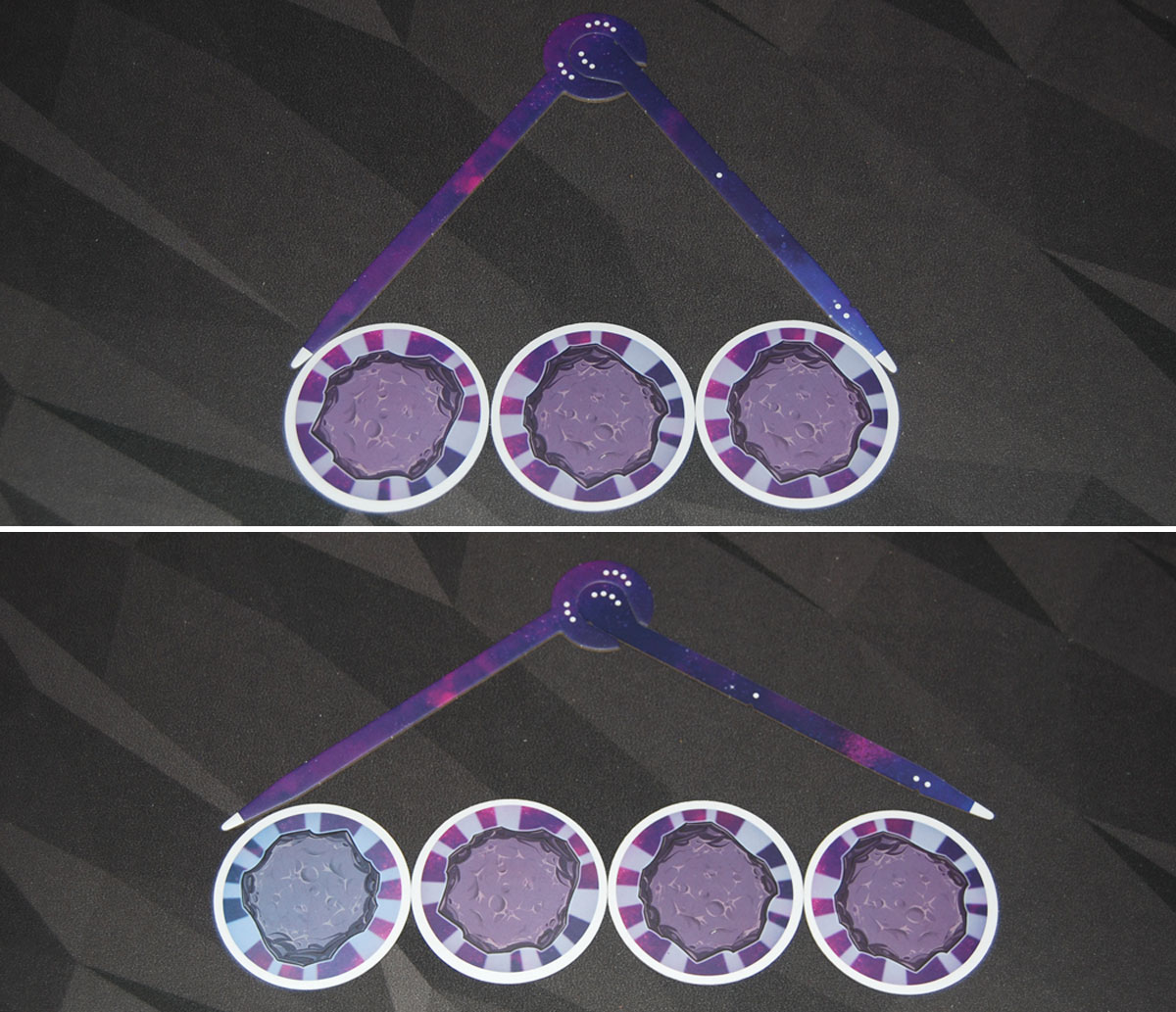
You’ll also need a mobile device running the Light Speed: Arena app, unless you also spring for the Analog Downgrade kit, which includes rubber bands, rulers, and scoring tokens so you can calculate the scores manually.

The asteroid tiles are double-sided and about as big around as a can of soda. Each one depicts an asteroid on one side, and then a “sponsored” side on the other with the name of one of the in-game sponsors like Drift Cola or Destiny Ammo.
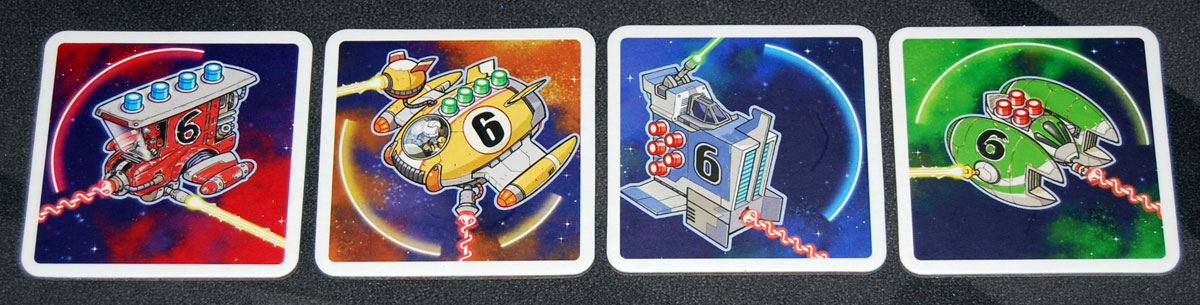
The ships come in 4 factions, which are distinguished both by color and style: the red ships look like they’re inspired by farm equipment, with a space barn for a mothership. The green ships have curved wings, while the blue ships are all very boxy. Each ship has a different combination of green, yellow, and red lasers, shields, and batteries, and the four factions all differ from each other as well. The art style is a little cartoony but slick, and it works well with the theme.
The tiles are small squares (slightly larger for the motherships) and are a nice size for handling, which is good because you’ll be shuffling them and then placing them on the table quickly.
How to Play Light Speed: Arena
The Kickstarter page has links to download a draft of the rulebook and a demo print-and-play (which includes access to the beta version of the app) if you’d like to give it a try yourself. The solo mode was not included in the prototype, so my review will only cover the multiplayer version.
The Goal
The goal of the game is score the most points by mining the asteroids, destroying other player’s ships, and protecting your own mothership. If there are sponsored asteroids in play, there are also ways to earn bonus points.

Setup
You’ll need an area roughly 30″ by 30″ to play. Mark the corners of the play area using the corner tiles.
Give each player a mothership and a set of ships of one faction. Place two asteroids near the middle of the arena, and each player places their mothership near themselves, about 4″ in from the edge of the playing area. Everyone shuffles their own stack of ship tiles.
Gameplay
Set up the mobile device nearby and start the game on the app—it will give you a countdown for each turn (the default is 10 seconds per turn, but you can adjust it in a range from 3 seconds up to a full minute).
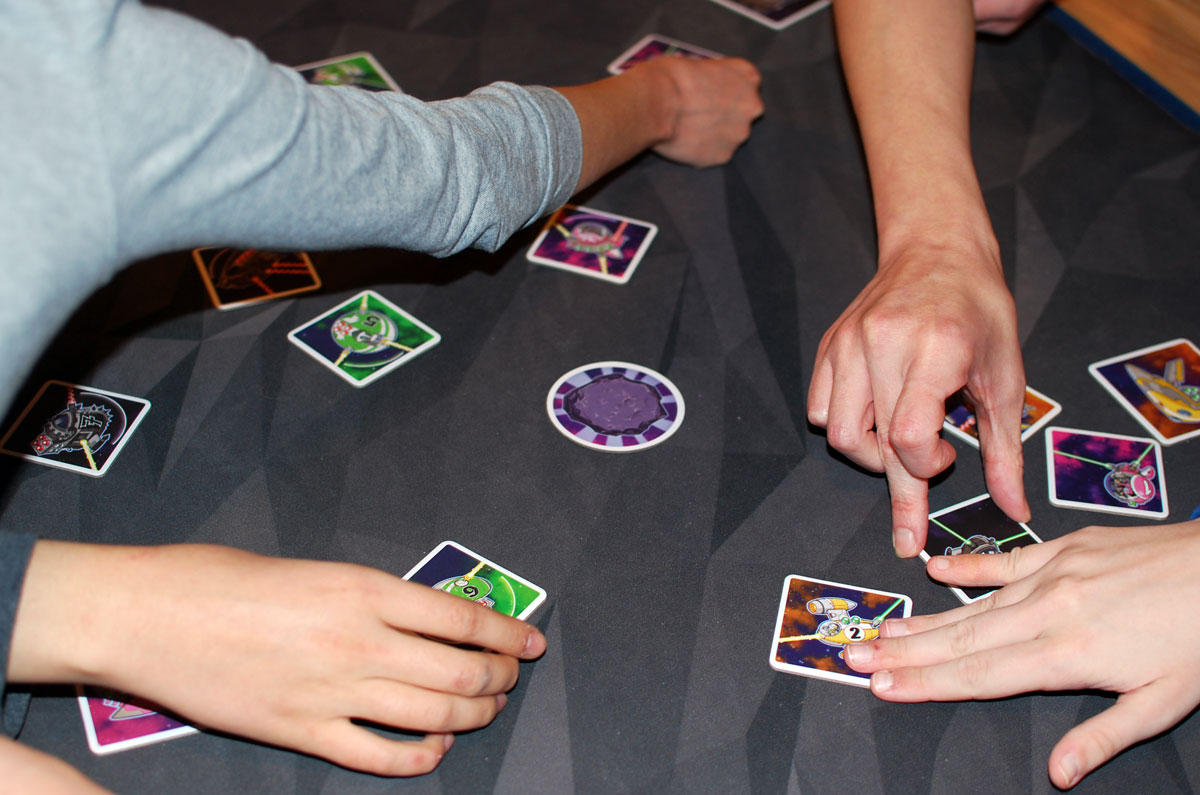
Each turn, everyone simultaneously places the first ship tile from their stack into the playing area. You may play your ship anywhere as long as it’s not overlapping another tile, and when the timer buzzes you must leave it where it is and draw your next ship tile.
After the last countdown, the game ends and it’s time to score!
Game End
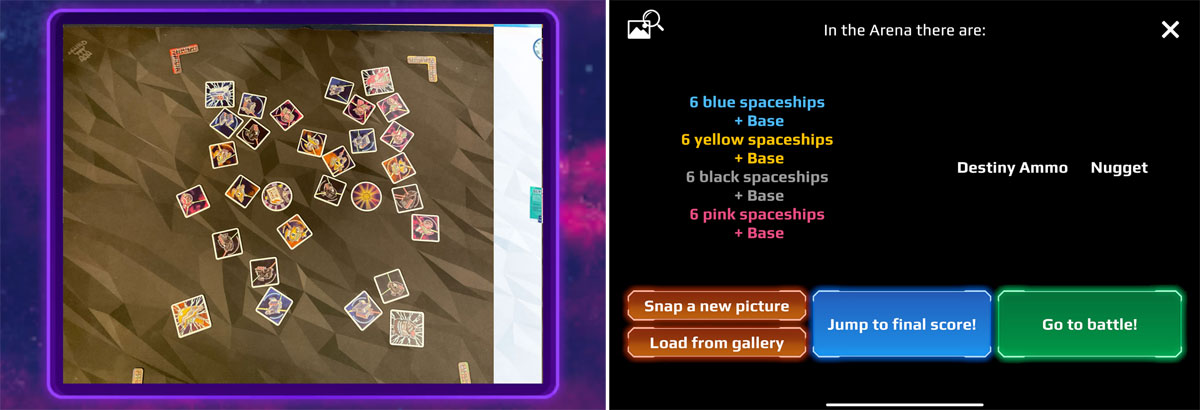
Take a picture of the entire playing area using the app, which will scan the picture and identify all the tiles. After making sure it counted all the tiles correctly, you can proceed to scoring. The app does the scoring for you, playing animations and showing where you gained or lost points (or you can also skip to the final scoring), but I’ll explain how scoring happens.

The ships fire in number order from 1 to 8, and all ships of the same number are considered to be firing simultaneously (though the app will play each one individually). Green lasers do 1 damage, yellow lasers do 2 damage, and red lasers do 3 damage. Shields subtract one point of damage from the laser. You must actually hit the ship illustration itself, not just the ship tile. Each ship (and mothership) has a number of batteries, indicating how much damage it can take before it is destroyed.
- Each time one of your ships damages another ship, you score 1 point.
- If a ship is destroyed, the player who did the most damage to it gets points equal to its full strength. (For a tie, nobody gets the bonus points. Your own ships give you negative points.)
- For each damage you do to an asteroid, your ship gains 1 mining point—but you only score for those if the ship survives until the end of combat!
- If your mothership survives, you score 4 points.
The player with the most points wins!

Sponsored Asteroids
Once you’re familiar with the game, you can flip the asteroid tiles over to play with the sponsor bonus points. Each asteroid adds its own twist:
- Nova Snipe: Any hit (to any ship or asteroid) delivered from at least 28cm (4 asteroid tiles away) gives you 2 bonus points.
- Photonbright: The 5 surviving ships closest to this asteroid at the end of the game will score 3 bonus points each.
- Drift Cola: You get 2 bonus points for close shaves: delivering a hit with a laser that passes through one of your own tiles without hitting yourself.
- Destiny Ammo: Whenever this asteroid is hit, it shoots a laser of the same strength in a random direction.
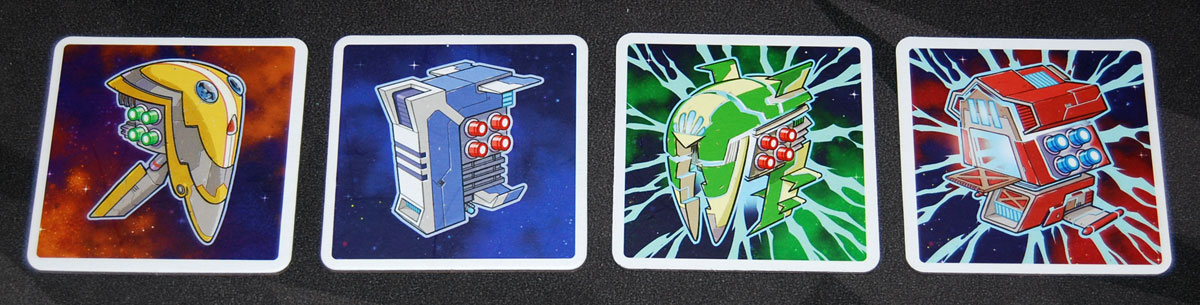
Faction Powers
Each of the factions has its own power, which you can optionally turn on in the app.
- Amboom (green): When you shoot a ship that was damaged on a previous turn, you instantly destroy it and collect the bonus points.
- Solspear (yellow): Your red lasers pierce the first target they hit and continue through.
- Agronauts (red): The first hit each of your ships takes is ignored, along with all other damage done during that same turn.
- Retroblast (blue): If your ship is damaged, all of its lasers do double damage.
- Black Hole (black, from the expansion): After firing, any nearby enemy ships that were not hit by this ship take 1 damage.
- Glyphon (pink, from the expansion): Lasers that pass through a tile without hitting the ship will still do damage, though Glyphon does not get the credit for the damage.
 Light Speed: Arena is GeekDad Approved!
Why You Should Play Light Speed: Arena
Shortly after I was introduced to games like Settlers of Catan and Ticket to Ride and Carcassonne, I discovered the rabbit hole of BoardGameGeek, and one of the things I loved to do was look for games that had unusual mechanics and gameplay. At the time, a lot was new to me, but even then there were some games that really stood out, that felt like nothing I’d ever played before. One of the titles I discovered way back then was this little game called Light Speed. It was from Cheapass Games’ Hip Pocket line—tiny games that literally fit in your pocket, and sold in a little baggie without tokens and counters, which you provided yourself. It probably cost me about $5—less than what I eventually spent on glass beads and tokens to go along with the various other Cheapass titles that I added to my collection.

Some of the things that set Light Speed apart for me were the simultaneous play—you didn’t take turns, but everyone just played at the same time—and the way the entire table was the playing area. There was no board, no grid: you played your cards at whatever angle you wanted, and that determined the direction of your lasers. It was fast-paced, with games often lasting less than a minute once we were experienced, and I loved navigating that fine line between speed and accuracy. Play too quickly, and maybe you end up shooting your own ships; play too slowly, and you don’t get all of your ships on the table. (In the old rules, you just played at your own pace and the game ended when somebody placed their last ship.)
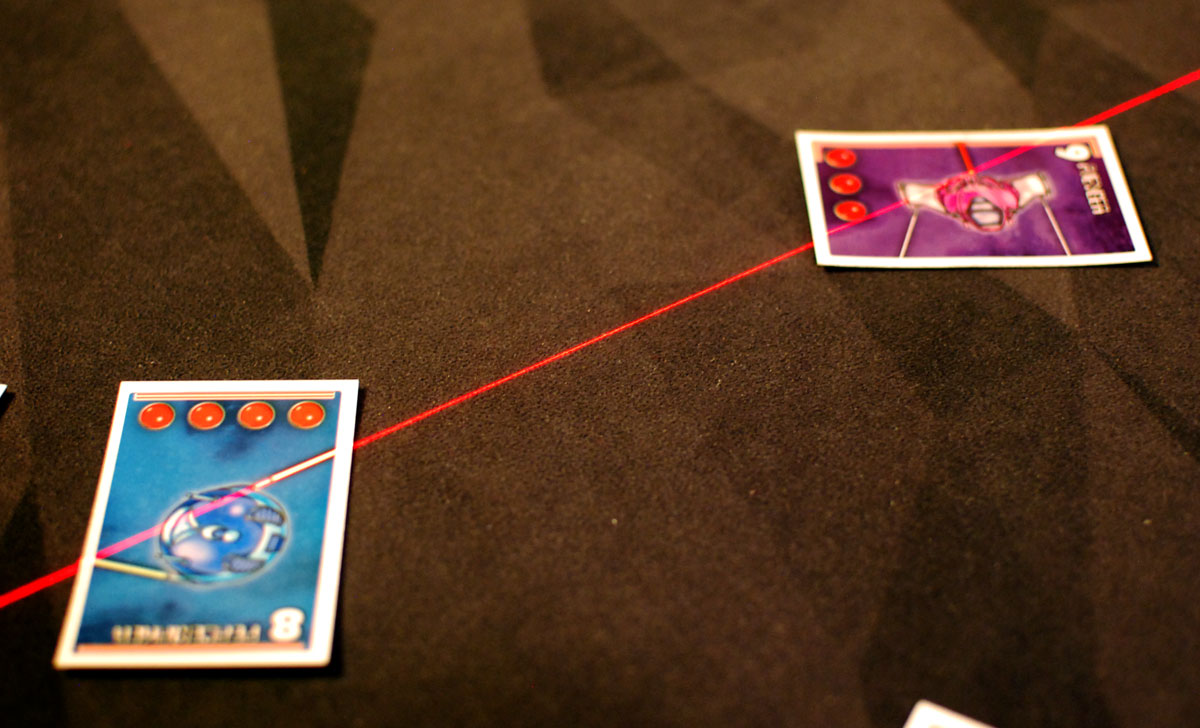
Of course, the play time lasted about a minute or two, but then the scoring took a lot longer. We used a cut rubber band to check the aim (as suggested by the instructions) until I eventually got a cheap laser level that I’d use to project the laser lines, which was a lot of fun. The small cards would get crowded with the glass beads I used for damage tokens, sometimes making it hard to see the lasers. And, of course, if somebody bumped a card while moving tokens around, that could make the difference between a hit and a miss. Even so, Light Speed was one of my favorites, and I was always up for a round or two.
Cut to 2024, nearly 20 years since I first picked up my copy of Light Speed: I happened to see an ad on social media for an app-assisted game called Light Speed: Arena, and it looked oddly familiar. I looked it up and saw that it was, indeed, a new version of Jolly and Ernest’s game, but with a technological twist: now, instead of manually tracing each laser and checking for hits, you could just take a photo of the play area with your phone and let it do all the scoring for you. Could it be? I sent a message to the folks at Tablescope and they were happy to send me a prototype set to try for myself.

The rules have been tweaked a bit from the original but Light Speed: Arena still preserves the feel of the original. It’s lightning-quick (though you can adjust that in the settings!) and still a tightrope walk of speed and accuracy. But being able to just snap a photo of the playing area and have it do the scoring? It’s like magic. While you can just skip to the scores, the app does a great job of making the scoring entertaining, too. You can turn on the commentators, who will pop up to make snarky comments when you shoot your own ships or praise a particularly good shot. The app pans from ship to ship and automatically zooms in and out to show you the lines of fire and how many points each player is earning. (You can have it autoplay, or you can set it up so that you tap to “collect” your points.)
It really is the best of both worlds: the actual play is still analog and old-school, and the app just handles the tedious part that was necessary but not as much fun. (Though if you prefer the old rubber-band scoring method or you don’t want to use a device, the Analog Downgrade kit has you covered, too!) While the app does add some bells and whistles that aren’t strictly necessary (like the sound effects and animations), its primary benefit is actually doing the work that you want it to do without replacing the tactile gameplay. The tiles are much easier to handle (and less prone to warping) than the old Hip Pocket cards, and the illustrations are an upgrade from the original as well.

It’s also extremely customizable: you can play with or without the sponsored asteroids that introduce new rules. You can adjust the timer for playing the spaceships, or you can even just play without the timer at all and just upload a photo at the end, if you wanted to make your own turn-based variant. The faction powers are all individually toggled, so you could let less experienced players use their powers and the more experienced players just use the basic ships. You could even change the number of ships each player has in their supply.
I like all the variety that the asteroids provide. I particularly like the Nova Snipe, trying to set up long-distance shots (and sometimes missing spectacularly). My son was able to make use of the Drift Cola to score a lot of bonus points, in one case passing through two of his own tiles before hitting mine! And for those who just like a bit of random destruction, Destiny Ammo just adds some extra firepower to the field.
The faction powers are fun to play with, though it’s the one thing that I’m not entirely sure is balanced. I looked over the four factions included in the prototype and they have a different makeup of lasers, ranging from 29 to 35 total damage points across the fleets. I assume that the difference is made up by the faction abilities, but does that mean some fleets have advantages when you’re not using the special powers? The abilities also have different difficulty levels: knowing that your red lasers can pierce, or that you get instant destruction on anything that has been damaged already is a little easier to take advantage of. Dealing double damage if your ship has already been shot is a bit trickier, because you may want to shoot your own ships to trigger that … but it makes it more likely your ship will just get blown up before it even fires! The red faction’s ability to ignore damage seems extremely powerful, though it’s entirely defensive and generally doesn’t help the red player score more points. That said, I haven’t noticed any single faction winning more often than others—and the game is so fast-paced that you won’t even really care. If you’re really concerned about balance, just play several games and rotate factions each round!
As you may know, I normally do not award the GeekDad Approved seal to unpublished games, because I want to see the finished gameplay before I make my final determination. In this case, I felt that Light Speed: Arena had already surpassed my expectations even in its prototype form. Since receiving the finished copy and using the finished app, I’m even more certain that this deserves our seal of approval. Between the prototype and the finished copy, I’ve played Light Speed: Arena 50 times, and never tire of introducing it to people.
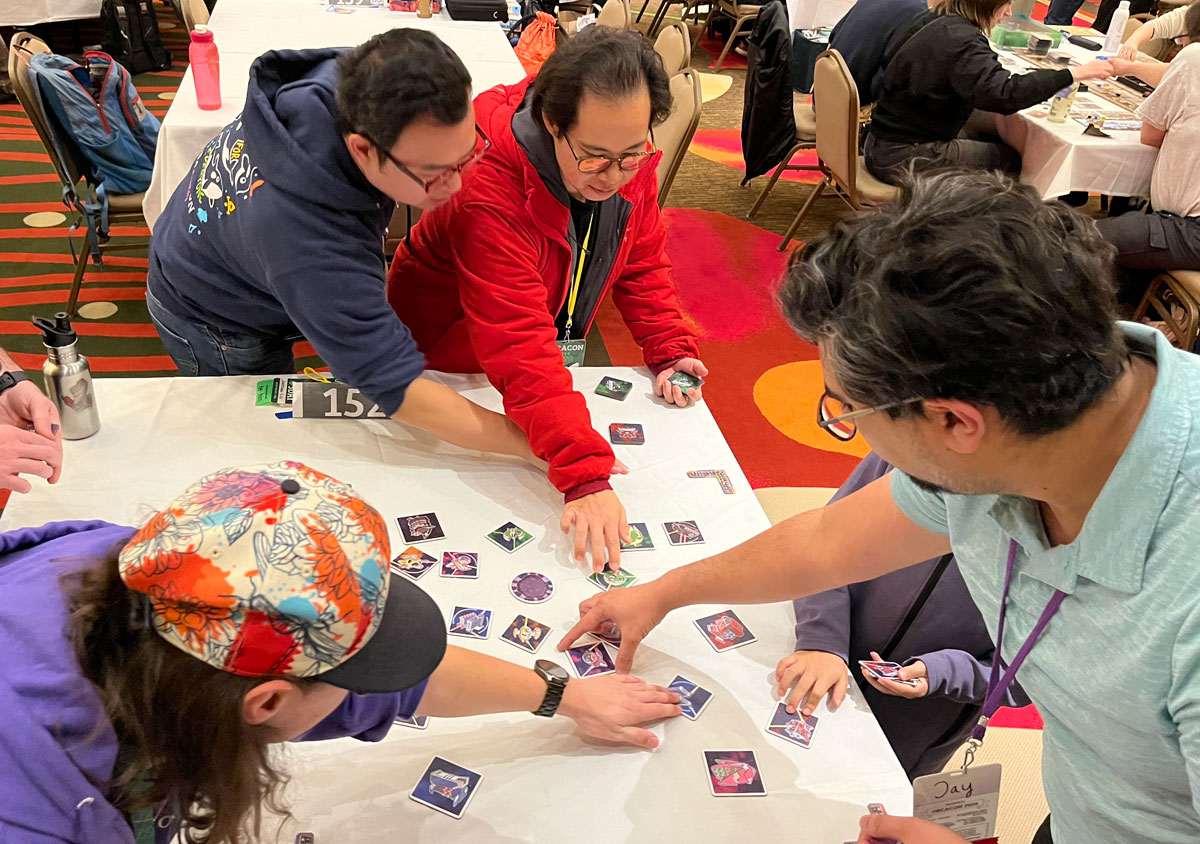
I’m also really impressed with the finished app: with the beta version, I’d occasionally have to retake the photo because it was missing a spaceship or two in the count, and I’d have to try a different angle to avoid shadows or glare. With the finished app, I don’t think I’ve ever had to retake a photo, even when we were playing in a dim hotel lobby or in a room that had a lot of glare from overhead lights.
If you enjoy real-time games (and space lasers!), don’t miss this fantastic revival of an old favorite.
Click here to see all our tabletop game reviews.
 To subscribe to GeekDad’s tabletop gaming coverage, please copy this link and add it to your RSS reader.
Disclosure: GeekDad received a copy of this game for review purposes.