

I’ve got a bunch of books in today’s stack. It’s a bit of a grab bag, but one thing most of them have in common is a sort of otherworldliness: portals or time machines or other impossibilities.

Return to Sender by Vera Brosgol
I’ve written about several of Vera Brosgol’s books before: she has written several graphic novels and illustrated picture books, and Return to Sender is her first novel. It does include some of her own illustrations throughout, but it’s the first time where the words are doing the bulk of her storytelling.
Oliver and his mother have been through a lot since his father died, but now they’ve inherited an apartment from his great aunt and can finally settle down. Oliver has been enrolled in a fancy private school nearby, where his mother has started work as a custodian—but it’s quickly obvious that he doesn’t fit in well with all of the wealthy kids in his classes. Then he discovers that the weird mail slot (on the wall of his seventh-floor apartment) can grant wishes! He writes a wish on a piece of paper, drops it in the slot, and then receives a note that has some strange instructions on it.
The Rube Goldberg–ish chain of events that grant his wishes are elaborate and fun to follow, and Oliver quickly uses the magic to better his social standing at the school. But every wish has a cost, and Oliver starts to realize that there’s collateral damage, and his nosy neighbor seems a little too interested in his life.
I really enjoyed this one: it’s a fun twist on the wish-granting genie who technically gives you what you asked for but not in the way you wanted. In this one, it’s a little more subtle than that: Oliver’s wishes come true, but sometimes they cost somebody else. Does that matter? What should he do about it? It’s a thorny question that he has to wrestle with, and eventually leads to the surprising secret of what’s happening inside the mail slot.

Candace, the Universe, and Everything by Sherri L. Smith
Candace Wells, an eighth-grader who is going through some tough times with her (former) best friend, discovers that her locker is some sort of weird wormhole when a magpie flies out of it on the first day of school. Not only that, but she discovers a notebook from 1988 with a lot of messages about friendship.
Tracey Auburn was in eighth grade in 1988 when her notebook went missing—so she’s a bit shocked when Candace Wells shows up with it forty years later… and when a message appears in the notebook from a Loretta Spencer with an address, they decide they need to investigate it.
The mystery of the portal in the locker—and the strange magpies that travel through it—drives a lot of the plot, as Candace, Tracey, and Loretta attempt to map out other portals and figure out how they’re connected. However, one of the big themes of the book is friendship. Candace’s best friend Deen has been hanging out with Becca, and the dynamics have all changed. Their traditions seem to be falling apart, and they don’t tell each other everything anymore. Plus there’s a boy at school who seems to like Candace, but she’s not entirely sure how to handle it. Meanwhile, Candace has been spending a lot of time with Tracey and Loretta, and her friendship with them has grown, but the kids at school think it’s weird that she hangs out with two older women who could be her aunt and grandmother.
Tracey and Loretta both have their own ways of dealing with relationships, too, and they each give Candace advice in their own ways. Tracey had a falling out with her own best friend in eighth grade and doesn’t put too much stock in long friendships. Loretta is in her nineties, and as a Black woman she had faced a lot of barriers that kept her from pursuing her real interests, so she had to find ways around them—and she knows her time is short.
It’s a fascinating story that juxtaposes the mundane with the mysterious: Candace is at once dealing with middle-school friend drama and investigating a scientific anomaly. It’s a touching book about friendship, with a weird phenomenon to investigate along the way.

The Sherlock Society: Hurricane Heist by James Ponti
Okay, this one does not really have anything supernatural, though there is a little bit of time travel … in the form of flashbacks. And I suppose Florida does count as a “weird world,” right? (Mostly I’m including it because it’s out this week!) In the first Sherlock Society book, siblings Alex and Zoe (along with friends Yadi and Lina) form the Sherlock Society and look for Al Capone’s treasure (among other things). In this second volume, summer is ending and a hurricane is on its way to Miami, which puts a damper on their final attempt to track down the treasure.
But, as is the case with most of James Ponti’s books, the story starts in media res, with the kids (and Grandpa) getting chased by guard dogs across a private ranch where they’ve been trespassing. But this time, the flashback doesn’t just go back a week or so—it goes back to 1964, when Grandpa was a twelve-year-old Pete, preparing for the arrival of Hurricane Cleo. He and his dad, who runs a hardware store, make a last minute trip to the Moroccan hotel to deliver supplies for sandbags and boarding up windows. But the next day, after the hurricane has passed, it’s discovered that there’s been a theft at the hotel. There was a heist movie being filmed at the hotel, and the jewels and art stored in the hotel vault have vanished, and the only suspect was “Doc” Ignacio, the bell captain of the hotel who was also nowhere to be found the next day.
60 years later, Hurricane Clyde uncovered some new evidence and Grandpa is determined to clear Doc’s name. He assembles the Sherlock Society and they dig back into the old crime, relying on Grandpa’s own memories as well as the FBI files he had requested much later when he became a journalist at the Miami Herald. Together they come up with a list of likely suspects and try to figure out how somebody could have broken into the vault without leaving a trace.
It’s a good mystery with a lot of red herrings and unexpected twists, but as with the previous book the clues that the kids use to crack the case are all there in the story—it’s not one of these books where the reveal includes information that was withheld from the reader. I also liked getting a little more of Grandpa’s story. He’s a fun character and we get to see a glimpse of how he eventually ended up becoming a reporter at the Herald.
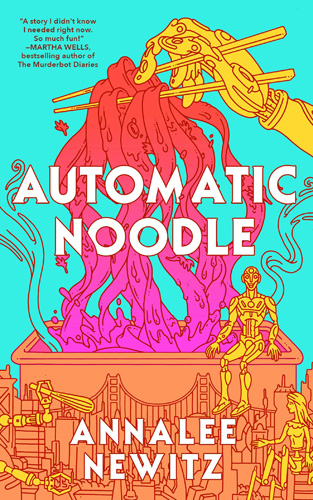
Automatic Noodle by Annalee Newitz
This novella takes place in a post-war San Francisco, where humans are trying to rebuild and recover. Sentient robots have been granted citizenship in California, though they still lack a lot of rights. When a group of robots wakes up from a months-long deactivation, they find that the ghost kitchen they operated is overdue on its rent and the owners are AWOL. Rather than let the lease lapse and have their contracts sold off, they decide to just run the kitchen themselves, making biang-biang noodles and hoping to find success.
Automatic Noodle takes place in a sort of dystopian world, but its focus is hopeful. It’s about the community that is built up by the robots—both the relationships they have with each other and the relationships they make with those who discover their little restaurant. When the shop gets review-bombed by some anti-robot activists, they have to figure out how to work around it. It’s a short book, but it packs a lot into it and I thoroughly enjoyed it. Plus, the descriptions of the biang-biang noodles will make you wish that this robot kitchen was real. If you liked Becky Chambers’ Monk and Robot stories or even Martha Wells’ Murderbot series, you should add this one to your list.

Extremity by Nicholas Binge
Here’s another novella, this time with a weird premise: billionaire Bruno Donaldson has been murdered … twice. He was shot in his office in London in the middle of the workday, but he was also found dead under a bridge in Vauxhall. Former police detective Julia Torgrimsen has been brought in as a consultant—she had once gone deep undercover to investigate a human-trafficking ring, and rubbed shoulders with Bruno and his associates.
The story is told through the recorded testimonies of three people: Julia herself; detective chief inspector John Grossman, who was Julia’s contact while she was undercover; and detective constable Mark Cochrane, new to the team and only involved because he happened to be at the office when Grossman got the call. Right from the start you understand that the story is going to end up with a lot of dead bodies and Julia looking very guilty, and this is their testimony about what happened. Julia is indeed able to use her knowledge of Bruno to find some leads, but when they finally track down his killer, what they find is weirder than ever: somehow time travel is involved, and also the impending doom of the entire human race. Because billionaires.
The story is fast-paced: it doesn’t leave you hanging for long, in part because Julia is relentless and just doesn’t stop. Along the way, we do find out more about her past—why she left the force four years ago, why she never wanted to see Grossman again. I will warn you: there’s a lot of ugly stuff involved, a lot of it having to do with the fact that the ultra-wealthy just aren’t subject to the same laws as the rest of us—and that part has nothing to do with the sci-fi portions of the book.
As it turns out, the time travel itself is really a fairly small portion of the story; once you get to that point the weirdness gets cranked up quite a bit. There are some things that aren’t ever fully explained and some of it is pretty creepy, but the story hooked me and I read this in an afternoon.

Chrononauts written by Mark Millar, illustrated by Sean Murphy
Corbin Quinn and Danny Reilly are buddies; Corbin has finally developed a time machine that lets the traveler broadcast back (or forward) to his original time. His first planned trip will be to film Columbus landing in America. But a glitch throws him off course and he winds up in Samarkand, 1504. When Danny jumps in after him to save him, he’s surprised to find Corbin as the king of Samarkand, which is full of modern-day technology like Jeeps and jet fighters. Yep, after Corbin’s crash-landing, he realized that he had nothing to go back to, and instead has just been time-hopping and making himself incredibly wealthy and powerful. And then the two of them buddy up and just mess with the timeline even more, until everything comes to a head.
In the second portion, Futureshock, Corbin finally figures out how to get to the future, and they find a utopian society run by his old professor, who has used time travel to change history to ensure that the future era is successful. He wants to hire Corbin and Danny to move to the future and work for him, but they’re not sure they agree with the way he runs things.
There’s some fun stuff going on in this comic book, and a lot of visual gags and pop culture references, but I couldn’t help but feel like Corbin and Danny were a bit too over-the-top for me. At first I thought Corbin was going to be the straight man and Danny was the cocky, arrogant sidekick … but then it turned out both of them are arrogant and self-serving, using time travel to enrich themselves and woo women. And they still somehow get to be the heroes by the end. While there were some clever uses of the time travel, for the most part I just didn’t find them quite as compelling.
The version I read was the Library Edition, which includes the first two volumes. There’s apparently a third volume, Big Game, but I haven’t read that one.

Backflash written by Mat Johnson, illustrated by Steve Lieber
When Devin’s mother dies after a long illness, he’s at the end of his rope. His mom’s house is headed into foreclosure if he can’t get it sold, and though his estranged daughter shows up to help she doesn’t have much patience for him, either. He doesn’t have a job, doesn’t have much of a family left besides his Uncle Larry, and doesn’t really have much of a future. What he does have is the past: he puts on one of his mom’s favorite records, and suddenly finds himself in the 1970s, inhabiting his childhood self, seeing his mom as a young woman.
Eventually Devin meets some others who are able to “backflash,” mentally traveling to the past through the use of nostalgic artifacts. He starts to push at the boundaries of the ability, trying to figure out who his absentee father was—but spending all this time in the past puts even more of a strain on his present and his relationship with his daughter.
Backflash had a clever method of time travel, and the underground group that he finds is pretty funny. It’s also a lot of fun just for the nostalgia—I recognized a lot of the various music, toys, and artifacts that Devin uses to travel back in time. The guy who ends up helping him figure out his abilities is described as a “Filipino Lou Ferrigno” and he’s a great contrast to the stressed-out, serious Devin. He’s a bit of a dope, but he also has some good advice in the end.


