

I read many, many comics throughout the year (as you may have gathered if you follow Stack Overflow), and a great deal of those, particularly the ones for middle grade and young adults, tend to be smallish paperbacks, similar to a typical paperback novel. While they can vary in length to some degree, a lot of them are somewhere close to 200 pages—there’s kind of a “typical” size, and I have big stacks of them in my “to read” pile. I’ll pick a stack of them from my office and sit down and read throughout a day; my daughter usually has at least one of these at hand at the dining table to read while she eats.
And then there are the big books. Large format, often hardcover, sometimes the size of a picture book but usually much thicker. These tomes say, “Hey! Put everything else down for a minute because you’re gonna need both hands for this.” There’s more room for the artwork to spread across the page, or more pages so the story can take a little more time to unspool. And some artists use the space to do very weird and interesting things with the format.
So, today: a big stack of these big comic books. Make room!
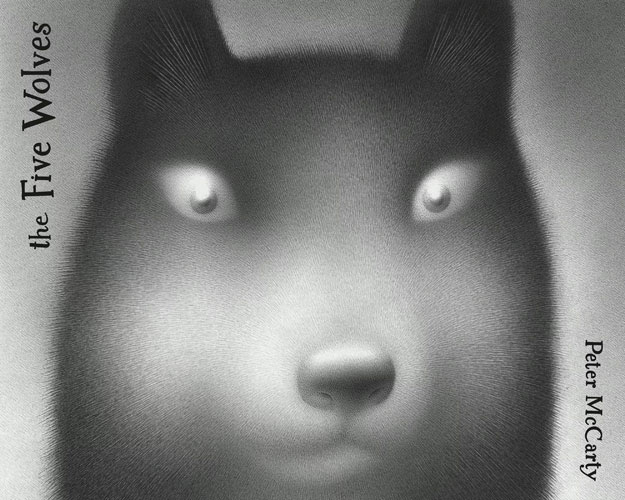
The Five Wolves by Peter McCarty
Here’s an example of an artist really playing around with the medium. Peter McCarty is well-known for his picture books, often featuring animals or kids that remind me a bit of those Squishmallow plush toys: rounded and soft, with small stubby limbs. His illustration style is immediately recognizable for the soft, almost glowing look achieved with countless tiny little marks.
While the pictures in The Five Wolves still have that same quality and are mostly monochrome, the book itself is a good deal bigger than his usual picture books, at nearly 300 pages. The plot is strange and absurd, starting with the five wolves at sea (and painting portraits of a fish), arguing with a boatful of cats, encountering the “flying yorbas,” and taking advice from a rabbit with “42” on its chest. The book is rectangular, and large enough that most of the illustrations have wide margins all around, or sometimes appear letterboxed with margins on top and bottom—though sometimes there are figures just on a plain blank background, too. (You can see a few examples of the interior on Macmillan’s website.)
What stands out in particular, though, is the text itself. Each page with text is itself an illustration, a dense mess of hand-written text (and the occasional drawing) fit into a rectangular block. Usually there are a few sentences in larger, bolded letters, and you could read just those to follow the story, and the effect would be a bit like reading a typical picture book. But you could also spend twenty minutes just scanning all the little text on a single page, meandering around the main “plot” text: some of it feels like a weird stream-of-consciousness that is only obliquely related to the story, and sometimes there are passages that make a little more sense. It really heightens the somewhat surreal aspect of the story. This is definitely a book I want to spend some more time with—maybe there’s some other hidden meanings I haven’t found yet!
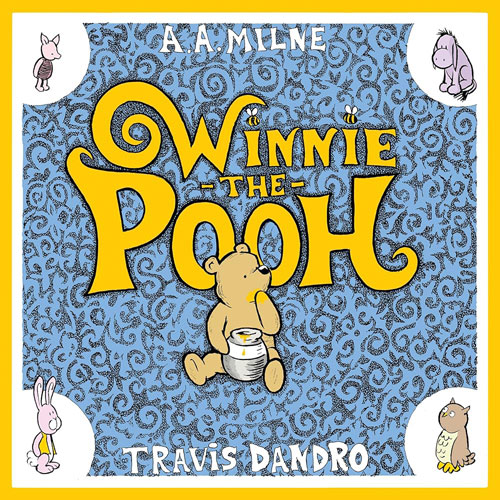
Winnie the Pooh by A. A. Milne, adapted by Travis Dandro
This graphic novel adaptation of Winnie the Pooh stays pretty true to A. A. Milne’s original stories, but the characters themselves vary a bit in how closely they look like E. H. Shepard’s versions. Pooh and Piglet are fairly close (though Piglet’s nose is more square), and Eeyore is a little closer to the Disney version, but Rabbit and Christopher Robin were both changed significantly. (Fan-favorite Tigger didn’t appear until Milne’s second Pooh book, so he’s not in this one at all.)
Winnie the Pooh is one of my wife’s favorite kids’ books, so it’s one that we’ve read many times. There’s the story of Pooh pretending to be a cloud to get some honey, Piglet’s house getting flooded, Eeyore losing his tail, Pooh getting stuck in Rabbit’s doorway, and so on. Much of the dialogue is taken straight from the original stories, but Dandro has filled out the visuals to make it a full comic book.
Those who grew up with Shepard’s illustrations may find it a little hard to get used to Dandro’s versions—they’re close enough to look similar but not quite right, unlike the Disney versions that just went in a wholly different style. But for kids who are just discovering Winnie the Pooh now, this option might find some new fans who might have passed over the old-fashioned prose books.

The Super Hero’s Journey by Patrick McDonnell and Marvel Arts
Here’s another artist I’m familiar with, but illustrating a subject quite different from what I’m used to seeing. Patrick McDonnell is the cartoonist behind the Mutts comic strip, and he has also illustrated picture books (like A Perfectly Messed-Up Story from 2014). Here, he tells a story about his own love of comics as well as some of his worldview and philosophy of life, viewed through the lens of Marvel characters. The book includes many excerpts from old Marvel comics (usually untouched but occasionally modified a little for story purposes), interspersed with McDonnell’s versions of the characters.
Doctor Doom is using the power of the Negative Zone to bring despair and discord across the planet, and the various heroes from the Marvel universe end up fighting each other. As the Watcher observes, he sees that Reed Richards—Mister Fantastic—seems to be a kindred spirit, searching for a way to fight the despair. They end up traveling through other classic comics, but ultimately Mister Fantastic has to look inside himself.
It’s a somewhat strange but deeply personal adventure, and serves as McDonnell’s love letters to both Marvel and the wider world of comics itself.

He Lost His Keys in Space by Luke Milton and Lizzy Lang
Vega Ulysses is Earth’s first ambassador, sent on a twelve-year mission of galactic diplomacy for which he was completely unsuited. He was supposed to travel to various planets to build relationships and share what’s great about Earth—but his journey was filled with poor choices and open hostilities. But now he’s done, and ready to head back home to Earth … except he can’t find the keys to his fortress home. So he takes his crew and goes back to retrace his steps, hoping to discover where he left his keys behind. We get flashbacks of his original trip, and see how the planets are faring years later as a result of his visits.
Vega has almost no redeeming qualities whatsoever. He’s more of a Zapp Brannigan than a Captain Picard, and he ruins pretty much every planet he lands on in one way or another. A planet of community-minded musicians gets turned into a capitalist consumer nightmare (involving a Garfield-inspired cartoon); his mission to establish trade routes resulted in the assassination of the planet’s leader. His crewmates include Zax Snaxston, who is constantly trying to see the good in Vega, and Vanessica Planders, who has seen enough to know better.
It’s hard to say whether this book is a cautionary tale, warning us about the ways that humanity would be toxic to pretty much any alien life we encountered, or if it’s just meant to be a silly romp about a terrible person, but it’s definitely a comedy of errors.

Total THB Volume 1 by Paul Pope
THB is a comics series that Paul Pope self-published starting in 1994 until 2003, with additional short stories as recently as 2021. It’s now being collected into three large paperback volumes by 23rd Street Books; Volume 1 is currently available and Volume 2 is expected in July 2026.
THB stands for Tri-Hydro Bi-oxygenate—it’s a molecule introduced at the beginning of the book by Doctor Yukimoto, and it has some very unusual properties. Dormant, it looks like a tiny rubber ball, but adding water makes it immediately expand into a seven-foot tall, rubbery figure. THB is given to teenager HR Watson, the daughter of the head of Watson Robotics, as a secret security measure that very quickly becomes the talk of the school.
The story takes place on Mars, where humans have built some cities but much of the land is still vast expanses of desert. While HR thinks of THB as something between a toy and a companion, it turns out to be a necessary precaution because Mr. Watson has a lot of enemies, some of whom make an attempt to capture HR while Watson is away. HR turns out to be pretty resourceful herself even without THB—it is incredibly strong, but eventually its activation wears off and shrinks back into a little ball, often at very inconvenient times.
I hadn’t ever read THB before, but it does remind me a little of some of Paul Pope’s later books, Battling Boy and Aurora West. (I interviewed Pope about these in 2014.) There’s a strange world with its own rules and culture and background, and we get a small window into it by following a few of the characters around. THB‘s Mars has robots, both intelligent and not-so-intelligent, and there are also the Olmari, the native Martians, who have to some extent assimilated into Earthling culture. There are action sequences with agents attempting to capture HR, and there are quieter moments where HR is hanging out with her stepbrother or questioning THB about its nature. It’s a weird sort of story and I’m curious to see where it goes next!

Dune The Graphic Novel, Book 3: The Prophet adapted by Brian Herbert and Kevin J. Anderson, illustrated by Raúl Allén and Patricia Martín
This is the final volume in a graphic novel adaptation of Dune, released over the past few years about the same time as the two-part film version, but although it carries the “Now a Major Motion Picture” text on the cover, it does not appear to rely too much on the films for its visuals (or the character portrayals). This third volume is where everything comes to a head: Paul Atreides becomes accepted as the leader of the Fremen but is also expected to follow their traditions, some of which he disagrees with. Baron Harkonnen has schemes in place to put his nephew in charge of Arrakis, and everything is leading up to one big final battle.
I actually have not read the original Dune novels, nor seen the films, so the graphic novels have really been my primary introduction to the story (well, those and the Dune: Imperium board game). So I can’t say how faithful an adaptation these are, though I imagine there are things that were omitted or abbreviated somewhat. The three volumes are now available together in a box set.

Drome by Jesse Lonergan
Drome is the most visually stunning comic I’ve read in a while, one that takes the comic book medium and pushes it in surprising directions. The plot itself is a creation myth of sorts: two celestial beings, Chaos and Order, darkness and light, both create people, who clash in various ways. Chaos’s humans immediately kill each other and subdue animals in service of making war. Order’s hero—the woman pictured on the cover—is sent to impose control, which leads to discipline, and then a flourishing of civilization. Like most myths, there is violence and sex, conflicts on earth that reflect the conflicts in the heavens.
What makes Drome remarkable, though, is the way the story is told. In particular, Lonergan incorporates the gutters—the white spaces between comic panels—as parts of the drawings themselves. The negative space feels almost solid at times. Some pages are a large grid of tiny squares, like the cover, but some of the squares are a shared window into a single image, while other squares show the passage of time or movement of a character like a traditional comic book. Sweeping actions may trail a line of gutter across the page. Order herself is made up of negative space, a person-shaped void in the ink with a face. You can see a few of the interior pages on the Macmillan website, but the ones included there aren’t the most spectacular examples.
There is dialogue, but it is sparse. Pages go by with no words spoken; communication is implied through gestures and facial expressions. This is a story told by the images, and they tell it well. If you want to be blown away by the possibilities of the comics medium, this is a good place to start.

From Above: An (Info)graphic Novel by Martin Panchaud
This comic book tells a story in an unusual way: everything is depicted “from above,” literally. It’s a top-down view of the world, but all of the people are represented by colored circles, animals like dogs and horses are ovals. The world itself is more detailed, with maps and floor plans that are fully illustrated, but everything does have the feel of an infographic, as implied by the title.
The plot centers around a teenager named Simon, an overweight kid who is bullied by some neighborhood kids into participating in their get-rich-quick schemes. He has a rough home life, too, with parents who are constantly arguing with each other. But then he meets a fortune teller who reads his fortune in exchange for a favor, telling him to bet on a horse race. Simon becomes a millionaire—on paper. Unfortunately, as a minor he needs an adult to sign his ticket, but he finds his mother in a coma and his father missing.
What follows is a story about Simon’s attempts to cash in his winning ticket, hoping that the money will solve all his family’s problems, but things just keep getting more and more complicated, drawing in all sorts of other characters, including a gang of bikers, a pair of unhelpful cops, and even a blue whale. (I will note that despite its somewhat cute appearance, this is not a story for younger readers: while it’s not graphically explicit, there’s still a good deal of violence and the escapades of some fairly raunchy adolescent males.)
It’s a really intriguing format—throughout the book there are some actual infographics, but largely it’s a matter of getting used to recognizing the characters by the different colored circles and the context given by the conversations. I was impressed with how much emotion and action can be conveyed just by the relative position of a few colored circles on a page.

Raymond Chandler’s Trouble Is My Business adapted by Arvind Ethan David, Ilias Kyriazis, and Cris Peter
This is a graphic novel adaptation of Trouble Is My Business, a Philip Marlowe hard-boiled detective novel by Raymond Chandler. Marlowe has been hired to take care of Harriet Huntress; apparently she’s a gold-digger, playing up her affections for the stepson of millionaire Mr. Jeeter. Jeeter wants her gone, but as Marlowe starts to dig into the case, all he finds is more trouble: a couple of dead bodies, a pair of goons with guns, and a Dartmouth-trained chauffeur who definitely has more up his sleeve.
As Ben H. Winters writes in the foreword, it’s hard to imagine the time when Chandler’s hard-drinking, tough-talking detective was a new concept. I grew up reading Calvin & Hobbes and his imaginary “Tracer Bullet” character, and watching Daffy Duck and Bugs Bunny play detective in Looney Tunes cartoons. But here we get the original—or, at least, a comic book version of the original. Philip Marlowe gets hired to do a job, but to do the job right he sticks his nose in a lot of places it doesn’t belong. Oh, and he also gets pretty drunk along the way.
This team does a pretty good job with the story: Marlowe is tough and is often in black-and-white, even when some of the other people around him are in color. There are plenty of shadowy faces and trails of cigarette smoke to evoke the film-noir setting, and the plot itself is twisty and keeps you guessing until Marlowe explains it all at the end.

Smash the Patriarchy: A Graphic Novel by Marta Breen and Jenny Jordahl, translated by Siân Mackie
What is the patriarchy, and how do you go about smashing it? This book is a conversation with Breen and Jordahl, who take the reader on a trip through history. They make note of the many men who helped establish and uphold a system where men are in control and women are less valued, and they also highlight the women who stood up to them in various ways.
The book is a large format, but not very long; it includes a lot of direct quotes (particularly from patriarchal men), but also shares stories of a few particular women throughout history like Mary Wollstonecraft and Pharaoh Hatshepsut. They explain concepts like “the male gaze” and show the double standard used for men and women regarding sex and relationships. Ultimately, this book’s tone is optimistic and hopeful for the future, and it was nice to have a bit of encouragement and a reminder of progress that has been made, even as we continue to see the ways that patriarchy hasn’t quite been smashed yet.
My Current Stack
Aside from the comics in today’s column, I’ve just started There Is No Antimemetics Division by QNTM and I’m really enjoying it. It’s about an organization that, among other things, is researching and tracking phenomena that resists memory—monsters that eat your memories, objects that you can’t observe because your brain just can’t believe they exist, and so on. It’s deliciously weird and kind of terrifying.
Disclosure: I received review copies of these books. Affiliate links to Bookshop.org help support my writing and independent booksellers.


