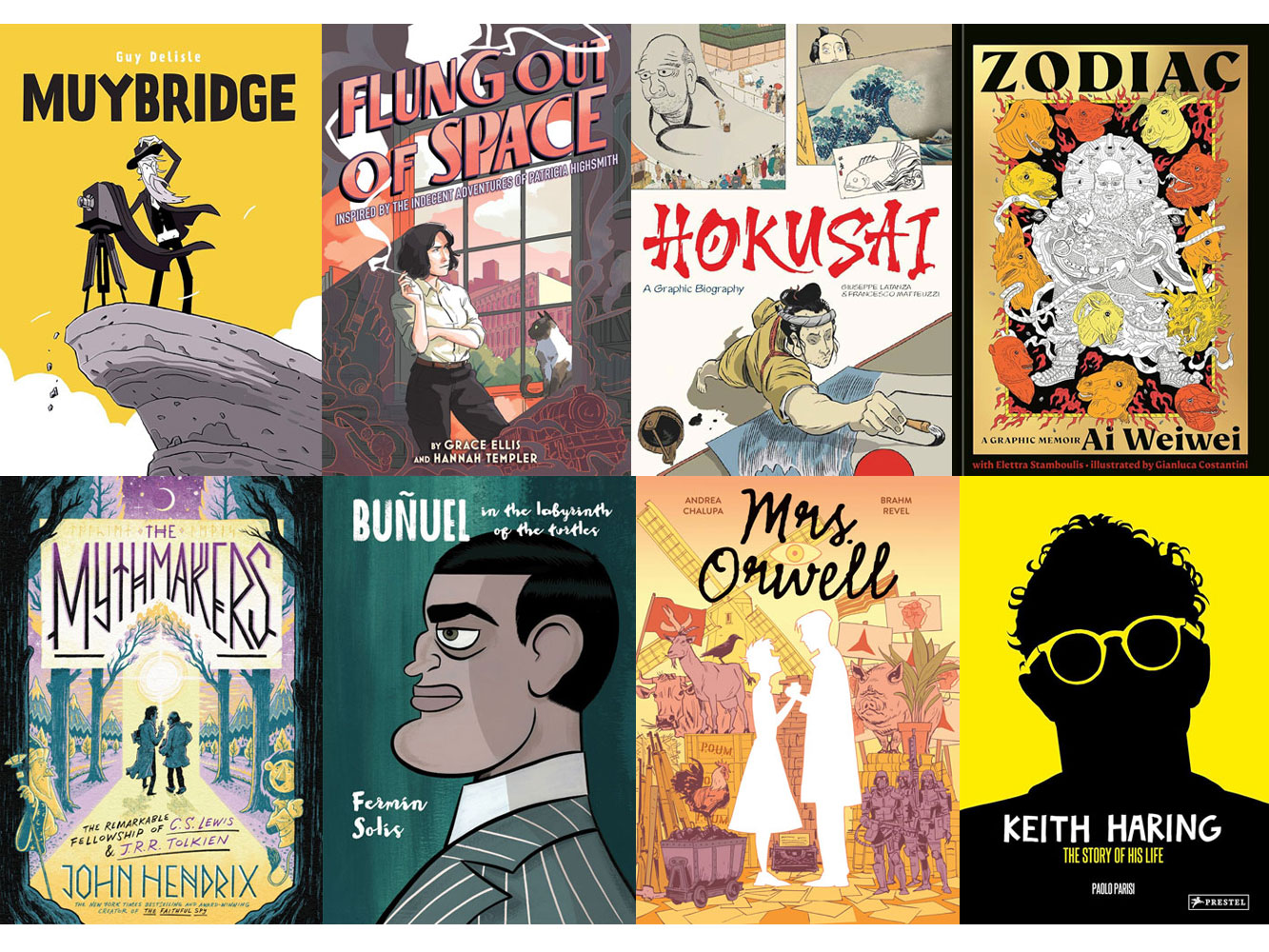
I’ve mentioned before that I have a growing box of comic biographies and memoirs, and this year I’m going to make a concerted effort to read through them. I’ve started with this stack of comics about creators: authors, filmmakers, painters, and more. Several of these books also paired up nicely with each other.
Today’s stack is extra-large because I’ve had several weeks to accumulate them! With our various New Year posts (resolutions, reflections, and favorites), I haven’t written a regular column in a while, so I’ve just been plugging away at this one in the meantime. (Several of these titles are older books that were unavailable on Bookshop.org, so in those cases I’ve included links to the publisher websites instead.) I also noticed that the list is pretty male-dominated, which is unfortunate, but these are the particular comics I have on hand that all fit into the artist/author category, so I’ll see what I’ve got for a different category for the next column.
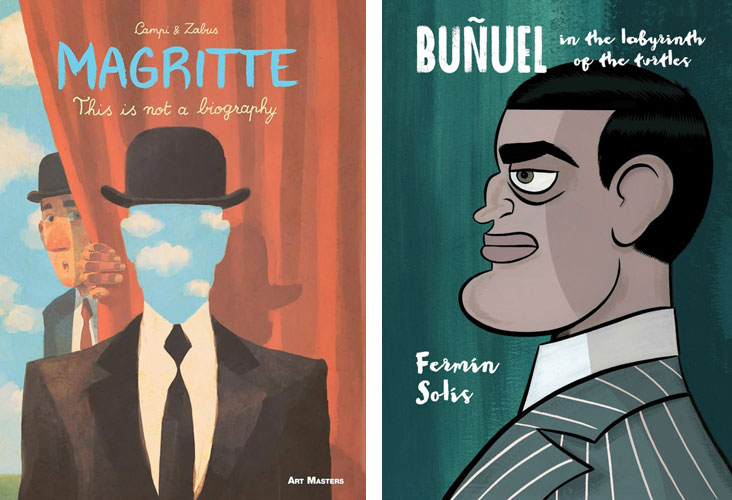
Magritte: This is not a biography written by Vincent Zabus, illustrated by Thomas Campi
Buñuel in the Labyrinth of the Turtles written and illustrated by Fermín Solís
These two books about surrealists are from SelfMadeHero; Magritte is translated from French and Buñuel is translated from Spanish.
Magritte is indeed not a biography of the surrealist painter, but a surreal fictional tale: Charles buys a bowler hat, only to find that he cannot take it off. This bowler once belonged to Magritte himself, and Charles has now entered Magritte’s bizarre, topsy-turvy world. He must delve into Magritte’s life story and his work to be freed of the hat. Throughout the story, some of Magritte’s famous paintings make their way into the frames of the comic: the train coming through the fireplace, the man with an apple hanging in front of his face, the reverse mermaid with the legs of woman and the body and head of a fish. We do get some biographical details about Magritte, but whenever the artist himself shows up in the story, he’s mostly antagonistic and does not want Charles digging into his past. It is a strange but fitting way to learn about Magritte. (Though it may be a little harder to find now, since it’s several years old.)
Buñuel in the Labyrinth of the Turtles is a little less surreal, though there are some dream sequences here and there where things get weird. This book mostly follows Luis Buñuel while he is working on his third film, Las Hurdes, a sort of documentary about the extreme poverty in the town of La Alberca. There are some references to his first two films, which he made with Salvador Dalí (but then ultimately had a falling out during the making of the second). Here, he is primarily in conversation with Ramón Acín, who funded his film: they have some conversations prior to the filming, and then the two of them are depicted on the shoot, which had all sorts of difficulties. This comic was originally published in 2008 in Spanish, and was adapted into an animated film in 2018.
Both of the books are intriguing, but not comprehensive. They seem to assume the reader already knows at least a little about their subjects, or that they’ll go look them up. I didn’t know a whole lot about Buñuel in particular outside of his connection with Dalí through the two films, so it was interesting to see a bit more of his tale in this book.

Muybridge by Guy Delisle
Whether you’ve heard the name Eadward Muybridge before, you’ve most likely seen some of his work. The most famous is probably his series of photographs showing a galloping horse, each a frozen moment in time. The photos finally settled a longstanding debate about how horses actually galloped, and whether all four legs were ever off the ground at the same time. I’d seen those photos before (and many of the others that Muybridge took, of other animals, of people performing various actions), but what I didn’t know was how much time and money was spent to capture those images on film, or why.
This book (translated from French) is both a biography of Muybridge and a history of the photograph. When Muybridge first left England for the US in 1850, daguerrotypes were all the rage, and Muybridge eventually got a job working for a portrait photographer. People were amazed at how realistic they were, even though sitting for a portrait meant holding a pose for several minutes—but Muybridge was disappointed in them, feeling that they were stiff and unnatural. Instead, he quit and took photos of Yosemite Valley, a difficult task that meant hauling heavy equipment around and developing his plates on-site in a little tent. Those photos brought him fame, and eventually he was hired by Leland Stanford, railroad baron, to photograph his estate.
It was that relationship that led to the photographs of the horse, because Stanford wanted evidence about the way a horse galloped. The project took over 6 years and the equivalent of over a million dollars, but Muybridge kept experimenting as cameras and film continued to improve. He developed a machine that also let him play back his still photos in a sequence to create motion, amazing audiences. (He even met Thomas Edison and proposed a collaboration between his images and Edison’s sound … but of course Edison just stole the idea and started working on his own movie projector.)
There’s a lot more to Muybridge’s story, too: murder, betrayal, and a long struggle for recognition and success even though he pioneered so many technological breakthroughs. I really enjoyed this book; the illustrations are cartoony, but we do get to see many of Muybridge’s actual photographs (as well as Delisle’s illustrated versions in some cases). We also get to see a lot of paintings of horses! That’s something that I hadn’t ever really thought about, but up until 1878, artists just weren’t absolutely sure what a horse in motion actually looked like, leading to all sorts of strange portrayals. Muybridge’s techniques paved the way for understanding creatures in motion, which has also been foundational to the world of animation.

Tolkien: Lighting Up the Darkness written by Willy Duraffourg, illustrated by Giancarlo Caracuzzo
The Mythmakers: The Remarkable Fellowship of C. S. Lewis and J. R. R. Tolkien by John Hendrix
Both of these books feature J. R. R. Tolkien, but while The Mythmakers centers his relationship with C. S. Lewis, Tolkien: Lighting Up the Darkness seems to omit it entirely.
Tolkien: Lighting Up The Darkness puts a lot of focus on World War I, and the effects it had on Tolkien and his community of friends, particularly those of the TCBS—the “Tea Club, Barovian Society.” There are brief flashbacks to Tolkien’s childhood, and we also spend some time with him in college, but the war overshadows everything. The book shows how writing was the way that Tolkien and his friends sought meaning and life even while facing a war that seemed hopeless and senseless.
The Mythmakers has a lot more breadth to it, in part because of its format. Most of it is a graphic novel, but there are also sections that are mostly prose with accompanying illustrations. This one is narrated by two characters, a lion and a wizard, who aren’t exactly stand-ins for Lewis and Tolkien, but are at least inspired by their characters. The two of them take the reader on a journey through some of the philosophies behind the writing: they talk about story and legend and myth, and the way that Lewis and Tolkien thought about them. It’s a more fanciful approach and includes a lot of humor, but feels appropriate for the men who wrote about hobbits and Narnia. This book also focuses on their faith: Tolkien’s faith that grew from his childhood roots, contrasted with Lewis’ longer journey from skepticism to atheism to Christianity. While there is mention of the TBCS and some of the other people who influenced the two writers, Hendrix really centers the relationship between these two men and shows how they inspired each other, but also the ways that they started to drift apart as well.
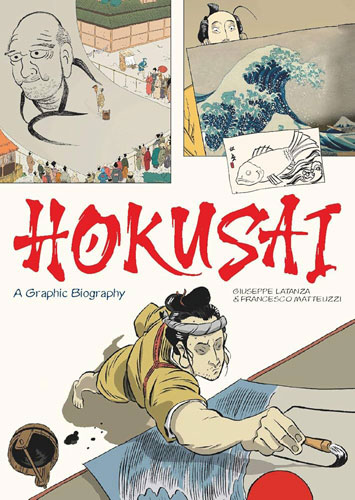
Hokusai: A Graphic Biography written by Francesco Matteuzzi, illustrated by Giuseppe Latanza
Under the Great Wave Off Kanagawa is an instantly recognizable image that has been reproduced, remixed, and parodied in countless ways. It’s the most famous of Hokusai’s prints, but it is just one of countless works made under the most famous name he went by over the course of his life. (Although it was common for Japanese artists to change their names, sometimes reflecting the master they were working under, Hokusai was exceptional, with at least 30 different names.) Aside from woodblock prints, he also made ukiyo-e prints, illustrated postcards, satirical pamphlets, erotic shunga art, manga, and instructional art manuals.
This book, translated from Italian, follows the life of this prolific Japanese artist, who was constantly pushing the boundaries. I didn’t know how structured Japanese art traditions were at the time, with competing schools, but Hokusai chafed at those restrictions and wanted nothing more than to be free—neither a pupil nor a master, but able to create whatever art he wanted. His artwork not only shaped Japanese traditions, but also had a huge influence on European art. In the afterword, Matteuzzi admits that some of the stories about Hokusai must have been exaggerated or fabricated, but it’s hard to know for sure. Like Stan Lee (more on him a few entries below!), Hokusai told a lot of stories about himself to create a particular image.

Banksy: A Graphic Novel written by Francesco Matteuzzi, illustrated by Marco Maraggi
Keith Haring: The Story of His Life by Paolo Parisi
Both of these artist biographies are from the publisher Prestel and are translated from Italian, and feature artists with strong, often countercultural messages in their art, challenging the status quo and disrupting traditions of the art world.
The Banksy book takes an oblique approach to telling the story of the well-known (yet still unidentified) street artist, with a fictional framing story. Adam is caught by the police spray-painting graffiti, and Claire—who had been trying to track down Banksy—got lumped in as an accomplice. The two of them are sentenced to community service, painting over graffiti. Over the course of their service, they have conversations about street art and Banksy in particular, which Claire uses to make videos for her channel.
The book’s pages are printed with a cream colored texture, making them look a little like an unpainted wall. Claire and Adam share a lot of stories about Banksy’s exploits and visit the sites of some of his famous pieces. Of course, since Banksy’s true identity is still unknown, some of the biographical material is unverified, but the various shows and events that Banksy organized are more factual. Although the story does incorporate some visual elements borrowed from Banksy—balloons, rats—and uses them in fanciful, somewhat surreal ways, it never actually shows any examples of Banksy’s own art, which seemed a little odd. Several of the other books in today’s stack include writing excerpts and photographs or reproductions of the subject’s work, but for some reason this book about a visual artist does not include any of the actual art.
That’s also true of the Keith Haring biography, which makes me wonder if it was the publisher’s choice. As with the Banksy book, this one never actually shows any of Haring’s drawings. The closest you get is a few illustrations where you see Haring in the act of drawing and the beginnings of his iconic figures are taking shape. Since this book does include reproductions of some non-Haring signs and posters, it’s unclear why none of Haring’s art is included.
The book draws a lot from Haring’s journals, which he kept for 12 years leading up to his death, so we get to see a lot of his story in his own words. There are occasional parts that are told by other people, but mostly Haring himself serves as the narrator. The book’s illustrations are done in vibrant magenta, yellow, and blue—not exactly the same palette Haring used, but it does evoke his bold, colorful style. Though I’ve been familiar with Haring’s artwork and knew a little bit about his life, this book did deepen my appreciation for his journey as an artist and the way he used his work as activism.
Of the two, the Keith Haring book felt a little more informative; the conversations between Adam and Claire felt a little stilted at times, squeezing in a lot of information that didn’t feel like a natural conversation. But I definitely would have appreciated the inclusion of the artwork itself.

Flung Out of Space: Inspired by the Indecent Adventures of Patricia Highsmith written by Grace Ellis, illustrated by Hannah Templer
I Am Stan: A Graphic Biography of the Legendary Stan Lee by Tom Scioli
I honestly didn’t know much about Patricia Highsmith prior to reading this book, other than remembering that she wrote The Talented Mr. Ripley (of which I’d seen the film but had never read the book). She wrote many psychological thrillers (including several more about Ripley), but this comic book biography mostly focuses on the period leading up to her second novel, The Price of Salt (later republished as Carol). Highsmith is a conflicted person: she is a lesbian who keeps trying to get “cured.” She drinks too much, makes racist comments, and is destructive both to herself and those around her. But she also wrote a book that changed the face of lesbian fiction: unlike most writing about gay characters at the time, it had a hopeful ending.
This book follows Highsmith as she’s trying to get Strangers on a Train (her first novel) published. Meanwhile, she’s writing comics to make ends meet but she hates her job and doesn’t want her name on them because she wants to be taken seriously as a writer. She’s in therapy and is dating a guy to prove that she’s getting better, but somehow keeps winding up in bed with women anyway. The book doesn’t paint Highsmith as a hero, but it also depicts the struggles of being a writer, of being gay in the 1950s, and the early days of comic books before they became the entertainment behemoth that they are now. (Stan Lee even makes an appearance briefly.)
I really enjoyed this one; Ellis does a good job capturing Highsmith as a complex, flawed person, and Templer’s illustrations are excellent and really feel like they fit the time period they’re portraying. I may put a few of Highsmith’s novels on my reading list for sometime down the road.
So what does this have to do with Stan Lee? Well, as it turns out, Stan Lee, the king of cameos, shows up in Flung Out of Space, playing himself. Highsmith gets introduced to him and they spend an evening talking about comics and writing as he tries to convince her to write for him. He also ends up hitting on her, which immediately turns her off … though apparently she does end up writing for him anyway.
That scene doesn’t turn up in I Am Stan, but it certainly wouldn’t be out of place. Tom Scioli’s biography is not an authorized biography, and as such it does not always show Lee in a favorable light. The book pulls from a host of different sources: interviews (with Lee and others), books, public appearances, and more. At times it feels more like a chronological collection of anecdotes than a cohesive story—many of the scenes last a single page, and there are some pages that almost feel like a movie montage scene. Stanley Lieber trying out a bunch of extracurricular activities at school. Stanley trying to find a job. Stan Lee meeting and talking to comic book artists, one after another.
Strung together, though, all of these little bits do add up to a compelling portrait of a man who really was legendary—even if some of those legends were ones that he made up himself. Stan Lee was full of contradictions. You see a kid who wouldn’t give up (in part because of the way his mom believed in him), who loved reading stories and telling stories, who helped turn Marvel Comics into the behemoth it is now. But you also see somebody who was forever under the thumb of his cousin Martin, who ran the magazine company. He belittled his artists and praised them; he took credit for everything himself but was good at passing the buck. He was an innovator, and he was forever chasing trends.
One of the things that still seems remarkable to me—though this isn’t the first time I’ve read about it—was his “Marvel method” of creating comics. Lee would provide the artist with a brief outline or idea of a story (sometimes based on a character design the artist had invented), and then the artist would just illustrate the whole thing without a script. Lee would then come back later and create the dialogue after the fact. Compared to the way most comics are made now, it feels absurd that this would ever have worked, but those stories and characters resonated with readers.
Toward the end of his life, Lee was beloved for his appearances in Marvel movies and was always a hit at conventions, even as controversy swirled around his claims about creating popular characters. He signed away the rights to his image, and then tried to sue to get them back. There were lawsuits about elder abuse involving his business manager, and even as Stan Lee had become a profitable brand, Lee himself was in decline and it seems like he wasn’t always clear on what was happening.
Both Highsmith and Lee were larger-than-life storytellers, and these books give us a glimpse of their complicated, often contradictory personalities.

Fire!! The Zora Neale Hurston Story by Peter Bagge
Zora Neale Hurston is another author that I knew very little about, and I hadn’t read anything by her—another oversight that I hope to correct. This book, a little like I Am Stan, is a whole lot of short vignettes, usually just a page or two, showing scenes from Hurston’s life in chronological order. Unlike I Am Stan, though, there’s a lot more text packed into every page. The individual frames of the comic are fairly small, and Bagge packs in the speech bubbles in every frame. Not only that, but there are nearly 30 pages of endnotes at the back, providing a little background and fun details about many of the scenes. The endnotes also include a lot of photographs of Hurston and many of the other people and publications referenced in the comic.
What I found was an absorbing story about a spirited, fiercely independent, and often controversial Black woman who never seemed to settle down for long. She grew up in an all-Black community in Florida and loved the culture there, but had trouble portraying it without being criticized as pandering or perpetrating stereotypes. She had many romantic relationships, but had no interest in becoming dependent on a man (or trapped at home), and would rather be poor if it meant she was independent. Her writing found success, but even so financial security was always fleeting—she once got a job as a housemaid even after she was a well-known writer to make ends meet.
Bagge’s illustrations are very cartoony; he depicts everyone in his usual style, with somewhat oversized heads and exaggerated features, spaghetti-noodle limbs curving around. But even though the images are a bit caricatured, you can tell that he takes his subject seriously. This book is very well-researched, and Bagge tries to give us a comprehensive picture of this multi-faceted author. I recommend checking it out!

Orwell written by Pierre Christin, illustrated by Sébastien Verdier
Mrs. Orwell written by Andrea Chalupa, illustrated by Brahm Revel
Everyone knows who George Orwell is, right? The guy who gave us Animal Farm and 1984, the reason that “Orwellian” was coined to signify totalitarian dystopias. But, I have to admit, I didn’t actually know a whole lot about Orwell himself—not even some of the most basic things, like the fact that George Orwell was a pseudonym and his real name was Eric Blair.
Orwell is a sweeping look at his entire life; the portion about his childhood is fairly brief but provides some background about his home life and unpleasant boarding schooling years. He also spent time in Burma as an imperial police, and both his journey there and his experiences (which included shooting a rampaging elephant) informed his opinions on imperialism and inspired his first novel, Burmese Days. Much of the book is like this, alternating between Orwell’s life experiences and his writing, showing what shaped his views of the world. Like Tolkien, Orwell also fought as a soldier—he was badly injured in the Spanish Civil War, which kept him out of the field for World War II. The book itself is illustrated mostly in black and white realistic style, but there are occasional sections contributed by other artists that are in color and in different styles.
Mrs. Orwell is about Eileen O’Shaughnessy Blair, Orwell’s first wife, and in particular her relationship with Orwell. Although she does make an appearance in Orwell, her significance in Orwell’s life is severely underrepresented. This book shows Eileen as somebody who was smart, passionate, and resourceful: when she and her fellow typists weren’t happy with their employer, she poached them and started her own office. The book is a love story, showing Eileen and Eric meeting for the first time and his attempts to court her (she didn’t accept his first proposal). Their relationship was built not just on affection and attraction but also a shared sense of justice: shortly after their marriage, Orwell went to fight fascists in Spain, and Eileen followed and found work as a typist so she could stay in closer contact.
But the book is also about the huge influence Eileen had on Orwell: not only did she type and edit much of his work—putting much of her own work on hold—she also inspired him and pushed him. Without her, Animal Farm would have been an essay rather than a fable, and probably wouldn’t have had the lasting influence it has now. Even more: without her, Orwell may have been captured in Barcelona and we might not have had Animal Farm or 1984 at all.
It was definitely interesting to read these two books back-to-back. Orwell provided a broader overview of his life, but Mrs. Orwell filled in a crucial missing piece. As Chalupa says in the afterword, many of Orwell scholars were men and simply overlooked Eileen’s contributions, an oversight that I’m glad this book addresses.

Zodiac: A Graphic Memoir by Ai Weiwei with Elettra Stamboulis, illustrated by Gianluca Constantini
Ai Weiwei is an activist and dissident who has used various media to criticize China’s government. This memoir depicts Ai having conversations—often with his young son—about a range of topics: his own family background, Chinese folklore, thoughts about art, and more. The book is organized into 12 chapters, one for each animal of the zodiac; within each chapter Ai references some of the traits that the animal represents, and many of them also include a bit of the traditional story about the creation of the zodiac, the great race between the animals that resulted in the ordering of the animals.
I particularly liked the back-and-forth between father and son, because his son is curious and asks questions, and Ai has a thoughtful way of talking through his experiences, and it feels like he is processing them even as he relates them. While I had known that Ai had been arrested by the Chinese government, I didn’t know about his background: his father, Ai Qing, was a poet and had been exiled, so Ai grew up in a labour camp and in exile until he was a teenager, an experience that informed his own understanding of China.
There was a time when I would have said that human rights violations and issues with democracy were primarily something that happened in other countries, that the US served as a refuge for people like Ai who were fleeing persecution and retribution for sharing their views. But now it is becoming more and more evident that we have our own problems right here at home; Ai is an example of somebody who has been able to use his art as a way to speak up and engage people about injustice, and I appreciated this glimpse into his life.
Disclosure: I received review copies of these books. Affiliate links to Bookshop.org help support my writing and independent bookstores. When unavailable, I have included links to the publisher websites instead.