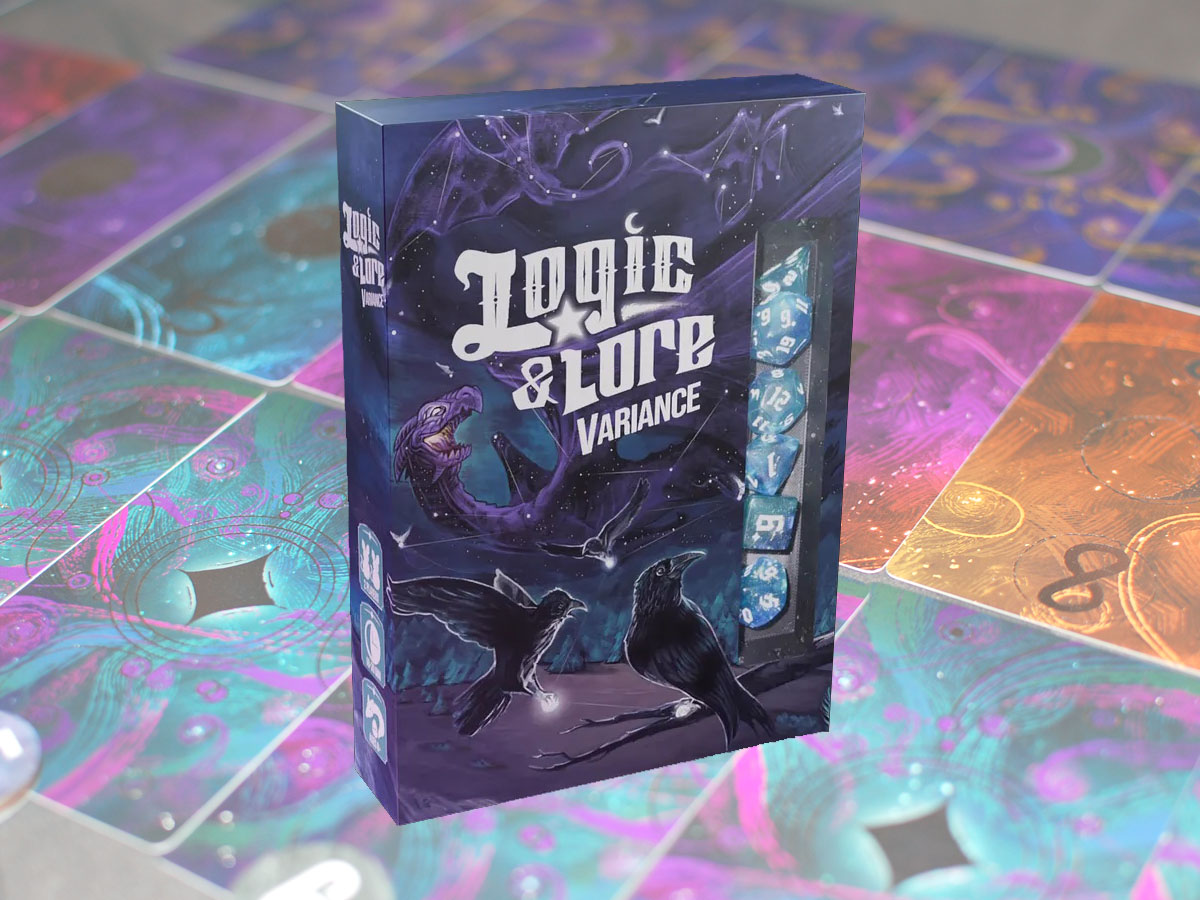
Throw a dash of unpredictability into this 2-player deduction game.
What Is Logic & Lore: Variance?
Logic & Lore: Variance is an expansion to Logic & Lore, a deduction game for 2 players, ages 8 and up, with a play time of about 20 minutes. It’s currently seeking funding on Kickstarter, with a pledge level of $19 for a copy of the expansion; additional pledge tiers are available for the base game only or the base game with expansion. This campaign also includes the 2nd Edition of Logic & Lore (with a slightly bigger box and a revised rulebook). The base game is required to play Variance.
Logic & Lore: Variance was designed by Carla Kopp and is published by Weird Giraffe Games, with illustrations by Jason Hager.
New to Kickstarter? Check out our crowdfunding primer.

Logic & Lore: Variance Components
Note: My review is based on a prototype copy, so it is subject to change and may not reflect final component quality. For instance, the cards may end up being tarot-sized cards instead of the 4×6 cards pictured here, and the notepad will be resized so that it actually fits properly in the box.
Here’s what comes in the box:
- 2 Turn Reference cards
- 2 Question Reference cards
- Dice card
- 6 Dice (d4, d6, d8, d10, d12, d20)
- 22 tokens (2 copies each, A through K)
- Notepad
The dice set will be a little different from the ones pictured—notably, the “4” on these dice has a strange font that looks like a “9” so the publisher has decided to change those out, but I imagine otherwise they will probably look pretty similar.

The tokens are fairly simple round tokens, labeled A through J, that let you mark your cards, and they go along with the notepad so that you can easily make notes about particular cards, and have the tokens move along with them.
The reference cards are double-sided, with a “Star Flight” side and a “Star Sprite” side, the two variations of the game.
How to Play Logic & Lore: Variance
You can download a copy of the rulebook here. The expansion plays similarly to the base game, which you can read more about in my original review. There are two new ways to play in the expansion: Star Flight and Star Sprite. I’ll explain Star Flight first.
The Goal
The goal of the game is to be the first to arrange all of your cards in sequential order.

Star Flight Setup
Lay out the alignment cards in the center in order. Each player takes their own set of 9 cards, shuffles them, and then lays them out face-down next to the alignment cards without looking at them. Each player gets a set of the letter tokens and a sheet from the notepad, as well as a set of reference cards. Give each player 4 dragon tokens and 2 mouse tokens (from the base game).
Place the dice card nearby; roll all the dice and place them on their matching spaces. Place your mouse token on its matching icon. Place the remaining 3 dragons per player near the dice card.

Gameplay
Each turn, you get the following actions in order:
- Move the Heavens (optional)
- Align the Stars (optional)
- Scurry
- Choose Focus
- Search the Sky
- Move the Heavens (optional)
Move the Heavens: Rearrange any number of your cards as you like, without looking at the faces—just be sure to use the various tokens to keep track of things!
Align the Stars: End the game by declaring that you think all of your cards are in order—you reveal them all, and if they’re all correct, then you win! Otherwise, you lose. (Of course, you’ll be skipping this step most of the game.)

Scurry: Move your mouse 1 space clockwise, stopping at the next available die and skipping over the space that your opponent’s mouse occupies. You may spend dragon tokens to move further. Re-roll each die that you leave behind (including your starting space). If you pass your mouse icon, gain 2 dragons from the supply. The die that you stop at will be X, your rolled value, for this turn.
Choose Focus: Select two of your cards, holding them up so the other player can see them. (I found that it may make sense to let your opponent hold the cards so your hands are free to take notes.)

Search the Sky: Ask your opponents questions from the list. You must ask questions in order from top to bottom, but you may skip questions you don’t want to ask, and you stop as soon as you get a “yes” answer to a question (or when you reach the last question). The questions are:
- Are either of these aligned (in the correct positions)?
- Is either card lower than X?
- Is the sum of the cards higher than X?
- (Choose one card) Is this card within X spaces of where it belongs?
- Is one of these cards X?
- Which card is greater?
Game End
The game ends when a player chooses to Align the Stars. Their cards are revealed, and if they are in the correct order, they win. If not, then their opponent wins.

Star Sprite Rules
For Star Sprite, you use the other side of the reference cards and the dice cards. You don’t use the mouse tokens—instead, each turn you may choose any available die from the card, and then you return the die that you had previously (so after the game begins there will always be two dice that are currently held by players and are unavailable). You roll the die on your turn to determine X for your questions.
The game flow is the same, but the Search the Sky questions are a little different.
At the end of your turn, you gain a dragon token for the die that you used and place it on your reference card, unless there’s already a token there. Dragon tokens may be spent to manipulate the die during the Search the Sky phase: spend 2 tokens to subtract 10 from the die, and spend 6 tokens to set the die to any value.
Other Variants
The Logic & Lore base game included two variations, Star Light and Star Bright, so the expansion makes four variations total. Each player can actually play a different variation, and there are some instructions included for how to manage multiple modes at once.
Why You Should Play Logic & Lore: Variance
As I mentioned in my original review of Logic & Lore, I enjoy this light deduction puzzle and figuring out which questions will give me the most information with “no” answers so that I can continue asking more questions. The other player can’t affect your cards in any way, so it’s a race to solve your own puzzle before they solve theirs—and if you think somebody is getting close, then it may be worth taking a chance on a guess. (Although the game technically ends even if you guess incorrectly, I usually still have the other player see how close they got—after all, they’ve done all this work!)
The two new variations in Variance introduce exactly that: some random variance. Many of the questions you ask will depend on the value of the die that you choose, and some numbers are more useful than others for certain questions. For instance, asking if a card is within 7 spaces of its correct position is not really helpful, but knowing if two cards add up to less than 7 could give you a bit more information. And, of course, those different dice have very different ranges. Typically, I felt like the d12 and d20 had a bit too much variance—rolling a high number made those dice virtually useless, whereas the d4 and d6 were often pretty helpful no matter what you rolled.
I’m a little torn: while I liked the bit of unpredictability the dice added, I wasn’t sure that the game really needed all of the dice. The extra rules—moving the mouse around to select dice, spending dragons to skip dice or manipulate dice—seemed to be largely in service of mitigating those less-helpful values on the larger dice. If the game only included a d4 or a d6, then you’d get a bit of randomness for the questions but without the added rules overhead. On the other hand, an expansion that only adds a single die and a few cards is probably a harder sell than a set of sparkly polyhedral dice.
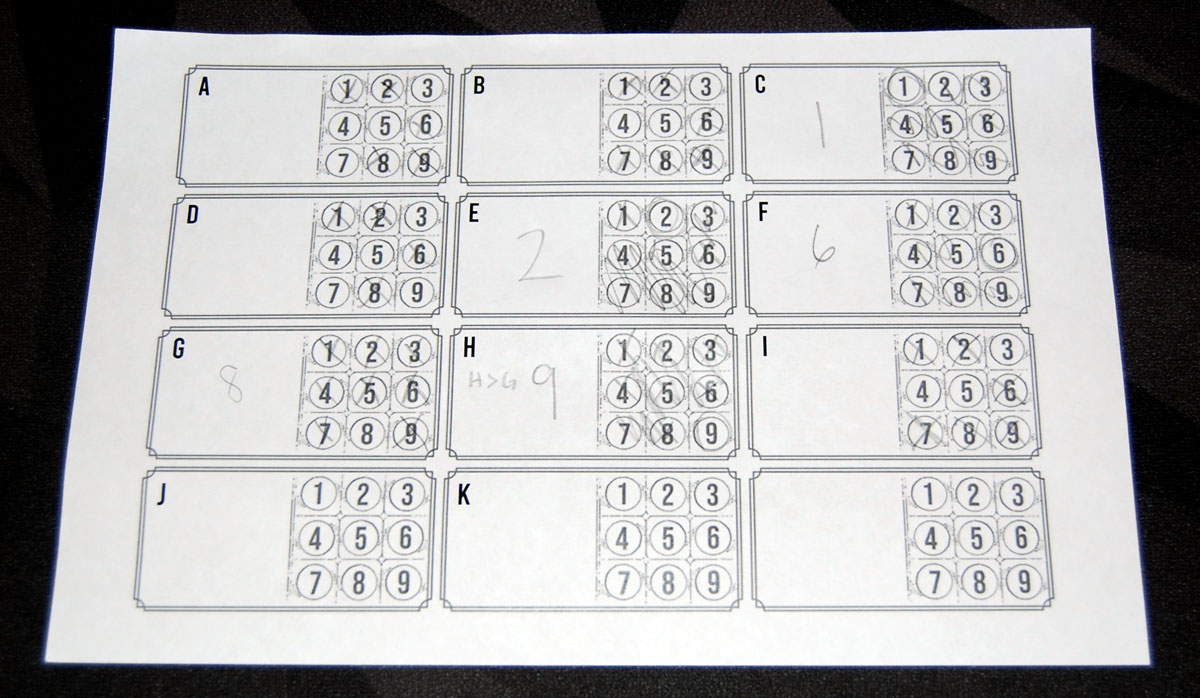
What I do really like about the expansion is the letter tokens and notepad. They don’t actually change any rules, but they are a much better way of keeping notes on what you’ve learned, and are easier to use than the symbolic tokens from the base game. You can eliminate specific values for each individual card, and also write down some notes like D>G or C+E<6 in a way that’s easier to refer to later once you’ve moved your cards around.
The one potential downside is that the notes can make it more obvious how close another player is to solving their puzzle. Before, you could see how many cards had already been turned face-up (as a result of the first question about alignment), but you didn’t always have a good lock on what else your opponent knew for sure. With the notes, it’s a little easier to tell which cards they have identified, even if they don’t end up turning them face-up for alignment. Of course, if that sort of thing bothers you, it’s quite easy to allow for player screens of some sort to hide those.
I still recommend Logic & Lore for players looking for a light, visually attractive deduction game, so if you missed the first print run, now you’ve got another chance to pick up a copy. Variance is for players who want to throw a bit more chaos into the mix, but it may also be worth it simply for the better note-taking features.
For more information or to make a pledge, visit the Logic & Lore: Variance Kickstarter page!
Click here to see all our tabletop game reviews.
 To subscribe to GeekDad’s tabletop gaming coverage, please copy this link and add it to your RSS reader.
Disclosure: GeekDad received a prototype of this game for review purposes.