Develop mastery and unlock the power of the Infinity Engine.
In “Reaping the Rewards,” I take a look at the finished product from a crowdfunding campaign. Shards of Infinity: Saga Collection was originally funded on Kickstarter in the summer of 2023, and was delivered to backers at the beginning of 2025.
What Is Shards of Infinity: Saga Collection?
Shards of Infinity: Saga Collection is a deck-building game for 1 to 6 players, ages 13 and up, and takes about 30–45 minutes to play. It retails for $60 and is available directly from Stoneblade Entertainment. Shards of Infinity was initially published in 2018 and was followed by several expansions; the Saga Collection is an all-in-one box set that incorporates the existing expansions, with some tweaks and rebalancing.
Shards of Infinity: Saga Collection was designed by Gary Arant and Justin Gary and published by Stoneblade Entertainment, with illustrations by Aaron Nakahara and Yoshiharu Nakahara.
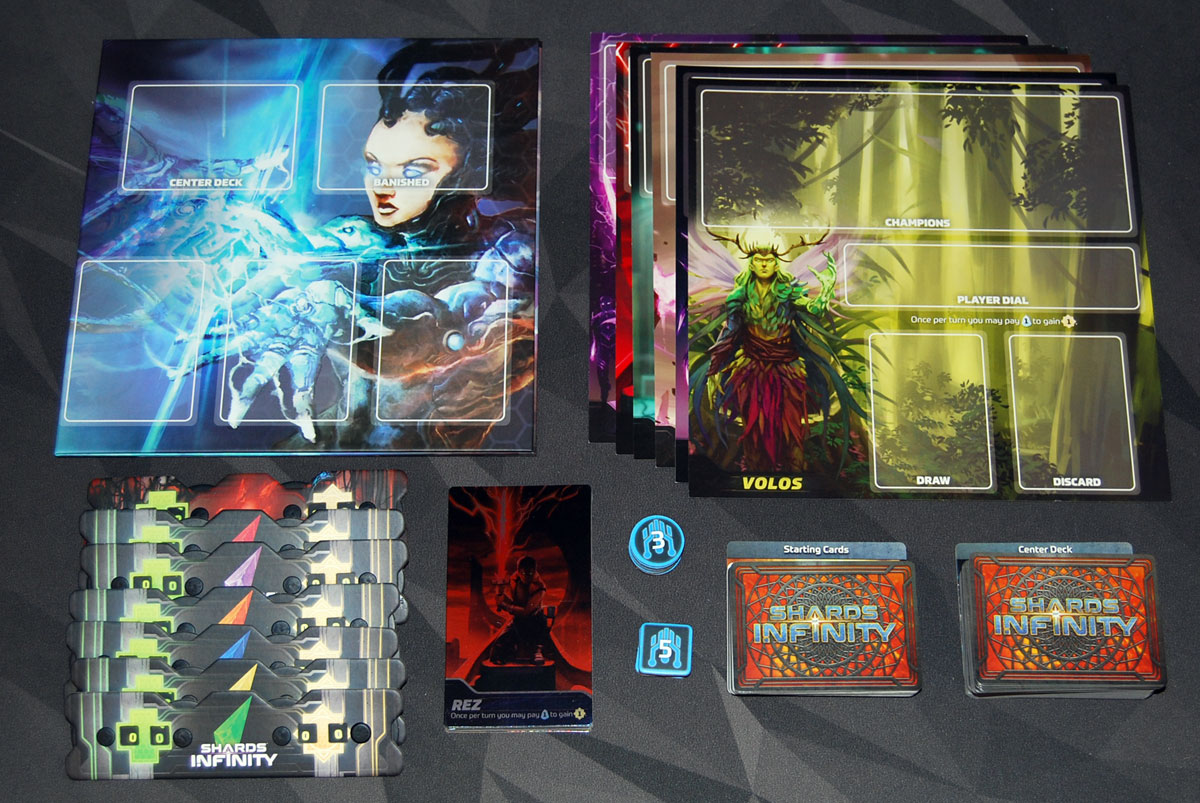
Shards of Infinity: Saga Collection Components
Here’s what comes in the box:
- Game Board
- 6 Player mats (Kickstarter edition)
- 6 Player cards
- 160 Center Deck cards
- 60 Starting Deck cards (15 per player)
- 30 Destiny cards
- 12 Relic cards
- 86 Boss Battle Campaign cards
- 6 Hero cards
- 7 Boss cards
- 6 Health/Mastery dials
- Boss Health/Mastery dial
- 12 Hack tokens
- Shadow of Salvation Campaign book
- Saga Achievement Tracker (with stickers)
The Kickstarter edition included 22 promo cards; some of these are the foil versions of the hero and boss cards. What I’ll cover in the review is primarily what is available in the retail edition of the game. (The Kickstarter edition also has the text “Kickstarter Edition” printed in foil on the cover and across the center board, though honestly I could do without that.)

Unlike most of the games I review for GeekDad, this one was not sent to me by the publisher—I backed it on Kickstarter myself, and did not actually get photos of everything before I started playing through the campaign, which means that I can’t show you how everything was organized when it first arrived. The cards are divvied up into five “chapters” that you can play through that gradually add what was originally new content from the various expansions. Although you could just open up everything right away (particularly if you were already familiar with the expansions), the saga campaign is a way to play through the various chapters and give players a chance to digest the new rules before adding more. The Saga Tracker includes various achievement-type tasks to complete before opening the next pack of cards.

The Battle Book is a smaller, separate book that is used for the cooperative campaign, which is unlocked along with Chapter 3. This was originally included in the Shadow of Salvation expansion.

The main game board is a double-sided tri-fold board, with spaces for the center deck, a banished area, and the six center row cards. One side of the board has an additional panel for the cooperative campaign mode, and the other has a panel for the Ingeminex, which are unlocked in Chapter 4. I do like the fact that I can fold over the Ingeminex panel to make the board a little smaller for the first three chapters, when the extra panels are unnecessary. (The original game did not include a board at all—really you just need room for the deck, a banished cards pile, and the six center row cards.)
The player mats are just cardstock—again, not entirely necessary, but they help you organize your deck and discard pile, as well as providing a limited amount of space for your champions. They do have character stories on the back. The retail edition just uses the hero cards to track who is who instead of these mats.

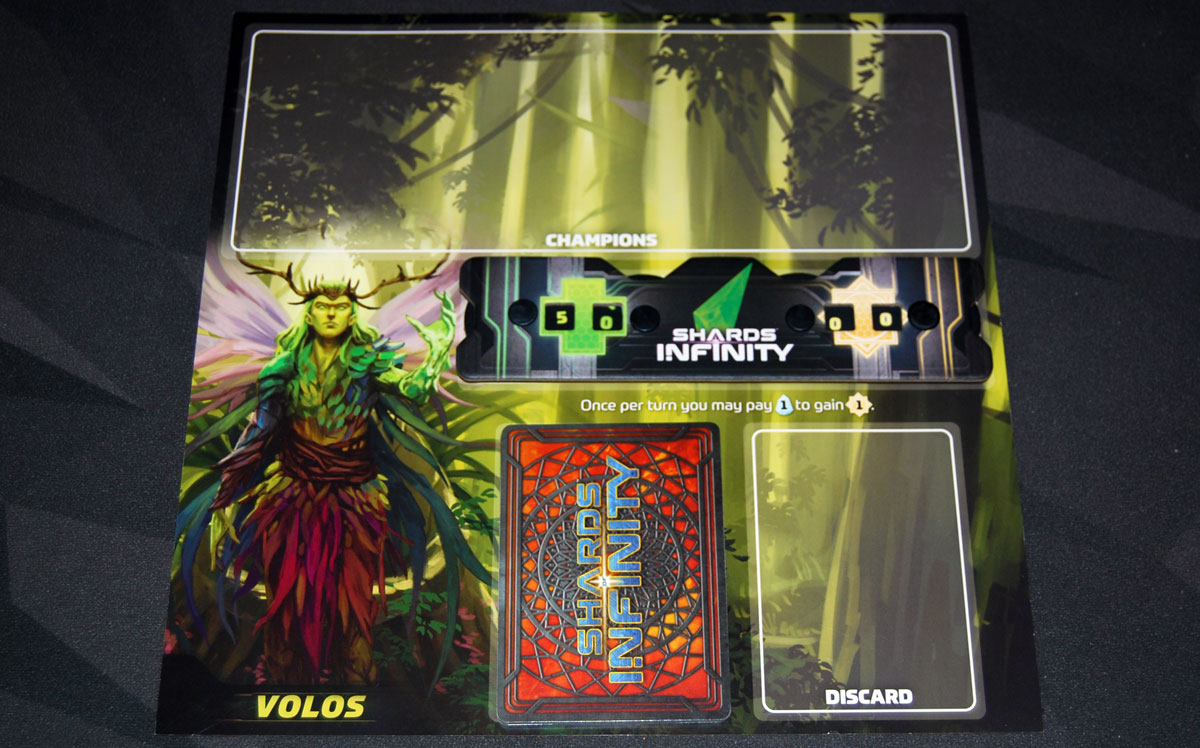
The health/mastery dials are wide and rectangular, with two digits for each. These are a big improvement from the original game, which had a single dial for each number, going up to 50 for health and 30 for mastery, making for a very large tracker for each player. Although the trackers are basically identical, they do have a different shard colors to match the player colors. (The boss’s health dial goes up to 90 instead.)
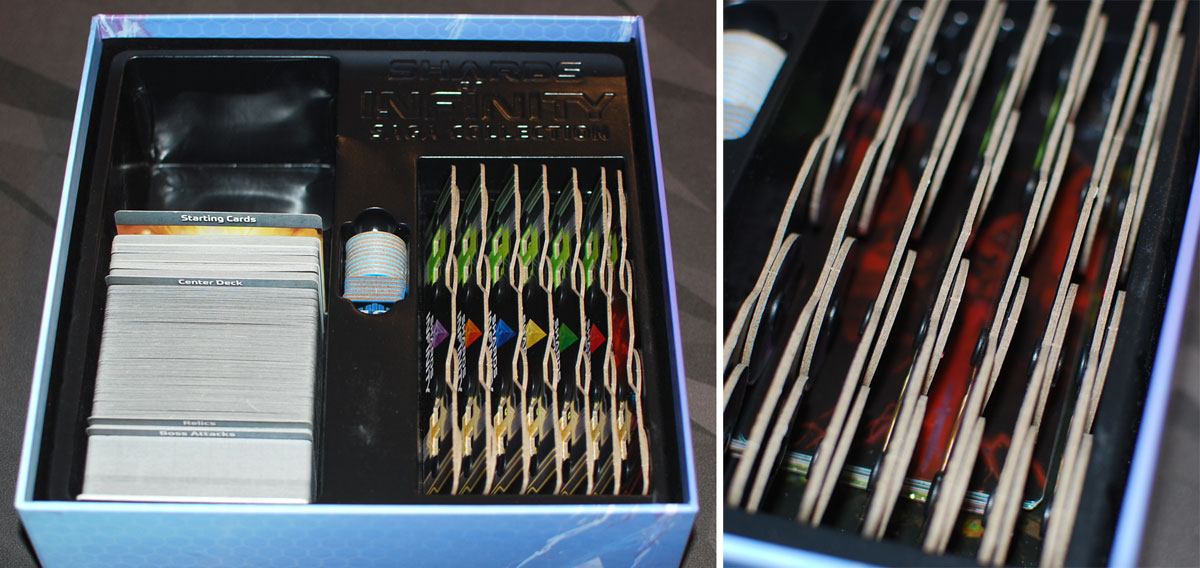
One of the primary reasons I backed this was that the original games and expansions came in smaller boxes and there was no really good way to combine them into one box, particularly with the really large player trackers. I liked the idea of having a one-box solution, though unfortunately there wasn’t a way to get just the box and storage and use my own existing cards. The box insert works pretty well, but the one thing I find odd is that the large foil cards are underneath all of the health trackers, and unless I’m playing a 6-player cooperative game I wouldn’t typically need to remove all of them—but, as I said before, those large cards are also mostly decorative and I usually don’t even use them. (I don’t know how everything is stored in the retail edition, where you’ll use the large hero cards instead of the mats.)
How to Play Shards of Infinity: Saga Collection
You can download a copy of the rulebook here. There are a few different play modes in the game, including solo and cooperative modes, but I’ll explain the basic gameplay (Chapter 1) first.
The Goal
The goal of the game is to eliminate all the other players.

Setup
Place the gameboard in the center of the playing area. Shuffle the center deck cards and place them on the space provided, and then reveal the top six cards to form the market.

Give each player a starting deck of cards, a hero card (or mat), and a health tracker set to 50 health. The first player starts with 0 mastery, the second player has 1 mastery, and so on. Shuffle your own deck and draw 5 cards.
Gameplay
On your turn, you may take actions in any order: play cards, acquire cards, use your focus ability, attack.
Most of the cards you play are “Ally” cards—you place the card in an area called the play zone and do its effect. Most cards will generate gems (currency for acquiring new cards) or power (for attacking), but there are a host of other effects as well.
Unify effects will give you bonus effects if you have other cards of the same faction, and Dominion effects have bonuses if you play a card from each faction.

Champions are cards that will stay in play, and they can be exhausted once on each of your turns for their abilities. Champions also have health, and will stay in play until another player attacks them or uses an effect to destroy them, at which point they go into your discard pile.

Some cards have mastery threshold bonuses: if you have reached a mastery level shown on the card, then the card has a stronger effect. Of particular note is the Infinity Shard, one of your starting cards: if you have 30 mastery, it gives you infinite power, which means you automatically win by defeating everyone else.

To acquire a card, you pay the gem cost (shown in the top right corner) and place it into your discard pile. Mercenary cards—outlined in red—can be fast-played: pay the cost and use the card’s effect immediately as if you played it from your hand. At the end of your turn, fast-played cards will be banished from the game. The card market is refilled each time a card is acquired or fast-played.
Each turn, you may “focus” once—spend 1 gem to gain 1 mastery.
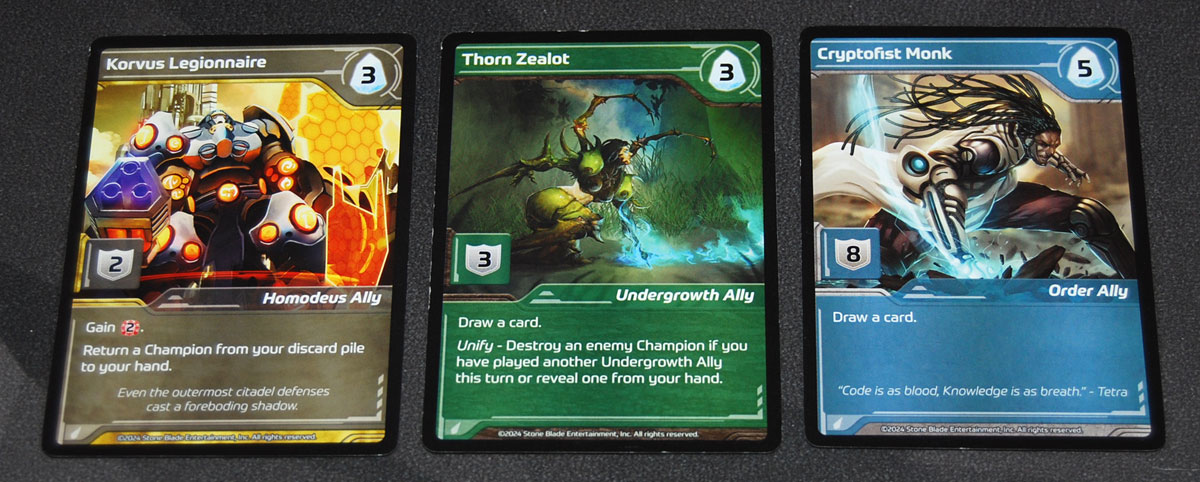
You may use attack power to attack other players or their champions. To attack a champion, you must use enough power to match its total health, because damage does not carry over from turn to turn. You may attack players at the end of your turn, using whatever power you have remaining, and you may split up the damage among players however you chose. Some cards have shield icons on them—if a player is attacked and they have shields in their hand, they may reveal them to reduce damage by that amount. (Shields cannot be used to protect champions.)
At the end of your turn, discard all the cards in your play zone, as well as any left in your hand that you chose not to play. Unspent gems and power are lost. Draw a new hand of five cards.
Game End
If you are reduced to 0 health, you are eliminated from the game. The game ends when there is only one player left, who wins!
Continuing the Campaign
As you play Shards of Infinity, you can mark achievements on the saga tracker as you play. While it’s not required (and you can certainly just add all the expansion content in immediately), the tasks are a way to make sure that you’re familiar enough with the rules of the game before you add some more rules. For instance, to unlock Chapter 2, you just need to complete 4 of the 8 possible tasks, ranging from “Win a game with 30 mastery” to “Have 3 or more champions in play at one time.”
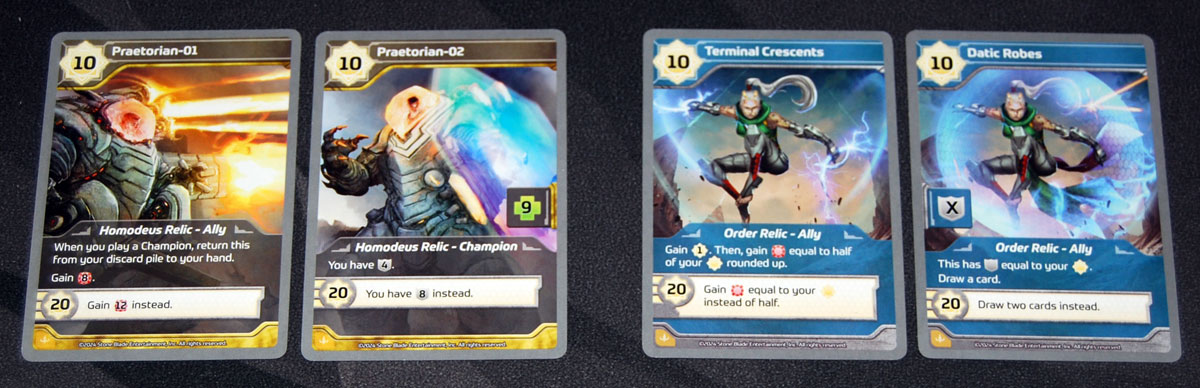
Chapter 2: Visions of the Future adds the relic cards. Each of the characters has two relic cards; when you reach 10 mastery, you choose one of them to add to your deck, and the other card is banished. They provide two different approaches to playing that character and are what introduces the asymmetric player powers to the game.
Later chapters unlock the warping ability—fast-playing non-Mercenary cards—and the Shadow of Salvation cooperative campaign. You’ll also meet the Ingeminex, enemies that will appear in the center deck and attack all the players. Finally, the last chapter is the Destiny expansion, where characters will gain destiny cards that give unique abilities—if you win, then you lock that destiny card to your character, with the ultimate goal of claiming 3 destiny cards.

Shards of Infinity: Saga Collection is GeekDad Approved!
Why You Should Play Shards of Infinity: Saga Collection
As I mentioned in the components section, I bought Shards of Infinity myself through the Kickstarter campaign. What I didn’t say earlier is that this is a game I like so much that I’ve bought it twice. Back when it was first released, I didn’t have the opportunity to review it, but I was curious about it and picked up a copy at my local game store. Over the years, I ended up buying all of the expansions for it, but I was never entirely satisfied with needing several small boxes for everything. (The original health/mastery trackers were so large that I ended up having one box with cards, and one with just the trackers, and then a third for some of the expansion content that didn’t fit in the first two.)
So when Stoneblade announced that they were making an all-in-one box set, I was thrilled. Of course, I would have preferred an option to get just a box to put all my existing games into, but a combination of factors made it logistically impossible—card tweaks, a 6th player, and some improved components. I sold off my old set and have been enjoying the new version, working my way through the saga.
Shards of Infinity owes a lot to Ascension, which was first published in 2010 and has spawned several expansions, as well as a spin-off tactics game. Ascension was, after Dominion and Thunderstone, one of the earliest deck-building games, and I think the first to use a center deck rather than the market stacks. Ascension essentially featured two currencies—runes and power—which were used to recruit cards and attack enemies, but the fact that all of the cards were mixed together in the center deck could lead to disappointing turns. If you had a lot of runes but the center row was filled with monsters, you felt cheated. Likewise, if you had a lot of power but there were no monsters in the center row, you had to make do with fighting the ever-present cultist (who wasn’t worth much).
Shards of Infinity still has those two currencies, but now the enemies you fight aren’t in the center deck—they’re other players, and their champions. If you have a lot of attack power, there’s always something to hit. Of course, it’s still possible that you have a lot of gems and there are only cheaper cards in the market, but it’s less likely that you can’t spend anything at all. That’s just one of the ways that Shards of Infinity takes the lessons learned from nearly a decade of Ascension and makes some tweaks that I think really improve the experience.
The faction colors in Shards of Infinity will also be somewhat familiar to fans of Ascension. Each one has its own sorts of strengths: Undergrowth (green) tends to focus on healing, Homodeus (yellow) relies on a lot of champions, Wraethe (purple) does a lot of damage and lets you banish cards. Even though your character represents one of the factions, you can still recruit whatever you want, but the unify effects mean that there are benefits to specializing. Meanwhile, the dominion effects pull you in the other direction: what are the odds that you can get at least card of each faction?
The mercenaries are a mechanic that felt new to Shards of Infinity. In most deck-building games, you put new cards into your discard pile, and you’ll have to wait until you get all the way through the rest of your deck before you get to shuffle them in—and then maybe they’re at the bottom of the deck. If you see an effect that you really want right away, mercenaries give you that ability. The downside, though, is that you only get the effect once, because you don’t get to keep the card. Still, sometimes that’s worth it, getting a powerful effect without diluting your deck.
I like all the various modes of play included in Shards of Infinity: the cooperative mode, which uses the battle book, is its own mini-campaign where you’ll play multiple rounds, choosing a boss to fight each time. The destiny mode is also its own campaign, ideally played with the same group of players as you compete to lock in your destinies.
If you like deck-building games, I highly recommend Shards of Infinity, whether you go for the original base game or the all-in-one Saga Collection. If I’d reviewed the original back in 2018, I definitely would have given it our GeekDad Approved seal then, so consider this a long-overdue award!
For more info, visit the Stoneblade Entertainment website.
Click here to see all our tabletop game reviews.
 To subscribe to GeekDad’s tabletop gaming coverage, please copy this link and add it to your RSS reader.