Forage for berries, mushrooms, and plants in this clever roll-and-write game.
What Is Forage?
Forage is a roll-and-write game for 1 to 6 players, ages 10 and up, and takes about 15–30 minutes to play. It’s currently seeking funding on Kickstarter, with a pledge level of $19 for a copy of the game. Other pledge tiers include a $10 print-and-play version, or $35 for both Forage and Honeypot (see my other review for more!). The game has a family-friendly theme that’s suitable for kids, but it does have some complexity that can make it challenging; less experienced players and younger kids may need a little more assistance with it!
Forage was designed by Molly Johnson, Robert Melvin, and Shawn Stankewich and published by Flatout Games with AEG, with illustrations by Beth Sobel and graphic design by Dylan Mangini.
New to Kickstarter? Check out our crowdfunding primer.

Forage Components
Note: My review is based on a prototype copy, so it is subject to change and may not reflect final component quality. However, as with most of Flatout Games prototypes, it is pretty close to what the final version will look like.
Here’s what comes in the box:
- 96 Foraging cards (Pantry, Gift-giving, and Exploration)
- 18 Starting Foraging cards (Pantry, Gift-giving, and Exploration)
- 8 Foraging dice (7 regular, 1 special)
- 24 Journey tiles (6 starting 12 regular, 6 final)
- 6 Goal cards
- 6 Time Tracker cards
- 6 Scoring cards
- Foraging Basket card
- 6 Dry-erase markers
All of the cards in Forage have a glossy surface so they can be written on with the dry-erase markers. The foraging and goal cards are regular-sized cards, and the time tracker, scoring, and foraging basket are oversized cards.

There are three types of foraging cards: pantry, gift-giving, and exploration. Pantry cards show a grid of 16 jars, grouped in rows by color, with various rewards shown for completing rows and columns. Gift-giving cards have a number of boxes that require a specific number of certain symbols to complete. Exploration cards show a map with various symbols at each intersection, and rewards in the spaces enclosed by the paths. The starting cards have the same features but are typically a little easier to complete, and are distinguished by a darker card back and a little dot by the hourglass in the bottom corner.
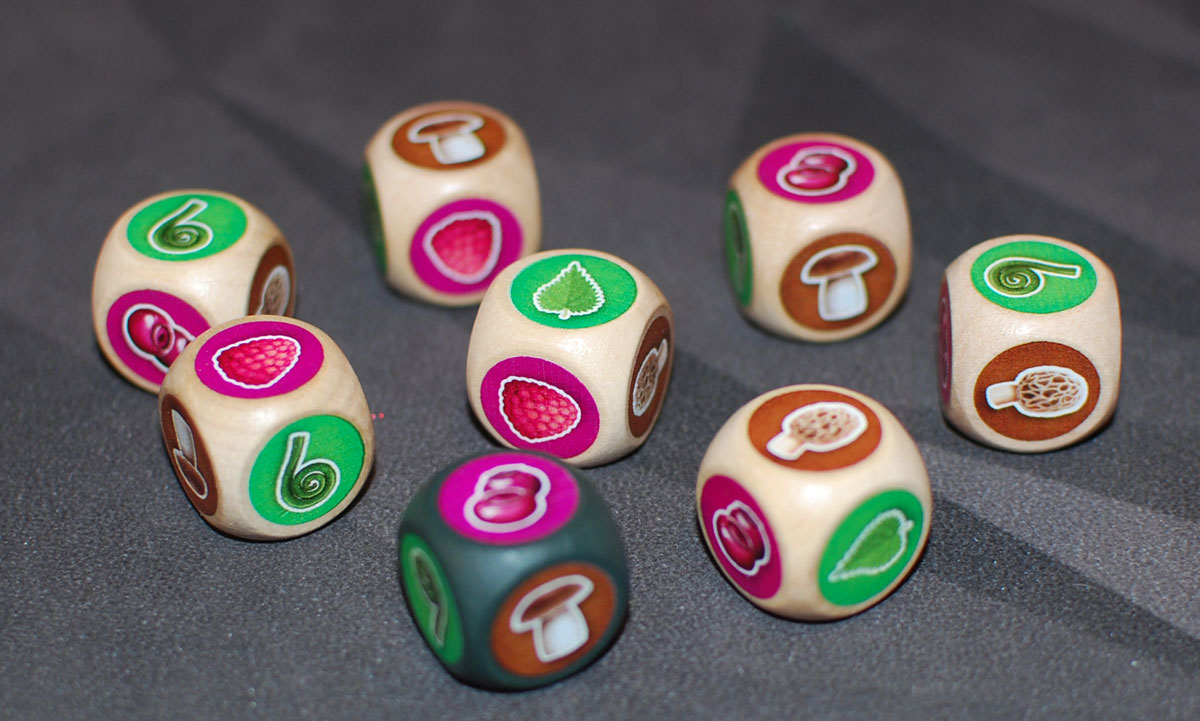
The foraging dice are oversized wooden dice, and each one has 6 unique symbols on it: two brown mushrooms (morel and porcini), two green plants (stinging nettle and fiddlehead), and two pink berries (salmonberry and huckleberry). All of these are found in the Pacific Northwest, and the rulebook includes a little section about foraging facts (with an important note about poisonous mushrooms and berries!). The special foraging die has the same faces, but has a darker base color.
The journey tiles are small rectangular tiles, most showing a little path through a field. They’re used to track the number of rounds in the game and also have various effects on the backs. My only complaint is that the shape makes it a little more tedious to flip them all face-down and mix them up, but they work fine otherwise.

Kickstarter backers will also receive the “Secret Glade” mini-expansion, which adds 6 more journey tiles and 3 more goal cards.
How to Play Forage
You can download a copy of the rulebook here.
The Goal
The goal of the game is to score the most points over the course of 13 rounds by using the dice to complete your foraging cards.

Setup
Shuffle each of the foraging decks and place them in the center of the playing area, and place the foraging basket card below them so that it matches the decks of cards—orange edge for pantry, green edge for exploration, and blue in the center for gift-giving. Place the dice nearby.
Randomly select 3 goal cards and place them nearby. (The goal cards are double-sided; the “A” side is a little simpler and is recommended for new players.)
Set up the journey tiles: 3 starting tiles, 10 regular tiles, and 3 final tiles. Reveal the 3 starting tiles. (Return the rest of the journey tiles to the box.)

Give each player random starting cards (one each of pantry, gift-giving, and exploration). Also give each player a time tracking card, scoring card, and dry-erase marker. All cards are placed in front of the players, face-up.

Gameplay
Each round, you first roll all of the dice and arrange them by the foraging basket card. The special die is always placed on the card itself. Any dice that match any other regular dice (not the special die) are placed on the orange side of the basket, grouped with the dice that they match. Any dice that are unique are placed on the green side of the basket in one group.

Then, reveal the next journey tile. Yellow tiles have immediate effects and are then discarded, but white tiles are simply revealed and added to the rest of the revealed tiles.
Players then simultaneously choose an action using the available dice and mark their cards, optionally using time to enhance actions or take extra actions. Whenever you gain time, you circle an hourglass on your time tracker, and then you cross off circled hourglasses to spend time. (The card starts with 2 already circled.)
You have 3 actions to choose from: store, gift, or explore.

Store: Choose one matching set of dice on the orange side of the foraging basket plus the special die in the basket. You may cross off one jar of the same color for each die in the set. If you complete a row or a column, you immediately gain the bonus shown on the edge of the card. (Some rewards require two rows or two columns.)

Gift: You may choose a set of dice from either side of the basket plus the special die in the basket. Using those dice, you may check off matching boxes on a gift-giving card. Some spaces can take any dice (grey “?” spaces), some will require a specific color, and some require a specific symbol. Each die may only be used once, but you can mark off multiple spaces with one group of dice if there are enough. Once a card is completed, you gain the reward shown at the bottom, as well as the scoring condition (or other bonuses) at the top.

Explore: Using the set of dice from the green side of the basket plus the special die in the basket, mark off matching symbols on your exploration cards. You can mark anywhere—they do not need to be connected. If you’ve marked off all the symbols surrounding a reward, then you get that reward immediately. As you gain additional exploration cards, they are added to the right or left of your existing cards—to gain the rewards on the edges of the cards, you must complete the loop formed by both cards.
When you complete cards by filling it out completely, you also gain 1 time, as indicated by the hourglass in the lower right.
You may spend time to add wild symbols to your action—each time spent counts as 1 wild, so you can cross off more jars, match more gifts, or cross off more path symbols.
You may also spend 2 time to take an additional action. However, you must choose a group of dice that you have not already used (but still include the special foraging die). If there are multiple groups of dice, you may continue spending time to take additional actions until you have used all of them.
Finally, most journey tiles have a time cost and a reward—if you spend the time, you get the reward immediately. Points gained are recorded on your scoring card in the “Journeys” section. When you use a journey tile, announce it to all players; other people may also use the same journey tile that round if they can afford it, but it will be discarded at the end of the round.

If you complete one of the goals, you circle the first available point value on the card, and write that on your scoring card in the Goal section. Other players who complete the goal in the same round also score the same number of points. At the end of the round, cross out the circled point value.
Once you are done with your actions and any rewards earned, draw a foraging card from any of the three decks and place it face-down in front of you. Once everyone has a face-down card, then the round is over. You may look at your card and either keep it (face-up in front of you) or discard it to gain 1 time.
Be sure to discard any journey tiles that were used this round, and cross off point values on goal cards that were earned this round.
Game End
The game ends at the end of the 13th round (the last journey tile will be revealed). Time to score!

Your scoring card shows the various things that will be scored:
- Experience/Knowledge: 5 points per pair
- Goals: total score for the three goals
- Journeys: total score for up to 6 journey tiles
- Gift-giving cards: points as shown on your completed cards; some gifts give points for completing other tasks
- Pantry cards: total points that you’ve earned by completing rows and columns of jars
- Exploration cards: total points that you have earned by encircling them on exploration cards
Highest score wins, with ties going to the player with the most unspent time.

Solo Variant
The solo variant plays exactly like the regular game, but with one difference: the points earned for completing goal cards will decrease depending on what round you are in. For instance, you’ll get 5 points for completing a goal in the first 9 rounds, but 3 points if you complete it in rounds 10 or 11.
There’s a list of achievements in the back of the rulebook that you can try to complete in the solo game.
Why You Should Play Forage
Roll-and-write, flip-and-fill, draw-and-draw … there are a lot of games in this still-growing genre, but what they usually have in common is some sort of randomizer (rolling dice, drawing cards) and then some sort of marking. But that marking can take a number of forms: checking off spaces, writing numbers, drawing polyominoes. I’d consider Forage to lean more toward the traditional roll-and-write: you roll dice for the randomizer, and you use those dice to check off spaces on various cards.
And in that vein, Forage also leans heavily into action combos: completing a row here gives lets you check off a space here, which might then earn you another bonus action. Each round, you get to choose one set of dice and take an action… but taking only one action per turn is for suckers. The three different card types have different sorts of rewards. Pantry cards can be great for some quick bonuses: most of the time you’ll get bonuses for completing a single row or a single column. They might not be worth as many points, but they’ll help you chain things together, especially when the dice roll has a lot of matching dice.

Exploration cards are a little more varied—the bonuses here require a variable number of checks, and you’ll need to match the exact symbols instead of just the colors. These can be completed with 12 checks instead of 16 so in theory they’re a little easier, but because you have to use the unique dice, that can be a limiting factor. (It’s possible, however unlikely, to have all 8 dice showing the same face to make for a huge pantry action, but at most you’ll get six dice to use for exploration in a turn, including the special one.)

Gift-giving cards vary a bit in how many dice they require, but the trick there is that you need them all at once. Pantry and Exploration cards can be checked off one at a time, but each space on a gift-giving card requires a number of dice that must be collected at once, so you’re constantly on the lookout for groupings that work. To me, they felt like the hardest ones to complete, but the rewards can also be significant. While all three card types may include points as rewards, some gift-giving cards have goal-type bonuses: 1 point per completed pantry card, for instance. If you can line up those goals with your strengths, they can be quite valuable.
At the end of each round, you’re presented with the choice to draw a card from any of the three decks. That in itself is not always too difficult: you usually want at least one of each card in play, because a lot of bonuses let you check off spaces on other card types, and you don’t want those to go to waste. If you don’t have any berry jars left in your pantry, then you might want to look for more, in case the next roll has a lot of matching berries; likewise, if your exploration cards are almost completed, you don’t want to lose out on the next roll with a lot of unique dice.
But then, after you’ve selected your card, you get another choice: keep it, or discard it for one time. That often feels like a much trickier choice to me. It’s probably unlikely that you’ll complete 12 cards in a game, so it’s not worth keeping everything you draw. On the other hand, is the 1 time a better payout than filling in a couple spaces on the card and getting a few bonuses? That’s a much harder calculation.
Finally, there are those journey tiles. Spending your time for extra checks or extra actions can be extremely helpful, because you might be able to reach goals more quickly when they’re still worth the most points. Using them at key moments can trigger cascading chains of bonuses, making your opponents wonder what they’re doing wrong because they’re already done with their turns. But if you don’t save up some time for the journey tiles, you might regret it. The rewards on the journey tiles are often more efficient actions, or make up for it by awarding points as well. And since they are discarded after the round when somebody uses one, the timing is important. If somebody uses a tile that you wanted but you don’t have the time to spend during that round, then you miss out.
Since the turns in Forage are simultaneous, it can be harder to catch mistakes when players are still learning the game. It’s important to make sure everyone understands how the dice are grouped and how many they’re allowed to use on any given action, and it’s also helpful to remind everyone about the journey tiles and the other ways to use time. The first time I played, I know a couple of players felt like they must have missed something because halfway through the game they were well behind others in terms of how much time they’d earned or cards they’d completed.
If you like roll-and-writes, and especially making action combos, then take a trip to the Pacific Northwest in Forage! Despite its small box size, Forage feels like a pretty hefty roll-and-write because of some tough choices throughout the game.
For more information or to make a pledge, visit the Forage Kickstarter page!
Click here to see all our tabletop game reviews.
 To subscribe to GeekDad’s tabletop gaming coverage, please copy this link and add it to your RSS reader.
Disclosure: GeekDad was loaned a prototype of this game for review purposes.