Secret agent bears gather intel—but don’t get fooled by the honeypots!
What Is Honeypot?
Honeypot is an “I cut, you choose” game for 1 to 6 players, ages 10 and up, and takes about 15–30 minutes to play. It’s currently seeking funding on Kickstarter, with a pledge level of $19 for a copy of the game. Other pledge tiers include a $10 print-and-play version, or $35 for both Honeypot and Forage (see my other review for more!).
Honeypot was designed by Joseph Z. Chen and published by Flatout Games with AEG, with illustrations by Kwanchai Moriya and graphic design by Brigette Indelicato.
New to Kickstarter? Check out our crowdfunding primer.

Honeypot Components
Note: My review is based on a prototype copy, so it is subject to change and may not reflect final component quality. However, as with most of Flatout Games prototypes, it is pretty close to what the final version will look like.
Here’s what comes in the box:
- 172 Honeypot cards
- 8 Round Bonus cards
- 18 Swiping tokens
- 6 Character Identity cards
- 6 Secret Cache folders
- Turn Rotation marker
- Beeees! token

The honeypot cards depict a variety of different items, with point values or effects, and some of them also include a red ruby in the top corner. Fans of games like Sushi Go may recognize the type of set collection involved in scoring, as many of the cards will score based on how many you’ve collected, but there are others that have special effects.
The round bonus cards have a different back, showing 5 honeypots, but the faces are all items that also appear in the regular honeypot cards—the main difference is that there are no negative cards.

The character identity cards and the accompanying secret cache folders are very cute. There are 6 different colors, and each one also has a unique illustration, from the techie green bear to the classy purple bear to the grizzled “I’m too old for this” blue bear. The secret cache folders are just that—little tiny folders—and the interiors are illustrated as well.

Kickstarter backers will also get the free “Sticky Fingers” mini-expansion that includes 32 more honeypot cards to mix into the deck, including some that depict three bear-themed works of art.
How to Play Honeypot
You can download a copy of the rulebook here.
The Goal
The goal of the game is to score the most points over 5 rounds.

Setup
Shuffle the honeypot cards to form a deck. Shuffle the round bonus cards and place 5 at random face-down near the honeypot deck, returning the rest to the box. Place the rest of the swiping tokens and the Beeees! token nearby.
Give each player an identity card and matching folder, as well as 2 swiping tokens. Choose a starting player and give them the turn rotation token with the clockwise side showing.

Gameplay
Each round, everyone simultaneously draws 6 honeypot cards from the deck. Then, players secretly arrange the six cards in any order, placing them in their folder. Pass the folder to your neighbor (clockwise or counterclockwise as shown by the turn rotation token)—do not look at the caches that you are passed!
Once everyone has stacked and passed their cache, caches are revealed in turn order.

To reveal a cache, you flip over the top two cards of the cache. You must decide whether you want to keep this pair, or discard the cards and look at the next two, and decide again. If you don’t keep the second pair, then you must keep the last pair.

Some cards are action cards—if you choose to keep one, you resolve it immediately and then discard it. These include a Blind Swap (discard a card and draw one from the deck), Dead Drop (draw 2 cards from the deck), and Decoder (gain 1 swiping token).
Once a player has chosen cards to keep, if there are still cards remaining in the cache, then it is passed to the next player in turn order who has swiping tokens. That player may discard a swiping token to reveal the next pair in the cache as if it were their turn. (If you swipe, then you must keep a pair of cards.) If there are still cards remaining, a third player may also swipe.
If a player with swiping tokens declines to swipe, then that cache is finished and nobody else can swipe. Also, the player who set up the cache may never swipe it back for themselves. Any remaining cards are discarded.
Once a cache is completed, then the next player in turn order reveals their cache, until all caches have been revealed.
At the end of the round, players add up negative points on all of their cards (but not the Beeees! token), and the player with the most negative points chooses one of the round bonus cards and reveals it, adding it to their collection (or using its action if applicable). Ties are broken by the player with the most Bad Intel cards; if there’s still a tie, randomly select a round bonus card and discard it from the game.
Pass the turn rotation token clockwise and flip it over. (Note that the rotation indicates the direction the caches are passed, but the token itself is always passed clockwise.)

Game End
The game ends after round five and players score their collection.
Here’s a quick rundown of the different types of cards:
- Good Intel: worth 1, 2, or 3 points; a set of one of each gives a bonus 3 points
- Bad Intel: worth -1, -2, or -3 points; a set of all three is discarded
- Codebooks: 7 points per pair
- Berries: worth points based on the set, but a set of 5 resets to 0 points
- Disguises: worth more points if you have different unique disguises
- Honey Dippers: score more points for having only 1
- Honeycombs: Worth 3 points, but when you take it you also get the Beees! token, which is worth -7 points
- Neighbor Scoring cards: worth points based on certain items that one of your neighbors has
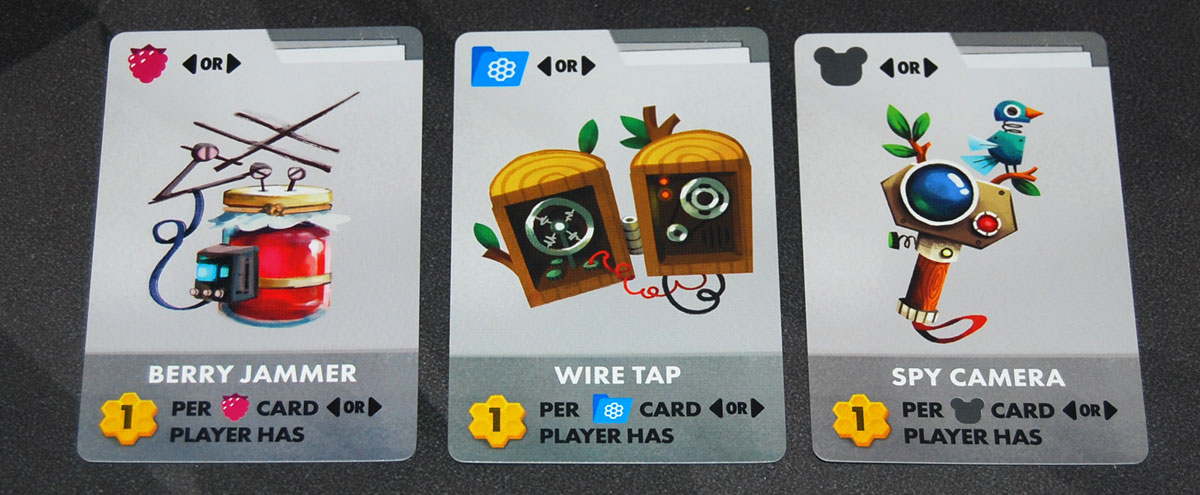
In addition, rubies will award points to players who have the most of them: 6 points for most, 4 points for second place, and 2 points for third place.
Finally, unused swiping tokens are worth 2 points each.
Players add up all of their points and the highest score wins, with ties going to the player with the most rubies.
Variant Rules
In a 2-player game, the swiping tokens work a little differently: a player may use a token on a cache they’ve revealed to take additional cards from it, because it never passes back to the player who set up the cache.
There’s a family mode that simplifies the game a little—ignore rubies and remove the neighbor scoring cards. Also, don’t use the swiping action—swiping tokens collected from actions are just worth 2 points. Play 6 rounds instead of 5.
The solo mode plays a little like a 2-player game, but the cache is made up of 8 cards instead of 6. You get to look at 2 cards, and then you shuffle all 8 together before you start revealing. The automated opponent takes the next two cards after you pass (or draws cards from the deck if you took the last two cards) as their turn, and always swipes if they’re able to. There are also some adjustments for difficulty level that change the number of cards the opponent takes or that you get to peek at.
There’s a list of achievements in the back of the rulebook that you can try to complete in the solo game.
Why You Should Play Honeypot
I’ve always enjoyed “I cut, you choose” games: there’s the challenge of divvying up a pile of goods so that nobody gets away with anything too good, and the challenge of choosing between options presented to you to figure out which one is actually best for you. Honeypot takes that concept but throws in a twist: often in an “I cut, you choose” game, the person who cuts will get whatever is left, so the decisions about how to make the split are based in part on what the cutters would like to have for themselves. Here, the cutter does not actually get anything from this deal—instead, it’s setting up the cache with the knowledge that the chooser must take exactly 2 cards from the cache.
If you get a mix of good and bad cards, how do you set it up? Do you put the good stuff up front, hoping that the chooser will dig further in case it gets better? Do you spread out the good and the bad, ensuring that no matter when they stop, they’ll get a mix? Or maybe you put some bad stuff up front, thinking that they’ll stop because things could always get worse.

More difficult, in my opinion, is when you have to set up a cache and it feels like all of the cards are good. Do you set them up so they’re pretty even, so the player will get about the same thing no matter which pair they choose? Or do you make them imbalanced, and hope that they wind up with one of the weaker piles?
Of course, the values of cards will shift over the course of the game. A Honey Dipper by itself is quite valuable at 6 points, but once somebody has one already, the next one subtracts 3 points. If you put in a pair of Honey Dippers in the cache together, you’ve already spoiled them a little. (On the other hand, maybe somebody will manage to get a Blind Swap later and ditch an extra Honey Dipper.) If somebody has been collecting disguises, then you’ll be able to see which disguises are worth more points to them.
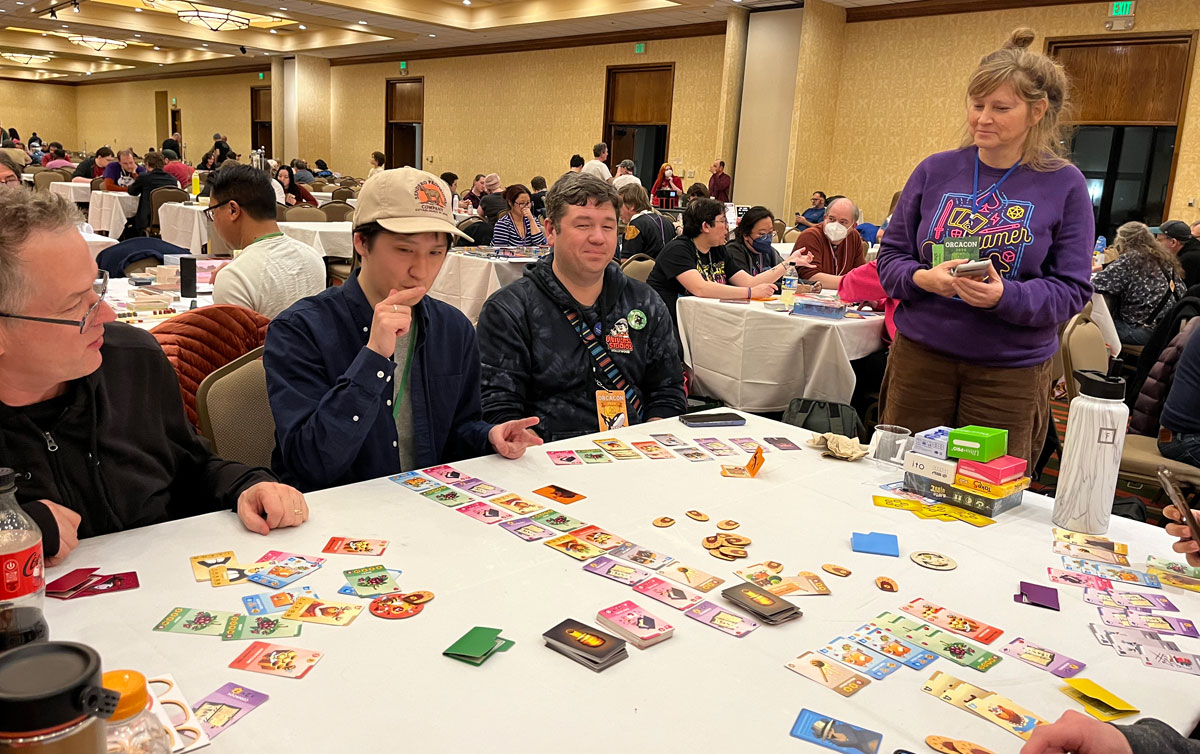
The possibility of swiping also changes the equation a little. Swiping tokens are worth 2 points, but getting a pair of good cards could be worth much more than that. Did the cutter set up this cache, hoping that it would get passed to the next player for swiping? And did they correctly predict the first chooser’s decision? There’s a lot of room for psychological games here, with a lot of second-guessing and Battle of Wits–inspired banter: “A clever man would put the negative cards in the second pair, because he would know that only a great fool would reach for the first pair he was given!”
There’s also an incentive to take some Bad Intel cards because of the round bonuses: if you have the most negative cards at the end of the round, you’ll get a bonus card. And you don’t have to have the most negative total score—just the most negative cards. The risk is when there are exact ties and the round bonus is discarded, because then you’re sitting on the negative points but also didn’t get the catch-up benefit. A full set of Bad Intel gets discarded, which can also be tempting, but dangerous.

The Honeycombs are a fun risk because taking one is a net negative at first: you gain 3 points for the Honeycomb itself, but lose 7 points for the Beees! token. There’s only one Beees! token, which means if you already have it you can accumulate more Honeycombs without any additional penalty. The best outcome, though, is that somebody else ends up stuck with a Honeycomb later than you, taking the Beees! from you and leaving you with just sweet, sweet points.
Honeypot is an excellent, quick game for players who love to get into each other’s heads. It’s all about figuring out what your opponents would want and whether they’re likely to take risks. I really like this spin on the “I cut, you choose” genre.
For more information or to make a pledge, visit the Honeypot Kickstarter page!
Click here to see all our tabletop game reviews.
 To subscribe to GeekDad’s tabletop gaming coverage, please copy this link and add it to your RSS reader.
Disclosure: GeekDad was loaned a prototype of this game for review purposes.