Ever since the halcyon days of the Nintendo 3DS, a purely theoretical Pokémon version of beloved life sim Animal Crossing has been one of my family’s go-to topics on long car rides and during vacation downtime. What if your next-door neighbor was an Eevee? What if you had to run errands for a down-on-his-luck Bulbasaur? What kind of house would you design for a Clefairy?
Fast-forward a decade plus, and our far-fetched mental exercise has become reality. Sort of. This week, Pokémon Pokopia releases exclusively on the Nintendo Switch 2, and not only is it a weirder and more wonderful franchise spin-off than my kids and I could ever conceive, but it’s also an early contender for my game of the year.
Pokopia begins with a memory; a lone Ditto fondly recalls his trainer and, like Ditto do, morphs into their likeness.

Ok, so maybe it’s not an exact copy. Your Ditto/trainer player character still wears the Pokémon’s vacant expression, and his flailing arms and shuffling gait are practically comical. However, it’s close enough to temporarily fool the next Pokémon you meet, a studious character called Professor Tangrowth.
The good professor goes on to tell you that it has been an age since he’s laid eyes on another Pokémon or a human being, thus setting up the game’s enduring mystery. It falls to your brave Ditto to restore this broken land, to tend its parched earth and mend its many shattered byways. In doing so, you’ll attract your fellow Pokémon and, hopefully, their human counterparts will eventually return as well.
Luckily for you, Ditto’s impersonation is close enough to the real thing to fool the few lingering facets of human technology, including the computer at the razed Pokémon Center and your trusty Pokédex.
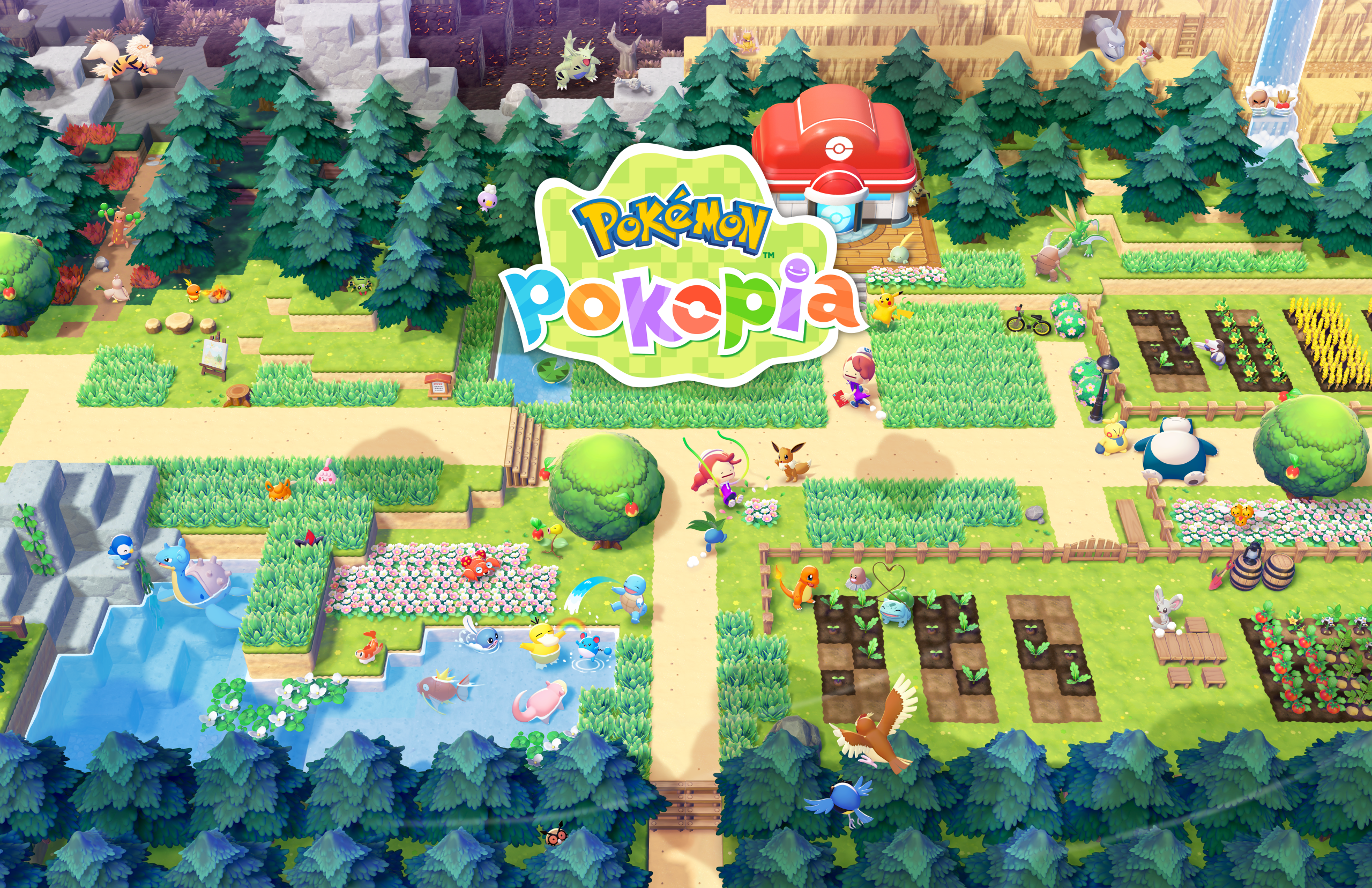
This particular device also includes a specialty feature called the Habitat Dex, meaning that, in addition to a Pokémon’s name and description, you have information regarding the kind of habitat needed to attract them back to this barren waste. Combining grass, trees, flowers, specialty items, and even furniture in specific ways can summon a variety of Pocket Monsters to aid you in your grand task.

Using these tools (and with a little friendly advice from Professor Tangrowth), you begin by restoring some simple Pokémon habitats. Each Pokémon acquired has specific likes and dislikes that you can leverage to make them happier in their new home, but each also has one or more Specialties that can help you further develop your fledgling community.
Bulbasaur, Charmander, and Squirtle, for example, have the Specialty moves Grow (to hasten plant growth), Burn (to start campfires), and Water (to hydrate dry earth), respectively. Bringing these allies along as Followers allows you to hasten expansion, and some Pokémon can teach Ditto moves of his own, like the plant-summoning Leafage and the hydrating Water Gun. In true Pokémon fashion, such moves require PP, which Ditto can easily replenish by eating food.
This further opens up the title’s expansive crafting system, as Ditto cuts, smashes, and tills his way through various terrain, collecting more materials along the way. These can be combined using learned Recipes to create all manner of items, allowing you to assemble a wider variety of Pokémon habitats and even begin repairing the various neglected homes and crumbling infrastructure.
Progression is handled largely through the tried-and-true mission system, which Pokopia refers to as Requests. These can be as straightforward as crafting or collecting a certain item for a needy Pokémon, but the more complex Important Requests tend to require large, multistep processes, like rebuilding that flattened Pokémon Center with the help of a specific cadre of Pocket Monster construction specialists.

Even in its ruined state, the Pokémon Center’s PC can be employed to complete challenges and purchase goods with the points awarded. It also helps you keep an eye on your Environmental Level, a sort of catch-all equation that takes into consideration the Comfort Levels of all Pokémon in the area. Feeding them berries when they’re hungry, giving them desired items to spruce up their habitats/moving them into new homes, or just letting them chill out and relax can keep your monster pals comfortable and bolster that important Environment Level.
All this progression, you’ll discover, helps make you a more effective “trainer,” which can be used to unlock additional environments. Though you start off in the Withered Wasteland, you’ll eventually access different biomes like the cavernous Rocky Ridges and the muck-covered Bleak Beach. Each offers new varieties of Pokémon, materials (and related Recipes), and Requests that can help you improve the Environmental Level both at home and abroad.
If a Recipe in an area demands some exotic item you’ve yet to encounter, it’s quite possibly only available (or initially available) elsewhere. But worry not, fellow traveler. By establishing a home—planting a Ditto flag atop a restored or newly constructed domicile—in each various environment, you can use the Pokédex’s Return Home feature to quick travel from one disparate locale to another.

This enhances one of the game’s most fun and challenging elements: space and resource management. Since Ditto can only carry a finite number of items in his trusty backpack (which is, in actuality, just an outward representation of his big ol’ mouth), you’ll often need to unburden yourself in the storage boxes you construct next to each of your crafting tables. The trick is remembering what item, resource, or collectible you stored at what location.
If, by this point, you’re shaking your head and intoning, “That doesn’t sound very much like Animal Crossing,” you’re absolutely correct. Pokémon Pokopia was actually developed by Koei Tecmo’s Omega Force team, who previously worked on another outstanding life-sim/adventure mash-up, Dragon Quest Builders 2. This explains how Pokopia so effortlessly blends an exciting and engaging story with the play-at-your-own-pace charm of a community-builder.
Case in point: I was both surprised and delighted by the discovery of Palette Town, a sort of blank slate environment where you can build solo or with up to three friends using multiplayer, creating a space that’s uniquely your own (one unburdened by the need for continual story development) right there in the core gaming experience. Making this built-in feature rather than some half-baked secondary mode really highlights the kind of care and attention you’ll find on display throughout Pokémon Pokopia.

Do I have some minor quibbles? Sure, I mean complex construction in a 3D game space is never without its shortcomings. In fact, I may have used some of my very bestest swears while trying to align and affix specialty roof tiles to my Withered Wasteland chateau. Furthermore, the recurring sequence of move to a new place –> build some stuff and make friends –> complete Important Request –> big reveal surely won’t be to everyone’s taste.
Still, I was able to overcome my short-term construction issues (it turns out camera placement is everything… also, there’s mouse mode support), and I just so happen to be the target market for quirky games that mix constant discovery, social-sim glad-handing, and one of the modern world’s most popular IPs. Whether I was actively building or idly exploring, uncovering sparkly Pokémon Traces that revealed new habitats or stumbling across scattered records and relics from the long-absent human inhabitants, I was not merely engaged but absorbed. Ergo: game of the year.
I could certainly go on for another few thousand words about why I love Pokopia. I could wax poetic about its delicate musical score, I could praise the simple logic of its purpose-built farming and cooking mechanics, hell, I could even regale you with my numerous surreal experiences with the game’s cast of custom Pokémon characters (Chef Dente is an absolute delight, while DJ Rotom is a borderline neighborhood menace).

The issue here is that this would take even more time, which I could otherwise devote to actually playing Pokopia.
Pokémon Pokopia is a perfect example of one of those desert island video games, the kind of experience with near-limitless playability (not to mention replayability, for the same brand of maniac who resets their Animal Crossing: New Horizons island). With dozens of hours of gameplay in the bag, it feels as though I’m only just beginning to realize the sheer scope of all that is available… and that I’ve barely scratched the surface of what is truly possible.
So instead, I will humbly suggest that you proceed to the nearest gate, scan your Pokédex, and join me in the fantastical world of Pokémon Pokopia. I’ll be the Ditto wearing Buddy Holly glasses and obsessively collecting twine.
Review materials provided by Nintendo of America. This post contains affiliate links. No Pokémon were harmed in the writing of this review. I mean, except for my Ditto almost drowning, like, 14 times.