As members of the Din’Lux council, you must work together to address the city’s needs—but sometimes personal ambitions pull you in other directions.
In “Reaping the Rewards,” I take a look at the finished product from a crowdfunding campaign. Kinfire Council was originally funded through Kickstarter in April 2024 and was delivered to backers in the fall of 2025. This review is based on my Kickstarter Tabletop Alert, updated to reflect the finished game.
What Is Kinfire Council?
Kinfire Council is a worker placement game for 2 to 6 players, ages 14 and up, and takes about 90 to 120 minutes to play. It retails for $74.99 and is available in stores and directly from Incredible Dream Studios. (The Winds of Change expansion is also available for $34.99, and there’s a $49.99 upgrade kit that includes wooden tokens, neoprene mats, and an illustrated lore book.) I think it’s possible to play this with younger kids if they’ve played worker placement games before, as long as they have the patience for a longer game. (My 11-year-old played it with us but had to quit early because it was her bedtime.)
Kinfire Council was designed by Kevin Wilson and published by Incredible Dream Studios, with art direction by Katarzyna Bekus.

Kinfire Council Components
Here’s what comes in the box:
- Status board
- 3 Dual-layer city boards
- 18 Cultist chits
- 2 Cult Leader chits
- Cult of Altan bag
- Threat board
- 5 Lighthouse Site sheets
- 6 Worker sheets
- 6 Councilor sheets
- 35 Threat cards
- 35 Research cards
- 40 Decree cards
- Lighthouse Tracker board
- Lighthouse Progress token
- Speaker’s Medallion (start player marker)
- 14 Threat tiles
- Hidden Threat tile
- 12 Sentry tokens
- Cult Score marker
- Cult 50/100 Score marker
- 6 Seeker standees (1 per player)
- 54 Influence tokens (9 per player)
- 30 Worker chits (5 per player)
- 6 50/100 Score markers (1 per player)
- City Coffers bowl
- 25 Food tokens
- 25 Common tokens (stone)
- 25 Rare tokens (crystal)
- 25 Magic tokens
- 50 Coin tokens
- 20 Trouble tokens
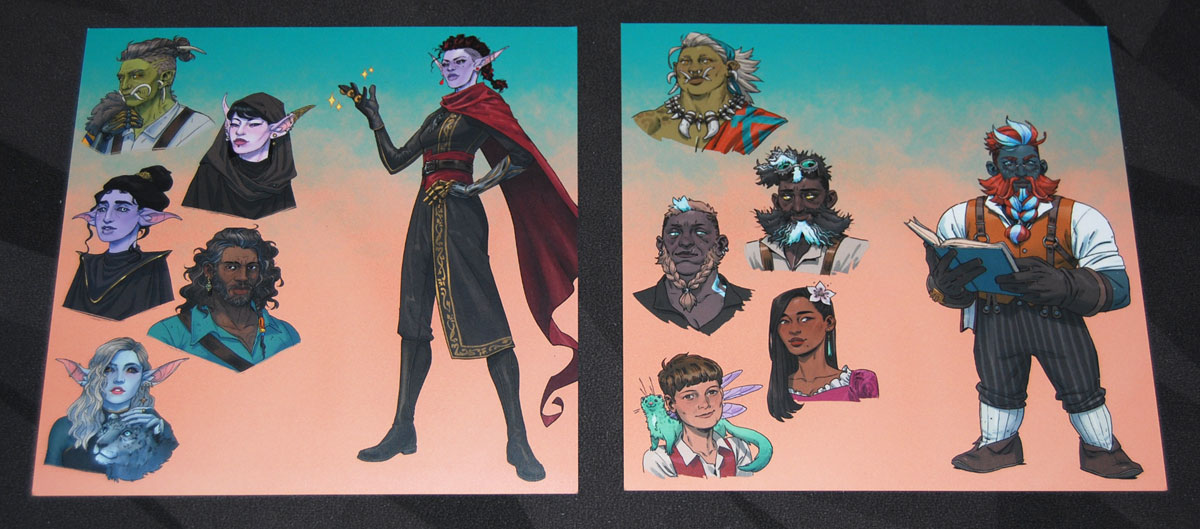
The illustrations in the game are in the same style as those in the other Kinfire games, and I really like this diverse take on fantasy characters—there are humans, elves, dwarves, and revenants. The worker tokens have individual character portraits on them, and many of the characters appeared in Kinfire Chronicles so if you’ve played that you may recognize some of them.

The Councilor sheets remind me of bookmarks—they’re the same height as the worker sheets, and depict the six Councilors of Din’Lux. The front of the sheet has the game-pertinent info with the Councilor’s ability, and the back has a portrait, a biography, and a little of that character’s play style.

The six player colors each have their own icon as well—you can distinguish the influence tokens (which have a lantern on the front side) by flipping them to the back side if needed. The workers themselves are identified by their portraits and standees, pictured on the worker mats; that may not be quite as easy to distinguish from a distance but I like that every player’s components are visually distinct.

The Seekers are workers with some special abilities, and also happen to be the six characters featured in Kinfire Chronicles and the Kinfire Delve series. In those games, they’re the protagonists, but here they are just one of your Councilor’s workers. The standees are the same type as in Kinfire Chronicles, but with a different portrait, so if you own both games, you can also mix and match them. I also like the fact that the standees have a front and back portrait … except Feyn for some reason. I don’t know if this is a misprint—I actually only noticed this when I stood them all together to take these photos!

The city of Din’Lux is built on a hill, and the game uses the storage trays to literally raise up the city boards so that there are three levels. It makes for a nice visual, but it’s also important because the higher levels have taxes when you send workers there, so it makes it easy to see at a glance what level any given location is on. The city boards are also dual-layered boards: the numbered spaces are sunken so that the worker and cultist chits can slot in nicely, and each location is also a double-sided tile that fits into its space. The tiles are left in the board when you store it, too.

The only problem with this setup is that it means you can’t use the handy storage tray as a resource tray while you play the game—you’ll have to pile up all the tokens somewhere on the table (or else, I suppose, keep picking up Tier 2 of the city and try not to knock over any Seekers that might be standing there). This particular tray is also a little weird—the six wells for the resource tokens work fine, but there are four larger wells that are just sized a little oddly for the rest of the components, meaning that you have to make some odd combinations of different components to make everything fit.

There are so many locations and abilities and actions you can perform, so the game uses a lot of iconography throughout. The one thing I don’t quite understand is why there are two versions of each icon, one in color and one in black and white. This has sometimes led to some confusion for new players, especially when they see one version of the icon in one place but don’t recognize the other version in another location.
How to Play Kinfire Council
You can download the rulebook here.
The Goal
The goal of the game is to score the most victory points by the end of 5 rounds. However, if the Cult of Altan has the highest score at the end, the Cult Conspirator, the player who has the most influence with the cult, will win instead.

Setup
Set up the status board and city boards, with all the location tiles turned to the basic side. Shuffle the research cards and the decree cards and place them in the indicated spaces on the status board, as well as the skill tiles. In the City Needs section, place 1 food in each of the top three spaces of the track. Place the various resource tokens nearby.
Set up the threats: shuffle the threat deck and place it and the threat tokens near the threat board. Draw the top 3 cards of the threat deck and set them face-down as a Hidden Threats stack without looking at them. Place the cultist tokens in the bag.
Shuffle the 5 lighthouse sites and place them in a stack next to the lighthouse track, and turn the top site face-up.

Randomly pair the worker sheets with the councilors. Choose a starting player and give them the medallion, and in turn order each player selects one of the sets. Give each player the matching Seeker and worker tokens—the number of workers each player has is based on player count. Everyone starts with 3 coins and 4 influence tokens on their sheet—the remaining influence tokens are set aside in a supply.
The cult starts with 0 points, the first player starts with 1 point, the second player starts with 2 points, and so on.
Gameplay
The game takes place over five rounds and each round has three phases: Sun’s Rise, Day’s Light, and Night’s Fall. Sun’s Rise is when you draw decrees to vote on, and the cultists show up. Day’s Light is the bulk of the game, when players take turns placing their workers. Night’s Fall is when you check the status of the lighthouse and the city’s needs.

Sun’s Rise: Draw 2 decree cards and place them face-up near the board. Players will be able to vote on these throughout the day—the decree with the most votes will pass.

Then, draw 3 cultists from the bag and add them to the hideout, and then resolve all the cultists in the hideout (including any that may have been placed there during the previous round) in numerical order. Cult leaders are unnumbered red tokens and are resolved last. Each cultist will go to its numbered spot and block that location, and will also affect the threat board.

On the threat board, there are three spaces marked 1–6, 7–12, and 13–18. If the spot corresponding to the cultist has no threat card, draw a threat card and place it there. If it already has a spot, add a trouble token to the card. If there are enough threat tokens to meet the number in the top corner, then the threat is triggered: follow the effects and then discard the threat card.
To resolve a cult leader, first add a threat card or trouble token to all three slots on the threat board. Then, put the cult leader token in the spot at the bottom of the board. If both leaders have been drawn, then the cultist bag resets: return all cultist tokens from the discard area on the board as well as any cultists that players have arrested back to the bag, along with the cult leader tokens.

Day’s Light: Players take turns placing their workers and Seeker on the various spaces to take actions. Your Seeker is a special worker that can go outside of the city (to the threat board and the lighthouse site), but can also be placed inside the city like the other workers. In general, you may not go to a location that is occupied, whether by another worker, Seeker, or a cultist.

Choose a worker from your board and place it into an empty space; if you go to one of the higher tiers in the city, you’ll need to pay taxes to the coffers, in the little bowl. Then, you may either use the effect of that location, or arrest an adjacent cultist (taking the token and placing it into your personal supply). Some locations have multiple effects—if so, you only get one of them.

Locations may give you resources, let you make various trades, or draw research cards, which are one-time-use cards. Some locations let you vote: you may place an influence token from your board onto one of the available decrees.

There are also locations that will train the worker you sent there—there are 6 different skills that will let you avoid paying taxes, place workers even in occupied spaces, and so on. Some spaces will give you cult influence—you place your influence tokens in the cult space on the board, and the player with the most influence there is the Conspirator.

At the bottom of the board there are a few locations that have a rectangular space next to them—these are not numbered and any number of workers can go there. One of them, City Planning, lets you upgrade locations, flipping them to the more powerful side and giving you points. Place one of your influence tokens on the upgraded location—you are now the patron of that location, and when other players use the location, you gain the patron bonus. (For instance, in the photo above, the orange player will gain a research card any time another player uses this location.)
Outside of the city, you can thwart threats by sending your Seeker to a location on the threat board and paying the required resources shown at the bottom. You immediately score the points shown on the card, and take the card itself—some places will let you trade threat cards for other benefits.

After placing a worker, you may optionally run an errand, like paying for one of the city needs or sending a supply shipment to the lighthouse. To meet a city need, you place an influence token next to one of the needs, and then pay the required resources to the supply. You’ll score points for meeting city needs at the end of the day.
To help build the lighthouse, choose one of the options shown on the site, which lets you build 1, 2, or 3 tiers at different costs. Spend the resources shown, place an influence token next to the tier that you paid, and then move the lighthouse tracker up that many spaces. The more of the lighthouse is built, the more points each floor built is worth, and the fewer points the cult will receive.

Night’s Fall: Resolve the city needs. For each row on the track, if there is an influence token next to the need, then it has been met and that player gains 2 points. For each city need that has not been met, draw a cultist from the bag and place it into the hideout area—it will be resolved during the next day. Then, return influence tokens to players.

Resolve the docket: the decree with more votes passes. If there is a tie, the first player (with the medallion) chooses which decree passes. There are a few different types of decrees that do different things when passed. Laws stay in play for the rest of the game and are placed nearby. Orders take effect and are discarded. Elections are awarded to the sponsor—the player with the most votes on the card—and give that player a special bonus. Crisis cards will trigger if they are not passed, usually with some sort of bad consequence. Influence tokens used as votes are returned to players.
Then, every cultist still in the city will trigger again, adding threat cards or trouble tokens to the threat board.
If there are any damage tokens on the lighthouse, move the tracker down one space for each damage. If the tracker is ever moved below the bottom of the track, add one threat card to the hidden threats stack.
Score for the lighthouse: the number left of the current level of the lighthouse is the point value for each floor that you’ve built this round. The cultists score the number to the right of the current level. Then, return all of those influence tokens, draw the next site card, and reset the lighthouse tracker to the bottom.
Everyone retrieves all of their workers and Seeker, and the medallion is passed to the next player.
Lastly, the city coffers are emptied (due to government waste) and returned to the supply.

Game End
The game ends after the fifth day. Cards that grant points at the end of the game are resolved now.
Then, reveal the hidden threat cards—the cult gains all of the points shown on those cards.
The player with the most points wins. If the cult has the most points, then the player with the most cult influence wins (but if nobody has cult influence, then the cult wins and all players lose).
Ties are broken in this order:
- The cult wins ties.
- Most patron influence from upgraded locations.
- Most unspent resources.

Kinfire Council is GeekDad Approved!
Why You Should Play Kinfire Council
Imagine this scenario: a strange phenomenon sweeps across the globe, wiping out countless people, devastating cities, and leaving a completely changed world. People struggle to survive; a solution is devised that seems to hold back the darkness and provide at least a little safety, though it isn’t foolproof. The government promises to provide this safety measure for more communities—though it’s a slow process, hampered by high costs, a shortage of workers, and bureaucracy. Oh, and there’s also a cult who decides that all of this protection goes against divine will, that the true path is to embrace the darkness.
Such is the setting of the completely fictional world of Atios —totally unlike our own, right? Okay, I don’t know that the Starless Nights were intended to be a metaphor for COVID, but this game feels like it could embody any number of metaphors. Unlike Kinfire Chronicles: Night’s Fall, where you play as the intrepid heroes venturing out into the darkness and fighting mutated beasts and the aforementioned cultists, in Kinfire Council you play as the bureaucrats. It’s less about battlefield tactics and more about taxes and errands and addressing the various demands of the city. As the Councilors of Din’Lux, you are all (mostly) agreed that the lighthouses need to be built and the cultists should be stopped, but you also have your own agendas. You want the credit for ushering in this new era for Din’Lux, and if that leads to a little infighting on the council, well …

Back in November 2024, I wrote about the campaign game Kinfire Chronicles: Night’s Fall: it alternates between phases where you explore the city of Din’Lux (and some other towns) and skirmishes where you play tactical battles against various enemies. I played through the entire campaign with two other friends, and we all had a really great experience—we liked the way that your character’s backstory is gradually revealed, and the way that the fights and encounters are woven into the larger narrative. There’s an interesting mechanism the game uses to “remember” decisions that your group has made over the course of the game because sometimes they have consequences down the road. And then we played through the whole campaign again with the same friends plus a new member of the party, so we could try out the other characters and take different paths from the first time we played.
Since then, Incredible Dream Studios has released a few more titles set in the same world of Atios: Kinfire Delve, a compact cooperative dungeon crawl that is mostly just a deck of cards and some dice. Each box pits two of the six Seekers from Kinfire Chronicles against increasingly challenging bosses, and if you have multiple copies you can mix and match them or combine them to play with more players.
Some parts of Kinfire Council will feel very familiar to anyone who has played a worker placement game: you have a limited number of workers and each one can only do one thing per round, and spaces are limited. You’ll often be trying to guess where other players are planning to go, because maybe you want to get there first. And, of course, most of the placements are in service of some combination of gathering needed resources or spending those resources to accomplish some task (and get points, of course).

But there are lots of little tweaks that set Kinfire Council apart, too. The Councilors themselves have special abilities: Hierophant Selen is not above dipping into the coffers; Guildmaster Leera can send any of her workers outside the city; Talos can spend research cards as a wild resource. You start with one special worker—your Seeker—who can go outside of the city to a few special locations. Moreover, each Seeker has a special ability—the guard can enter a space with a cultist and arrest them and use the location; the scholar can take research cards in place of another resource. So right from the start, there’s a bit of asymmetry, and you have to figure out how to make the most of the random pairings of Councilor and Seeker.
On top of that, you’ll be able to train your standard workers as well. Each of the six abilities that the Seekers have are traits that can be learned (at a price!) by going to certain locations. It can feel costly, sending a worker to a location just to train, because there are only 5 rounds. However, it can really pay off when you need to use a location that somebody else has taken, or you’re short some coin to pay your taxes, or you really want to get a jump on arresting some cultists.

The cultists themselves are also an interesting feature with multiple effects: they show up at random and take up spaces on the board—so annoying!—but they also contribute to the threat cards, which have various effects from damaging the lighthouse to increasing the city needs. They can even damage a city location, which becomes unusable until somebody takes an action to repair it. On the one hand, you want a few cultists around because you can arrest them and then turn them in for various rewards. On the other, if you don’t manage to clear them all out of the city before nightfall, then they get closer to triggering those threats.
Then there’s the decrees. There are generally just two to choose from, though there are effects that can add more. Thematically it’s a little funny that you’re not voting yes/no on each decree independently, but rather the decrees are competing with each other and only one can win each day. (Look, there’s only so much legislation we can deal with each day, okay?) Elections provide benefits to the person who stuck the most votes on it, but crises can have some seriously bad effects if you don’t pass them. Sometimes that can present a real dilemma between city needs and personal wants. I mean, sure, this decree means that the city will need a bit more money every day, but isn’t it worth it so that I get more research cards so that I can be of even more help to the city? What’s more, getting votes usually requires you to go to specific locations—which means you’re spending an action to vote rather than, say, fighting off that wyvern that’s threatening the city.

In some sense, it feels a bit like a cooperative game, where there is an overarching goal (build those lighthouses!) and lots of little fires to put out (arrest cultists! meet the city needs!). And you really don’t want the city to fall apart, so there is some amount of collaboration that happens—we often discussed whether somebody was planning to deal with a particular threat, because you don’t want people wasting their actions collecting the same things, and then having other city needs go unmet. But the individual scoring means that you don’t always do what’s best for the entire group, and it really did feel a bit like being on a city council with a bunch of other overly ambitious people. Maybe you have good intentions for the city, but today you really just wanted to do some more research and you didn’t get around to voting at all.

The Conspirator role is another interesting wrinkle. Certain locations let you gain cult influence, and whoever has the most influence with the cult is the Conspirator and will win if the cultists score the most. It’s a dangerous game, though: in most cases, you can retrieve your influence tokens from spaces on the board when needed, like giving up a patron bonus because you need the token to vote. Cult influence is never returned to you, though, and your total supply of tokens is limited, so gaining influence in the cult has an opportunity cost. If you get into a competition with other players to be Conspirator, then you better be pretty certain that the cult is going to win! So far in the games I’ve played the cult generally hasn’t been scoring as much, so we haven’t used the Conspirator mechanic as much—it would probably take some more deliberate (and obvious) sabotage. It does look like the Winds of Change expansion beefs up the cultists, though, so I’m looking forward to seeing how that affects the game.
I’m really enjoying the Atios universe as a whole. I like the concept of multiple different games set in the same world, with each one adding a bit more to the story. The games also have some fun overlap: the character cards from Delve can be used in Chronicles as an alternate portrait, and the Seeker standees in Council can also be swapped with those from Chronicles in case you want to change up their outfits. While playing Kinfire Council, we recognized a lot of the locations and characters that we’d encountered in Chronicles, and we even saw some threat cards based on things from the Delve series.
Ultimately this is a game that makes good use of its setting to tell a story—while playing it, I often felt those tensions between what I wanted for myself and what I knew was probably best for the city. There were times when nobody got around to building the day’s lighthouse—maybe the cultists were particularly active and we had to deal with some threats, or maybe we were too busy training our workers for the next day. It’s the sort of game that causes a good sort of discomfort because it helps you see the way that bureaucracy makes it easy to pass the buck and make an issue somebody else’s responsibility. It’s eye-opening, and yet it’s also a fun game to play, to puzzle out your next move.
Kinfire Council has an impressive table presence, a compelling story, and engaging gampelay. I’m happy to give it our GeekDad Approved seal! If you enjoy worker placement games, or you’ve always wanted to see what it was like to be a city councilor, this is a nice entry point into the world of Atios.
Click here to see all our tabletop game reviews.
 To subscribe to GeekDad’s tabletop gaming coverage, please copy this link and add it to your RSS reader.
Disclosure: GeekDad received a copy of this game for review purposes.