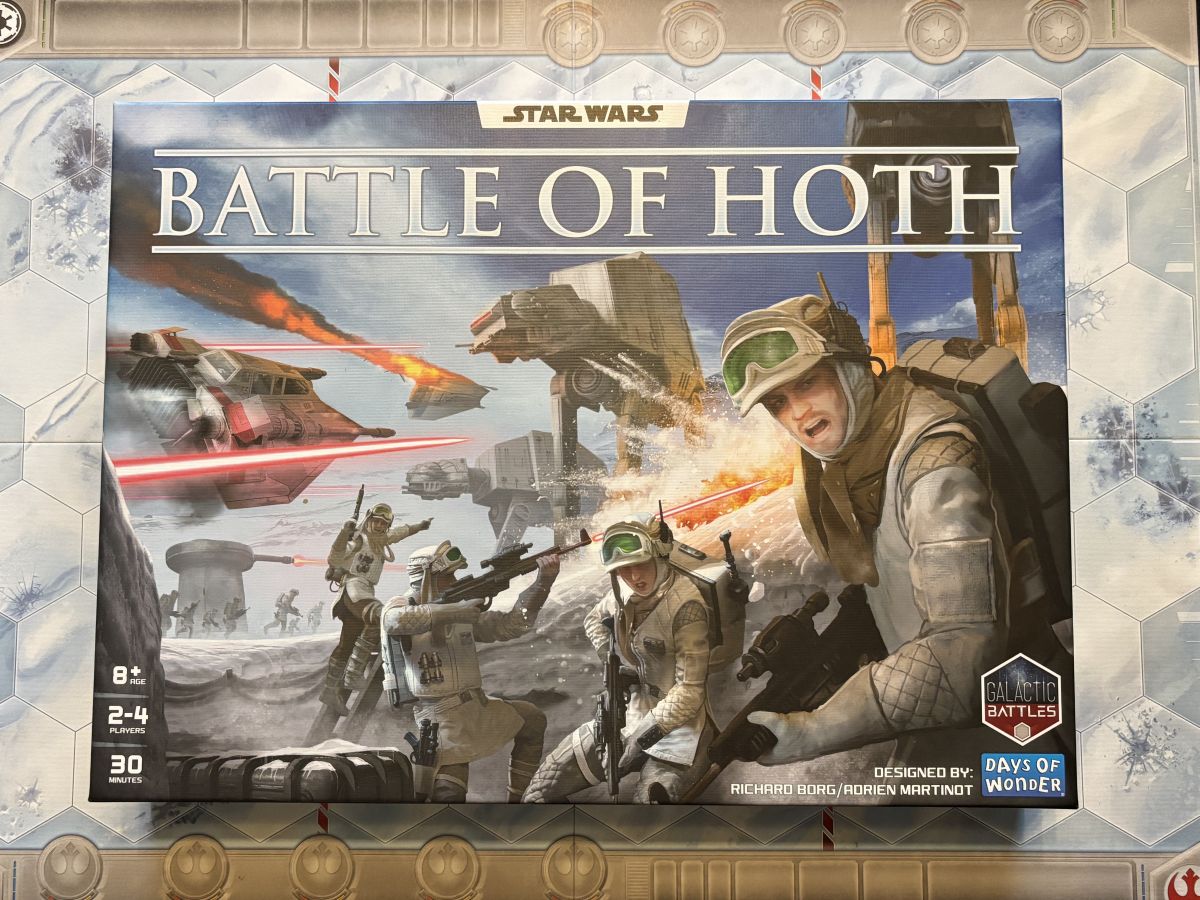
I remember vividly sitting in a theater back in 1980 and watching as these giant mechanical walkers advanced across a snowy landscape as Rebel soldiers in ice trenches fought back. Star Wars: The Empire Strikes Back is still one of my favorite movies of the saga and have I replayed that battle numerous times in video games both as a pilot of a snowspeeder trying to hook the legs of an AT-AT with a harpoon and then wrap a tow cable around its legs to make it fall down or even as an Imperial pilot of one of those walkers. Each time let me relive the excitement from my first viewing of that classic battle. Now I can also play it on my tabletop with the new release of Star Wars: Battle of Hoth.
What Is Star Wars: Battle of Hoth?
Star Wars: Battle of Hoth is a light, miniatures wargame for 2-4 players, ages 8 and up, and takes about 30 minutes to play. It’s currently available from your friendly local game store as well as online retailers such as Amazon with a suggested retail price of $59.99 for a copy of the game.
Star Wars: Battle of Hoth was designed by Richard Borg and Adrien Martinot and published by Days of Wonder, with illustrations by Ben Carre, Christophe Duhaze, Tony Foti, and Clément Masson.
Star Wars: Battle of Hoth Components
Here is what you get in the box:
- 74 miniatures
- 1 double-sided board
- 50 command cards
- 10 support cards
- 6 attack dice
- 19 double-sided terrain hexes
- 3 structure tiles
- 16 tokens
- 4 cardholder sections
- 3 summary sheets
- 1 rules booklet
- 1 scenario booklet
- 4 campaign booklets

Star Wars: Battle of Hoth comes with 74 detailed miniatures that include 3 AT-ATs, 9 snowspeeders, 32 snow troopers, 24 Echo base troopers, 4 Imperial probe droids, and 2 Rebel Artillery. The number of miniatures placed in a space on the map board represent how much damage the unit can take before being destroyed. For example, Imperial snowtrooper units have 4 miniatures while snowspeeders have three miniatures, and probe droids have only two.

The map board is double sided and consists of snowy hexes as well as boarder edges with spaces to keep track of objectives earned. One side is used for most of the scenarios while the opposite side is used with a second copy of the game to create larger battles and consists of half of the larger battle map.

Players use command cards to order their units. Some cards list a number of units and one or more of the three sectors on that map where units can be given orders. Unlike some games where players can move every unit every turn, the command cards in Star Wars: Battle of Hoth represent the limits on a commander to give orders during a battle. Each player has 16 command cards to use.

In addition to the command cards, Star Wars: Battle of Hoth also includes 18 leader cards, divided into six leaders each with three cards. The Rebels have three leaders and the Empire as their own three leaders. If players choose to use leader cards, they pick one of their leaders and add their three leader cards to the command cards to make a command deck. Each leader has their own specialty and choosing the correct leader for the scenario or for a play style can provide important advantages.

Star Wars: Battle of Hoth features two campaigns which direct players to start with a certain scenario and then advance to other scenarios based on the results of each battle. Along the way, players can earn support cards which they can use in future battles. There are five support cards for each faction.

The attack dice in Star Wars: Battle of Hoth do not have pips or numbers on them. Instead they have symbols and are used to determine damage inflicted during an attack. Different symbols represent damage to different types of units. For example, infantry receive one damage for each infantry or blast symbol rolled. Players roll a certain number of dice during an attack based on the type of unit used to attack as well as the range from that unit to the enemy target.

Since the map board is just clear snowy hexes, terrain tiles are used to represent landforms that can hinder movement or block line of sight. Some can also provide defensive bonuses to units on them. Three structure tiles are also included to represent shield generators and an ion cannon which are targets for the Imperials in some scenarios.

The sixteen tokens included in the game include six medals used to represent completing objectives as well as 10 badges that are placed next to units on the map to show that they are a specialized or upgraded unit with additional abilities.
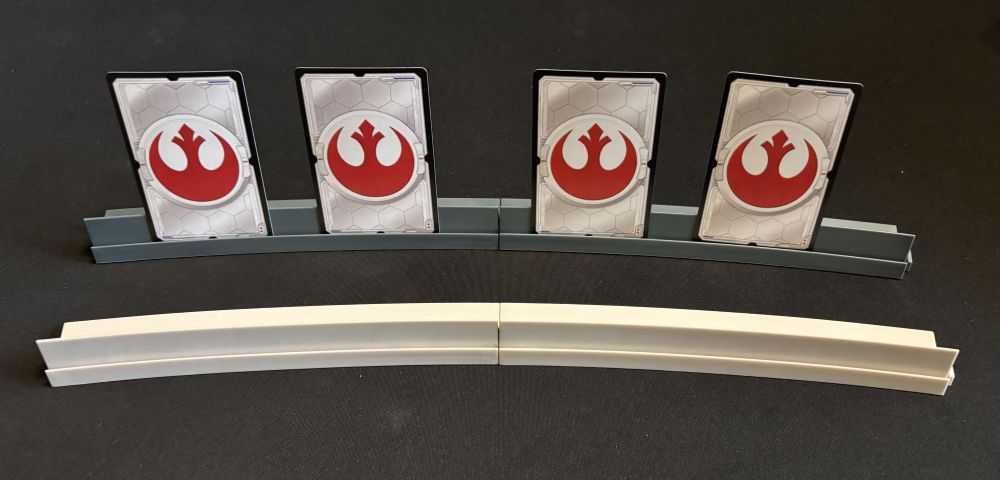
The cardholder pieces can be assembled into two cardholders which allow players to keep all of their command cards visible to themselves but not visible to their opponent. While players do not need to use them, they can be useful in team games so that both players on the same team can see what cards their teammate have.

Each player receives a summary sheet illustrating details on all of the units in the game including how far they can move and how many attack dice they roll at various ranges. A terrain summary sheet can be used by both players and contains information on the various terrain tiles and how they affect gameplay.

In additi0n to the rules booklet and a booklet of scenarios that show how to set up the map and the objectives for each side, there are also four campaign booklets with one booklet for each side for each of the two campaigns. These provide a storyline that progresses across a number of scenarios and can change each time depending on the results of each battle. After playing through some of the scenarios, the campaigns are a great way to take Star Wars: Battle of Hoth to the next level.
How to Play Star Wars: Battle of Hoth
The Goal
The goal of the game is to achieve your victory conditions for a scenario.
Setup
Start off by selecting a battle from the scenario book. After placing the map board in the center of the table, place any terrain tiles as indicated by the scenario. Next place the miniatures on the board on the positions shown in the scenario booklet. The number of miniatures in each hex depends on the type of the unit. Once this has been done, placed any special unit badges next to the units as shown in the scenario to designate that those units have unique abilities. Place the summary sheets where the players can easily access them and assemble the cardholders if the players choose to use them.

Decide which side each player will control and sit so they are either on the Rebel or Imperial side of the mapboard. Each player takes their 16 command cards for their faction. If the players agree to use leaders, then each player selects one of their three leaders and adds the three matching leader cards to their command cards and shuffle them all into a command deck. After drawing the number of cards listed in the scenario instructions, the remainder are placed face down. The scenario booklet also indicates which player goes first. You are now ready for the first player to begin their turn.

Gameplay
Star Wars: Battle of Hoth is played in turns with each player completing their turn before the next player takes their turn. A turn consists of five steps: play a command card, order units, move units, attack, and draw a card. Let’s take a look at each step in greater detail.
At the start of a turn, the active player selects a command card to play from their hand. There are two main types of command cards. a section card designates which of the three sections of the map units may be given orders. Tactics cards, on the other hand, allow the player to make special moves or attacks or take specific actions. After a command card has been played, the player then choose which units will receive orders this turn. Only ordered units can move and attack during the turn.
After all ordered units have been chosen, then the player can move those ordered units up to their movement range. This is listed on the unit summary sheets. Units can move one space for each of their movement allowance. Some terrain may affect movement or prohibit certain types of units from entering them. Only one unit can occupy a space and units cannot move through other units, whether friend or enemy. Infantry have a unique movement rule. They can move two spaces, but they cannot attack that turn. However, if they only move one space, they can still attack.
Once the player has moved all of the ordered units they wish to move, they can then attack with those units. To perform an attack, they first select a target that is within their attack range. This is listed on the unit summary sheet. They also check to see if the enemy is in their line of sight. Terrain and other units can block line of sight. If the target is both in range and in line of sight, then the attacking player rolls the number of dice listed on the summary sheet for the appropriate range. After the dice have been rolled, the attack is resolved by determining the number of hits based on the symbols on the dice and the type of unit being attacked. The infantry icon scores hits on all infantry. The vehicle icon with a gear scores hits on vehicles such as the AT-AT or snowspeeder. The blast icon scores a hit on all types of units. A cross icon counts as a miss. The retreat icon forces the owner of the unit to move the unit one space towards their baseline (the edge of the mapboard where the player is sitting) for each retreat icon rolled. If they are not able to retreat due to terrain or units blocking their way, they must take one hit for each space they could not move. After the number of hits have been determined, that number of miniatures are removed from the unit. If the last miniature is removed, it is given to the attacking player to place in one of their medal spaces along their baseline as a victory objective. There are a few special rules for attacking. For example, if you score hits on an AT-AT, you must reroll the dice that caused the hit for a confirmation roll. If any of these dice has a blast icon, the AT-AT is destroyed.

After all attacks have been resolved, the player then draws a command card to complete their turn. Now the next player takes their turn.
Game End
The game ends when one player has earned the number of medals listed in the scenario booklet. Medals can be earned by defeating enemy units as well as special instructions in the scenario such as occupying key hexes on the map. Once a player reaches the victory conditions, the game ends immediately and that player is the winner.
Why You Should Play Star Wars: Battle of Hoth
Star Wars: Battle of Hoth is based on the Command and Colors systems created by Richard Borg for Battle Cry! back in 2000 and then used for Memoir ’44 in 2004 and several other games since then. While I never had a chance to play the first game, I enjoyed playing the later with my children. It offered a great introduction to wargames which could be easily taught and played quickly. When I learned that Day of Wonders, which publishes Memoir ’44, was releasing Star Wars: Battle of Hoth, I could not wait to give it a try. Fortunately, my oldest son who I originally played Memoir ’44 with and is now an adult, was around to play with me. The first scenario focuses mostly on learning the basics of the game with both sides fielding infantry units and some probe droids for the Empire. The second scenario adds vehicles including an AT-AT as well as some snowspeeders. After playing through these first two battles, players are ready for the first real battle with all types of units. By playing these early scenarios, players learn the battle by focusing on using just a few types of units.

While the mapboard features only snowy clear terrain and the sector lines, the terrain tiles allow players to create a vast number of unique battlefields. Not only does the terrain look great, it also has important effects on the battlefield by blocking line-of-sight as well as restricting movement and giving advantages to units in that terrain. The key to winning most battle is using the terrain to your benefit and denying it to your enemy. The other important aspect is to use your units abilities effectively. Infantry are more effective when they are closer to their targets, so it is usually advantageous to have them advance towards the enemy–unless they can occupy terrain that make it harder to hit them. Snowspeeders can move quickly so they can get in close to attack with four dice. AT-ATs, on the other hand, move slowly. However they can roll three hit dice at ranges 1, 2, and 3, so keep them at a distance from Infantry and other units.
Star Wars: Battle of Hoth includes a useful plastic organizer in the box. All of the Imperial miniatures are kept in their own box with a lid as are the Rebel miniatures. These boxes can be removed from the game box so players can have easy access to them during the game. Each component has its own spot in the organizer, making it quick to setup a game and to put it away. This is a bonus for a game that is already quick to play and another great feature that adds to the overall value of the game.

After playing several games of Star Wars: Battle of Hoth, I am very impressed. It is a fun game to play. While some gamers will consider it too basic, there are other more detailed, advanced, and expensive Star War miniatures games on the market. However for the casual gamer who enjoys the movies and stories from a galaxy far, far away, Star Wars: Battle of Hoth is a wonderful way to relive the excitement of the most famous battle scene in the Star Wars movies. Since the battles are short to play, you can play several in one sitting since it does not take long to reconfigure the map with terrain tiles and return the miniatures to the board between scenarios. I really like the inclusion of the campaigns where the results of one battle influence the course of the war and determine not only which scenario is next, but also provide support and leader cards to add to your army. I hope Days of Wonder come out with expansions as they have done with their Memoir ’44 series since there are many different battles and wars from the Star Wars universe. I thoroughly enjoy playing Star Wars: Battle of Hoth and highly recommend this game for most Star Wars fans who want a quick game that is easy to learn and teach to others so you can focus on the battle rather than on the rules and setup.
For more information visit the Star Wars: Battle of Hoth page!
Click here to see all our tabletop game reviews.
 To subscribe to GeekDad’s tabletop gaming coverage, please copy this link and add it to your RSS reader.
Disclosure: GeekDad received a copy of this game for review purposes.