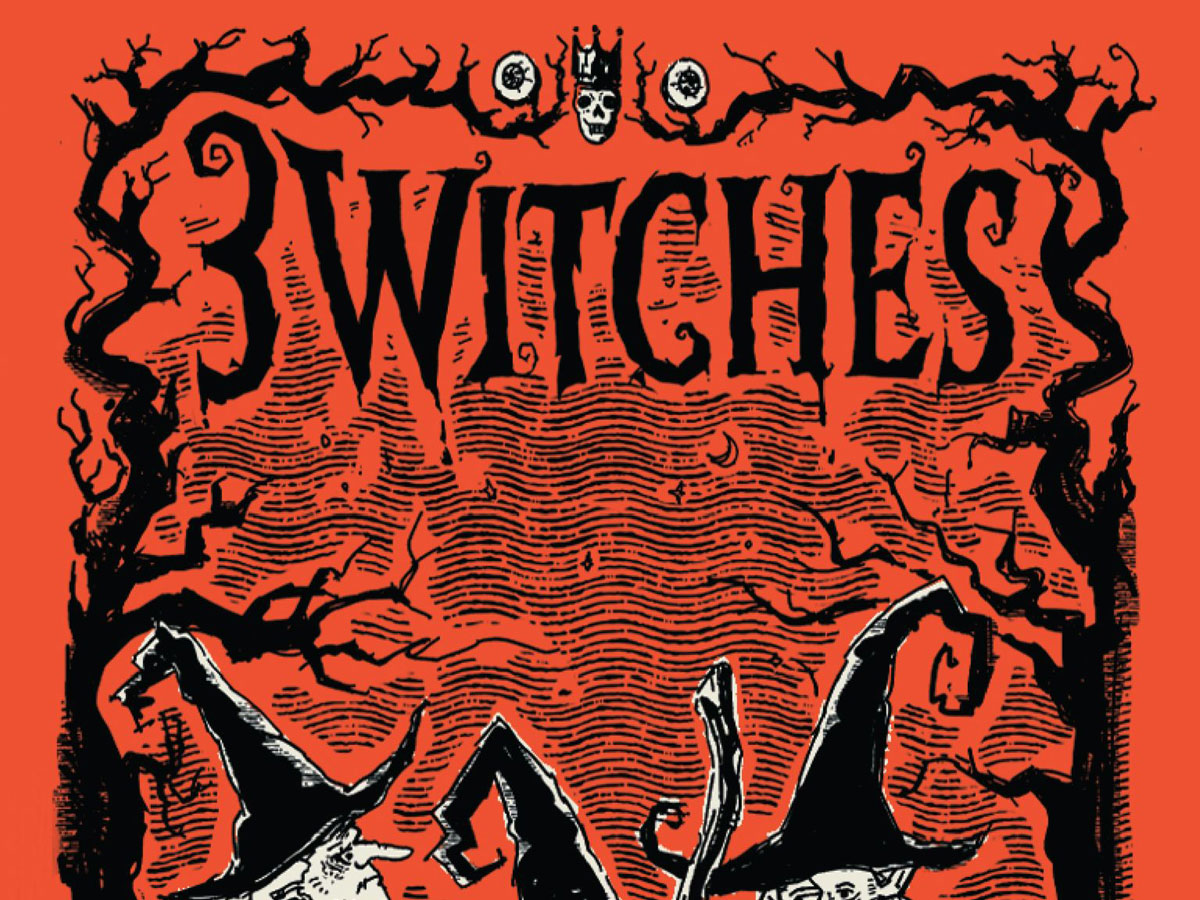
Three witches vie for control of the fates in this trick-taking game of shifting allegiances.
What Is 3 Witches?
3 Witches is a trick-taking game for 3 players, ages 10 and up, and takes about 20 minutes to play. It retails for $9 and is available in stores and directly from the publisher. There are some interesting twists to the game so some familiarity with trick-taking games is helpful, but not absolutely required.
3 Witches was designed by Corey Young and published by Allplay, with illustrations by Sai Beppu.

3 Witches Components
Here’s what comes in the box:
- 18 Ingredient cards
- 12 Fate tokens
- 3 Player Aid cards
- Crystal Ball card
Normally, I don’t include the game box itself in my components photo, but I wanted to highlight what a tiny little game this is. Allplay has a lot of games that come in a small square box, but more recently they’ve also introduced a line of tiny box games, and 3 Witches is one of them. As you can see from the photo, the box itself is only slightly longer than the cards themselves, and it’s a little thicker than a tuckbox for a standard poker deck—easy to fit in your pocket.
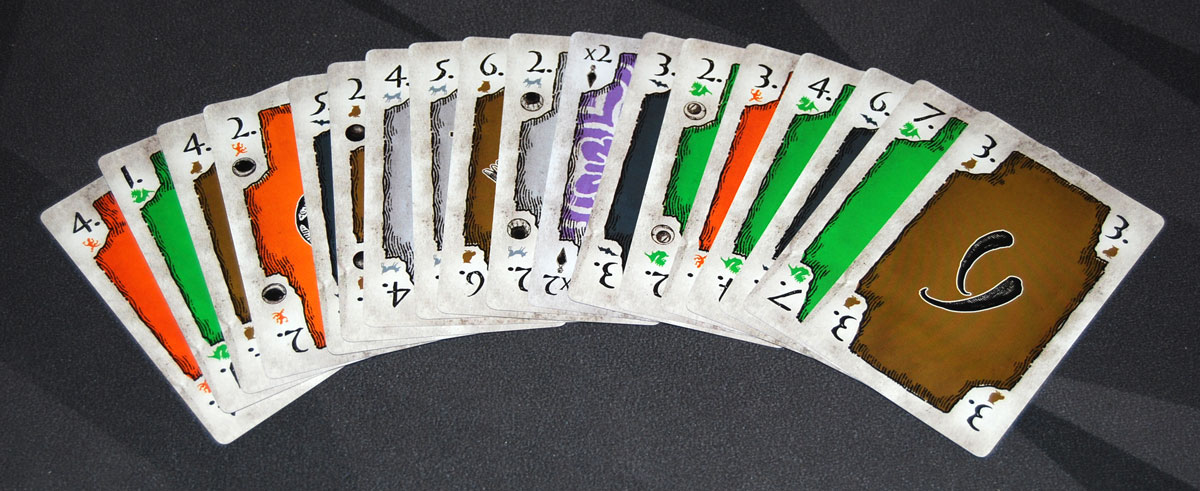
The ingredient cards represent a variety of animal parts: eye of newt, claw of owl, and so on, plus an Elixir. The values are tied to the ingredients—eyes are 2, tongues are 4—and the animals are the suits (dragon, dog, bat, etc.). One interesting thing to note about the deck is that not every suit has the same set of cards, or even the same number of cards.

The player aid cards have a handy little chart showing the various values of the ingredient cards so you can tell at a glance which cards exist. The other side has an explanation of how ingredients combine—but we’ll get to that in a minute.
The fate tokens are simple cardboard tokens (a skull wearing a crown), and the crystal ball card is double-sided, with a 3 on one side and a 4 on the other.
How to Play 3 Witches
You can download a copy of the rules sheet here. 3 Witches is a trick-taking game; for each “trick,” each players will play cards and then based on the values of the cards played, somebody wins the trick. However, 3 Witches has a few tricks up its sleeves and tricks are not resolved in the typical way.
The Goal
The goal of the game is to be the first player to earn 5 fate tokens.
Setup
Each round, shuffle the 18 ingredient cards and deal each player 6 cards. The player who was dealt the Elixir must announce it, and the player to their left becomes the first player.
Gameplay
First, in turn order, players will bid on how many tricks they plan to win. You must bid either 3 or 4 tricks, or pass. If somebody has already bid 3, you may outbid them, but as soon as a player bids 4, the bidding phase ends. Whoever won the bid takes the crystal ball card, turned to the side matching their bid, and is now the Lead Witch for this round. The other two players become the Lesser Witches; each Lesser Witch must discard a card from their hand face-down.
(There are some additional rules for what happens if everyone passes—cards are passed between players and bidding starts up again, but I won’t get into all of the details here.)
After the teams have been decided, the round will involve 5 tricks, and each team will play 2 cards to the trick. The Lead Witch plays two cards, and the Lesser Witches each play 1 card, with the highest combined value winning the trick—but there are some special effects in how values combine.

The Lead Witch always starts the trick by playing two cards, one face-up and one face-down; the face-up card is the lead suit. The next player in clockwise order must play the same suit face-up if possible; otherwise they may play any card or pass. The last player must also follow suit, or else they must play any card. Finally, if the second player passed, they must now play a card.
Once the four cards have been played, the Lead Witch reveals their face-down card, and each team calculates their total value:
- If both cards have the same value, add them together
- If both cards have the same suit, add them together
- Otherwise, only count the higher of the two values
The higher value wins, with ties going to the Lead Witch.
The Elixir doubles the value of the other card. In the photo above, the Lesser Witches have a total of 12 (the 6 of bats doubled by the Elixir) and the lead witch has 8 (3 and 5 of bats are added together), so the Lesser Witches win.
After the trick, the winning team chooses one of the two cards the Lead Witch played to return to the Lead Witch’s hand. (The exception is that the Lead Witch cannot choose the Elixir to return to their own hand if they won.)
After 5 tricks, if the Lead Witch won exactly the number of tricks matching their bid, they win the round and get 2 fate tokens. Otherwise, the Lesser Witches win the round and each get 1 fate token.
Game End
The game ends when a player reaches 5 fate tokens and wins. If two players get their 5th token simultaneously, they share victory.
Why You Should Play 3 Witches
There aren’t generally a lot of games that are for exactly three players. Two players? Sure, particularly when it comes to abstract strategy games or head-to-head combat games. Solo? A growing category, with a spike driven by early pandemic days when a lot of people were stuck at home by themselves. And, of course, “2–4 players” is probably one of the most common player count that I see in my collection. But for 3 Witches, three is indeed a magic number.
It’s also unique in the way that those three players interact. I’ve played trick-taking games where everyone is cooperating, or everyone is competing, or where players are on teams competing against each other. There are even trick-taking games where everyone is working together but there may be a hidden traitor trying to foil their plans. 3 Witches is the only one I’ve played so far that has a 2-vs-1 setup, and it makes for an unusual experience that will throw off some of your usual trick-taking tactics.
For each trick, each team ideally wants their two cards to match either rank or suit, because then the total value is the sum of the two cards. The Lead Witch, of course, gets to choose both of their cards themselves, so they’re only limited by what they’ve been dealt. The Lesser Witches have to read each other a bit—if you don’t have the lead suit, do you pass so you can see what your partner plays? If your partner passes, can you predict what value to play so they might have a chance to match you?

There’s another wrinkle: the eyes. If the Lead Witch’s face-up card is an eye (value 2), then the Lesser Witches must play their cards face-down, which limits their ability to communicate even further. In the example shown above, the Lead Witch ends up with a total value of 6 (summing the same suit) but the Lesser Witches have a total of 5 (the higher of two cards, since they don’t match). The downside is that if you lead with an eye, that’s a low card and there’s an upper limit to your total … and the Lesser Witches could easily figure that out.
With so few cards in the deck, that little chart showing all the available cards is really important. You can learn a lot of information about what other players have by observing who follows suit or passes. Not only that, but the Lesser Witches have a small piece of information if they win a trick and choose which card the Lead Witch gets to take back.
The most difficult part of the game to grasp may be the initial bidding. How do you look at your cards and decide how many tricks you could win? More specifically, you’re trying to decide if you could win exactly three or four tricks—no more, no less. If you become lead witch, the important thing to remember is that you’ll get one card back after each trick; if you’re not lead witch, you’ll have to discard a card from your hand before the round begins. If somebody bids 3 tricks, how strongly do you feel you could beat them at those tricks and then some?

Familiarity with the deck is important, but until then you’ll spend a lot of time consulting those player aid cards. With so few cards in each suit, there’s a lot of information to be gleaned by watching who follows suit, who passes, even which card the Lead Witch plays face-up. The Lesser Witches can often figure out what the Lead Witch’s maximum total value could be, but then figuring out how to beat it is another problem. Or, alternatively, how not to beat it, since the Lead Witch fails if they win all 5 tricks.
The one thing that I’m not totally satisfied with is the scoring. The fact that the teams aren’t set for the whole game and vary from round to round means that you’re still trying to get the most points for yourself, but at times you need to work with somebody to make that happen. But it also leads to some weird situations—for instance, if you’re paired up with a Lesser Witch who has 4 fate tokens already (and you have fewer), then perhaps you might actually work against your “teammate” to prevent the game from ending. There have been situations where my two opponents are both in position to win—if that’s the case, then being a Lesser Witch also makes me a kingmaker. The only way out is to become Lead Witch and win, but as soon as somebody bids 4 tricks then that’s no longer an option for me. Since you’re just playing to 5 points, this isn’t an uncommon situation, so it doesn’t always make for a satisfying ending.
That said, most of the folks I’ve played with have really enjoyed the gameplay and how different it feels. I think it’s hard to understate how weird this game is compared to other trick-taking games I’ve played. As I said above, you don’t have to be experienced in trick-taking games to play 3 Witches; it helps you get a grasp on figuring out who has what cards, but it is of almost no use in helping you strategize how to bid. I’ve really enjoyed the mind games involved in figuring out what to play, whether I’m the Lead Witch or a Lesser Witch.
If you like trick-taking games and you’re looking for something a little off the beaten path, 3 Witches is worth a try! Visit the Allplay website for more info.
Click here to see all our tabletop game reviews.
 To subscribe to GeekDad’s tabletop gaming coverage, please copy this link and add it to your RSS reader.
Disclosure: GeekDad received a copy of this game for review purposes.