Align the stars to restore the constellations to their proper places!
What Is Logic & Lore?
Logic & Lore is a light deduction game for 2 players, ages 8 and up, and takes about 10 to 30 minutes to play. It’s currently seeking funding on Kickstarter, with a pledge level of $19 for a copy of the game; there is also an $8 tier for a print-and-play version, or $39 to get the game with a play mat. The game has an easy mode and an advanced mode, so there is some flexibility for player age and experience level.
Logic & Lore was designed by Darren Reckner and Jason Hager and published by Weird Giraffe Games, with illustrations by Jason Hager.
New to Kickstarter? Check out our crowdfunding primer.

Logic & Lore Components
Note: My review is based on a prototype copy, so it is subject to change and may not reflect final component quality. For instance, the finished game will include dragon tokens instead of the cat tokens pictured here, and the graphic design is not finalized.
Here’s what will come in the box:
- 9 Luna cards
- 9 Nova cards
- 9 Alignment cards
- 4 Black Hole cards
- 4 Reference cards
- Dragon Tokens (one set per player)
- 30 Tracking tokens

The cards are all tarot-sized cards with a celestial theme to them—although they represent the night sky, there are some nice ribbons of color on them. The luna and nova cards are each numbered 1 to 9, and the only differences between the two decks are the card backs. The fronts show a large number on top and bottom, with a moon in the center—when properly ordered, the brushstrokes from the numbers flow into each other, and the phases of the moon go from new moon to full and back.

The alignment cards—also numbered 1 to 9—are double-sided for the two game modes, with just the numbers on one side, and different questions on the other. There are little symbols on the questions, and the tracking tokens have the same symbols so you can use them to take notes, though there isn’t specific guidance on how to use them so you will need to come up with your own system for that. The dragon tokens are used in the advanced mode.
How to Play Logic & Lore
You can download a draft of the rulebook here. There are two modes: Star Light (easy) and Star Bright (advanced). I’ll start with the Star Light rules.
The Goal
The goal of the game is to be the first to put all 9 of your cards in the correct order.

Setup
Lay out the alignment cards in the center in order. Each player takes their own set of 9 cards, shuffles them, and then lays them out face-down next to the alignment cards. Note that you are not allowed to look at your cards! Place the tracking tokens nearby—either player may use these to make notes on their own line.
Star Light Gameplay
On your turn, you may first optionally Move the Heavens: rearrange any of your cards that are face-down.
Then, if you think you’ve got everything figured out, you may Align the Stars—flip all of your cards face-up. If they’re correct, you win! If they aren’t, you lose.

Assuming the game isn’t over yet, you Search the Sky: choose any two cards in your row, hold them so that your opponent can see them, and you ask a number of questions, in the order they’re printed on the alignment cards. You’re allowed to skip over some questions but cannot change the order, and as soon as you get a “yes” answer you cannot ask any more questions.

Here are the questions:
- Are either or both of the cards aligned (in the right positions)? If so, the opponent points to the card(s) in the correct place and you turn the correct card(s) face-up.
- Are these cards neighbors? If the two numbers you are showing are sequential, your opponent says “yes.”
- Are these cards symmetric? If the two cards are the same distance from the center, then they add up to 10, and the opponent says “yes.”
- Which star is greater? The opponent points to the card that is greater.
After your question phase ends, you may optionally Move the Heavens again.
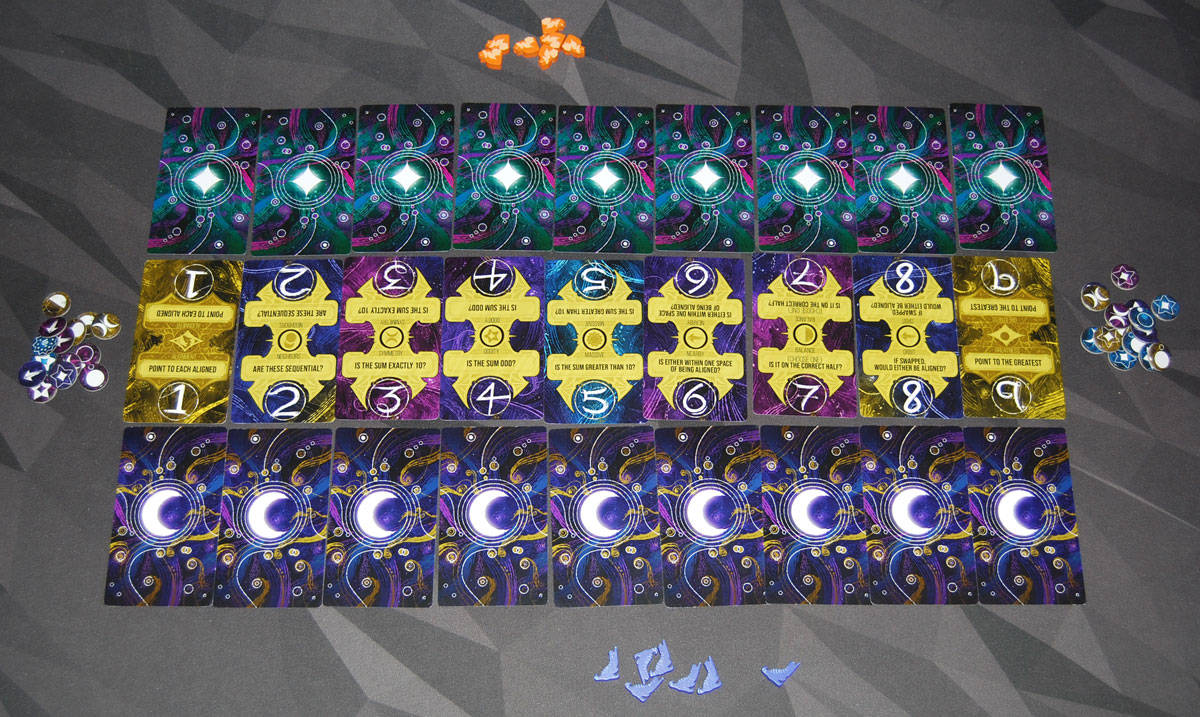
Star Bright Gameplay
For Star Bright, you flip the alignment cards so that all of the questions are face-up and give each player a set of dragon tokens.
Before you Search the Sky and ask questions, you must put one of your dragon tokens on one of the cards to select it. Questions 1 (are either aligned?) and 9 (which is greater?) are always selected for both players. Each card may only have one token on it, so if you choose one that has your opponent’s token on it, they remove it.

When you ask questions, you may only ask questions that have your tokens on them (plus 1 and 9). Again, you may choose to skip over any questions, but you must progress from 1 to 9 and cannot backtrack. As in Star Light mode, as soon as you get a “yes” answer, your question phase ends.
- Are either or both cards aligned?
- Are the cards symmetric?
- Are the cards neighbors?
- Is the sum of the cards odd?
- Is the sum greater than 10?
- Is either card within one space of where it should be?
- Choose one of the two cards and ask: Is this card on the correct half of the line?
- If the cards were swapped, would either be aligned?
- Which card is greater?

Black Hole cards
There are two black hole cards for each player that can be mixed in for an even bigger challenge. They are just shuffled into the rest of the cards and the line will now extend past the ends of the alignment cards. Your goal is still to align your numbered cards. When asking questions about black holes, they count as nothing and are never aligned, so the answer for them is always “no.” When pointing to which card is greater, you point to the bigger black hole.
Why You Should Play Logic & Lore
I enjoy deduction games, using logic to eliminate possibilities and narrow down an answer, so I was really curious to see how Logic & Lore works. It’s a clever little game that has a bit of luck mixed in with the deduction. Logic & Lore is a lighter variety than, say, Turing Machine—it’s still a number-based game, but overall feels a little less math-y, since you already have all the digits, you just need to get them in order.
The questions that you get to ask are pretty simple to understand for the most part, so the tricky part is figuring out which questions are most useful to you. Finding out that two cards are symmetric can be really useful because now as soon as you place one, you know where the other one goes. But I’ve had games where I managed to align one half of my line before finding any symmetry, which means that question was no longer helpful. (You can’t ask questions about face-up cards.) Using the “which card is greater” question over and over will eventually let you sort the line, but since this is a race against the other player, it may not be very efficient. The main pressure is the other player: you need to figure out your cards before they do, and if you think they’re getting close, you have to decide if it’s worth risking it all to use the Align the Stars action. It can make it feel like you’re just each playing a solo puzzle in parallel (which can be a common issue in deduction games), but this one is generally pretty quick. Though the box says up to 30 minutes, I think generally you’re not going to take that long (except maybe with the black holes thrown in).

There can be a bit of luck, of course—if some of your cards happen to be in the right place from the start, you’ll just have a head start on your opponent since you generally start by asking if they’re already aligned. Finding cards that are neighbors or symmetrical is often a matter of random chance at the start of the game. Question 4—whether the sum is odd—is a strange one, because it provides the same amount of information whether you get a “yes” or “no” response, but you only get to continue asking more questions if the answer is “no.” I remember one game where my opponent kept picking pairs with an even sum, and it seemed like every time I tried the same question I got an odd sum and had to stop.
The placement of tokens (in particular, only allowing one player’s token per card) didn’t seem quite as necessary to me, since you can always just replace a token if you really want to ask that question. It seems more important to restrict the number of questions a player can ask on their turn than to force them to play this little back-and-forth area control thing. It does also pose the limitation that you can only change one of your questions from turn to turn, and the rest will be the same. Still, by a few rounds in, you should be able to ask up to 6 questions on each turn, so it’s a pretty small limitation. In contrast, it’s very flexible that you can rearrange any number of your face-down cards at the start and end of each turn, rather than only being allowed to swap out cards that you asked about this turn, or move cards one space at a time, or something like that.
Overall, I’ve enjoyed Logic & Lore though I don’t have the opportunity to play as many 2-player-only games so it’s harder for me to get this to the table compared to some of my other deduction games. It’s been nice to have for when I’m waiting for other folks to show up for games, though, and makes a good appetizer. If you primarily play 2-player games and you like some light deduction, you should check it out. One last note is that the two players can play at different difficulty levels, too. One player can use Star Light and the other can use Star Bright; you can even choose to have only one player use black holes to make it more difficult for them. That could help to level the playing field if you’re playing against somebody who is younger or less experienced, which is an excellent feature.
For more information or to make a pledge, visit the Logic & Lore Kickstarter page!
Click here to see all our tabletop game reviews.
 To subscribe to GeekDad’s tabletop gaming coverage, please copy this link and add it to your RSS reader.
Disclosure: GeekDad received a prototype of this game for review purposes.