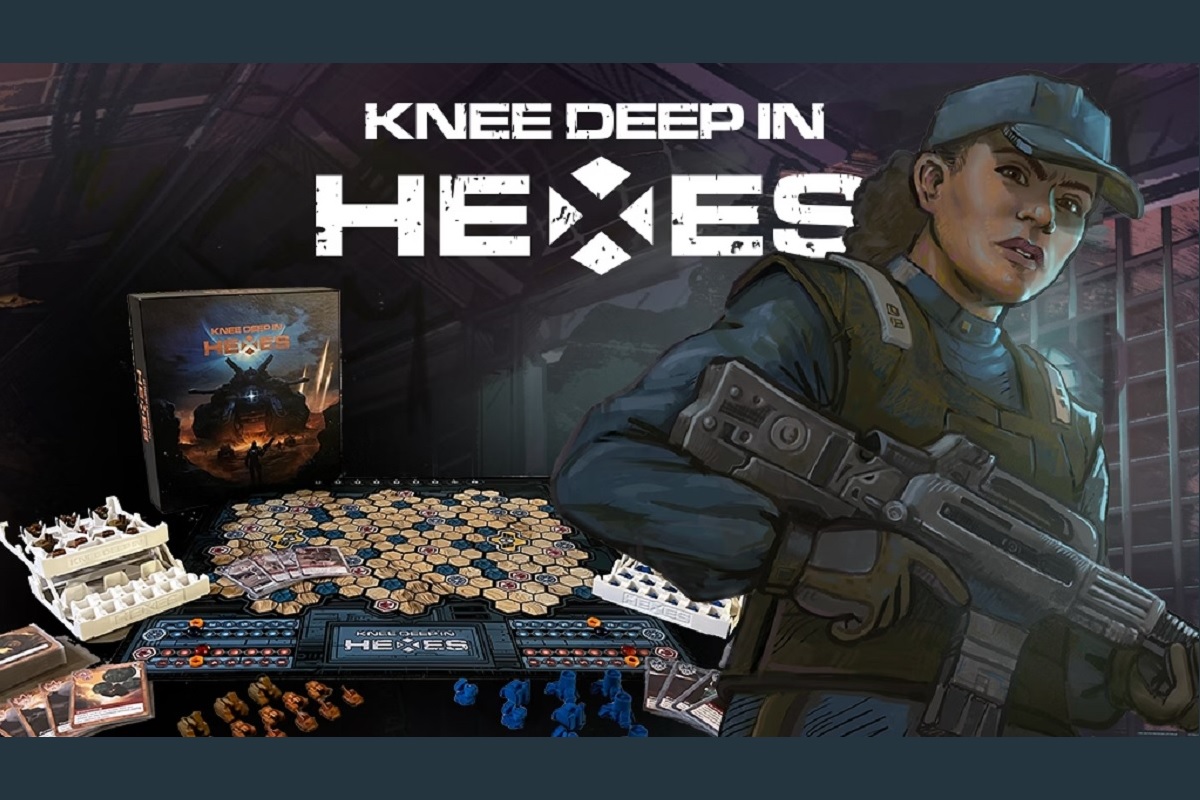
It has been a few decades since the RTS (real time strategy) video games took the entertainment world by storm. While they had various themes ranging from fantasy, science fiction, and even historical, they all had several things in common. Players stared out with a base, they had workers and soldiers, and needed to control resources in order to create new units. While you did not start out with much, you needed to quickly grab resources while denying them to your opponent. Once you built up an army, you were ready to go on the attack. The feel of the classic RTS games has returned–this time to your tabletop with Knee Deep in Hexes.
What Is Knee Deep in Hexes?
Knee Deep in Hexes is a skirmish strategy board game for 2 players, ages 14 and up, and takes about 45-60 minutes to play. Players start off with a base and then use resources and energy harvested each turn to build new vehicles and structures as well as take actions. It’s currently seeking funding on Kickstarter, with a pledge level of $59 for a copy of the game. There is an all-in pledge level as well which includes the base game as well as two expansions. It is available for $139. Delivery is estimated for September 2024. Knee Deep in Hexes was designed by Marcel Kraatz and published by till 5 am Games with illustrations by Lars Krause, Vicky Wecker, and Liz from Kiewitz Studios.
New to Kickstarter? Check out our crowdfunding primer.
Knee Deep in Hexes Components
Note: My review is based on a prototype copy, so it is subject to change and may not reflect final component quality.
Here is what you get in the box:
- 1 Double-sided game board
- 8 Companion cards
- 82 Strategy cards
- 28 Vehicle miniatures
- 18 Building miniatures
- 2 Warzone markers
- 4 Resource Trackers
- 14 Planetary cards
- 59 Terrain tokens

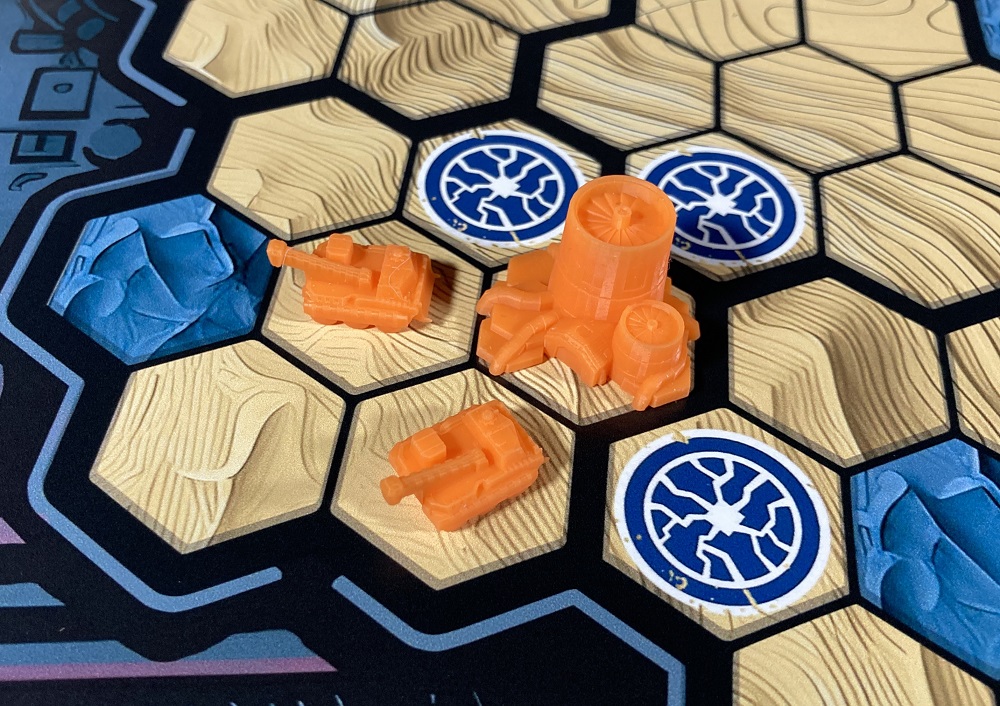
The game board contains a map made of up hexes. Each hex is called a field. Seven fields form a cluster called a sector. The tan colored fields are empty fields. Vehicles can be deployed and structures can be built only on empty fields. The blue fields are mountains and are impassible and cannot be built on. The fields with a red symbol are material resource fields and the blue symbols are energy resource fields. Like mountains, units and structures cannot be placed on them. Finally the four hexes covered by yellow form an HQ. One side of the gameboard has all of the terrain and resources already placed on it. The map on the other side has only empty fields to which you can add terrain tokens to create your own map. The planetary cards can be used to keep the map symmetrical for each player. Across the top of the game board is the scrapyard. This is where destroyed vehicles and structures are placed. At the bottom of the game board are the resource tracks for each player.

Each faction has four companions cards. These represent characters who provide players with resources as well as strategies to use on the battlefield. A companion card features an image of the character, their name, and character type. The resource symbols along the left side of the card provide resources for the start of each turn. The number in the yellow HQ symbol is the number of health points added to the health of your HQ. Some companion cards also have a special ability listed under the image.

Every companion comes with four pairs of strategy cards consisting of four action cards and four war cards. Action cards can be played during the action phase and have a cost in resources in the top left corner. After paying those resources, you can then resolve the action at the bottom of the card. War cards are played during the warzone resolution phase and often increase the combat points of the side playing the card. Some war cards have requirements listed at the bottom that must be met in order for them to be used while other list the effects of the card in the text.

In addition to the faction cards, each player gets the same nine neutral strategy cards. These consist of three pairs of war cards as well as three different action cards.

Players each receive a supply of miniatures. The 6 ACVs are used to construct buildings. Five tanks are the main combat units while the three paloozas provide the heavy firepower. The four extractors can be placed adjacent to resource fields and allow players to harvest resources during their turn. Two factories can be built on any empty field and allow new vehicles to be deployed adjacent to them. Finally, the three turrets can add combat points to sectors in which they are built. Think of them as immobile tanks. No vehicles or structures begin the game on the map. They must be built or deployed. When a vehicle or structure is destroyed, it is not returned to the supply but instead placed on the scrapyard track at the top of the game board. Each player also receives a warzone mark which is used to declare a warzone on the map.
How to Play Knee Deep in Hexes
The Goal
The goal of the game is to destroy your opponent’s HQ.
Setup
Each player starts off by selecting a color: either blue or orange. They than choose two companions from the four for each faction and take the companion cards and the matching eight faction cards for each companion. Each player also takes nine neutral strategy cards and shuffles them with the 16 faction cards to form a deck known as the draw pile.
Next players set up their supply by taking the following miniatures in their color: 6 ACVs, 5 tanks, 3 paloozas, 4 extractors, 2 turrets, 2 factories, and a warzone marker. Now select a starting player at random. Each player draws 3 cards from the draw pile. Players may take a one-time Mulligan by discarding their entire hand and drawing three new cards. Shuffle the discarded cards back into the draw pile. You are now ready to begin the game.

Gameplay
Knee Deep in Hexes is played in rounds with each player taking one turn per round. During their turn, the active player completes five phases in order. The phases consist of Power Up, Actions, Resolve Warzones, Place a Warzone, and Exhaust. Let’s take a look at each phase in order.
Power Up
Every turn begins with the power up phase. First the active player gains all the resources listed on their two companion cards as well as a resource for each resource field adjacent to one of their extractors. Each field only produced one resource even if the player has two extractors adjacent to it. Use the resource trackers on the game board to keep track of your resources. Finally, the active player draws a card from their deck. If they end up with more than six cards in their hand, the player must immediately discard down to six. It is important to note that players start out with 25 cards in their draw deck. When a card is discarded, it is placed face up in a discard pile. If the draw deck ever runs out of cards, you are out of cards for the rest of the game. The discard pile is not reshuffled into a new draw pile. Therefore, realize that when you discard a card, it is out of the game (unless another card lets you retrieve a card from the discard pile).

Actions
During this phase, the active player can take as many actions as their resources and cards in their hand allow. There are six types of actions. In order to deploy a vehicle, the player spend material resources to pay the cost of the specific vehicle and then can place the vehicle on any empty field adjacent to their HQ or one of their factories. An ACV costs one material resource, a tank two resources, and a palooza costs three. A player may move a vehicle by spending an energy resource. For each resource, an ACV can move three fields, a tank two fields, and a paloooza only one. However, a player could spend three energy to move a palooza three spaces. Vehicles can move through fields with friendly vehicles or structures, but must end its movement on an empty field. However, each movement action must be taken separately. Therefore, a palooza could not move through friendly units or structures since it can only move one field at a time and needs to end on an empty field before moving again. When moving vehicles, remember that movement comes after you deploy all your vehicles, so you can move any vehicles you deploy that turn as long as you can afford the energy.

Building a structure is another action. Extractors, factories, and turrets each cost only one material resource to build. After paying the cost, you can place a structure of your choice in an empty hex that is adjacent to two ACVs. Finally you can use actions to add cards to your hand. A player may pay one material resource to draw a card. They can also pay one energy resource to recycle a card. This requires the player to discard a card from their hand and draw a new card.
War Zones
Combat in Knee Deep in Hexes is different from most tactical games. Rather than individual units attacking other units, a player declares a war zone by placing a war zone marker at the point where three sectors meet. Therefore a war zone consists of three sectors of seven fields each. However, a war zone is not resolved until the other player’s turn. This allows the defending player to react. So in the order of play, after a player finishes all their actions, they first resolve an existing war zone their opponent placed on their turn. Then once it is resolved, they place their own war zone marker. Placed a war zone marker is completely voluntary. Due to the way the war zones are used in the turn order, there can only be one war zone on the map at a time.
In order to resolve a war zone, each player must have at least one vehicle or structure in the war zone of three sectors. If this does not exist, the war zone marker is removed and no war takes place. If a war begins, the attacking player (who declared the war zone) may play a war card from their hand face down. The defender may then play one war card from their hand face down. Both players then reveal their cards at the same time with the defender resolving their card first. Next players calculate their combat strength by adding up the combat points for their vehicles and turrets and adding any bonuses from their war card or special abilities of their companions. ACVs have 1 combat point, tanks and turrets have 2 combat points, and paloozas have 3 combat points. The player with the highest number of combat points is the winner. In case of a tie, the war zone marker is removed with no result. The winner can now assign any excess combat points (their combat points less the loser’s combat points) to inflict damage on enemy vehicles and structures. ACVs have 1 health, palooza have 3 health, and tanks and structures have 2 health. Targeted units are either destroyed by assigning their full health worth of damage or there is no affect. Any leftover damage is lost. For example, if you only had one excess combat point, you could only destroy an ACV. In order to destroy a palooza, you would have to have 3 excess combat points. So just winning a battle will not wipe out the enemy. You will need to win by a lot of combat points to destroy multiple targets.
If an HQ is in the war zone, it can be targeted. The health of an HQ is sum of the HQ health points on the defending player’s two companion cards. For most companions this is 2 so in most cases, you would need to win a war zone with four excess combat points.

Exhaust
Exhaust is the final phase of a turn. During this phase, the active player removes any unused material and energy resources from their tracker. Also, if they have more than six cards in their hand, they must discard down to six.
Game End
The game ends immediately if either an HQ is destroyed or the scrapyard is completely filled with destroyed vehicles and structures. The player who destroys their opponent’s HQ is the victor. In the case of the scrapyard end, each player adds up the total health points of vehicles and structures they have in the scrapyard. The player with the lowest total is the winner. In the case of a time, the winner is the player who destroyed more of their opponents vehicles and structures.
Why You Should Play Knee Deep in Hexes
One of designers goals for Knee Deep in Hexes is is to make it feel like you are playing a classic RTS video game. This is definitely achieved. At the start, you need to deploy your ACVs so you can then build structures near resource fields so you can get more resources to deploy more vehicles and structures and to have the energy to move them. The resource management is quite simple yet elegant. There are only three types of vehicles and three types of structures, so decisions are usually quick on what to spend your material to build or deploy. In addition, the vehicles are well balanced. Paloozas are powerful, but move very slowly. Plus your supply is limited. All of this makes for a quick-paced game.
Speaking of quick, one of the attributes I really like is how quick this game can be set up and ready to play. All you need to do is put out the gameboard, select two companions. Take their strategy cards and add the nine neutral cards. Shuffle your draw pile. Collect your supply of miniatures and you are ready to go. The miniature holders I show in the photo of the game setup will likely be a stretch goal in the Kickstarter campaign. They make set up even easier. Literally, you can open the box and be playing in just a couple minutes. The prototype I was able to review did not have the blank side of the game board, the planetary cards, or the terrain tokens. However, they allow players to create random maps and the planetary cards help by showing what tokens to put in each sector so that both sides of the map are symmetrical and one player does not have all the resources closer to them. It is a clever system that ensures the map is balanced. While creating a custom map takes a bit longer to setup, it does provide variety. There are also rules that allow deck building as well.
In addition to the simplicity of rules and setup, I find the combat very interesting. There are no dice roles or chance involved. In fact, combat is very strategic. When you want to attack, you have to consider all the units within a cluster of three sectors. So you want to go in with overwhelming firepower so you can inflict some real damage. However, the defending player still has their turn in which to build and deploy. Therefore, the attacker has to consider the opponents units on the map and if they can get to the war zone in time. Some action cards let players deploy vehicles or turrets anywhere on the map, so that has to be taken into consideration as well. Finally, war cards can add a lot of combat points to the battle as long as the requirements are met. While there may be much to consider when declaring a war zone, it is amazing how quick a war is resolved. Just add up the points and compare.
I only had the opportunity to play the base game and it offers a lot of fun gameplay. However, the campaign offers an all-in pledge level that adds a lot more to the game with two expansions. The Savage Dust expansion adds a third faction with their own miniatures, companions and strategy cards. It also includes 56 3D terrain tiles to represent mountains and resource fields as well as 18 event cards to add even more variability. The God’s Hand expansion adds a mercenary mini faction with one companion and their strategy cards which can be used with any other faction as well as as a complete fourth faction with miniatures and cards. The new factions add more options but the game is still for 2 players. Also, while the miniatures in the base game are the same, just different colors, the miniatures for the two new factions will each have their own designs that are unique.
After playing several games of Knee Deep in Hexes, I am very impressed with the game. The first few turns go fairly quickly since both players are trying to build up their access to resources. Since you have to spend energy to move vehicles, you can’t necessarily move every vehicle every turn. Plus the victory conditions help keep the game to under an hour. You either rush for the enemy’s HQ or destroy more of their units. Once the 11th vehicle or building is added to the scrapyard track, the game is over. I had a lot of fun playing the core game and can’t wait until the final game along with the expansions release. If you are looking for a two-player skirmish game you can quickly get to the table and play with some unique and fun rules, then I recommend you consider Knee Deep in Hexes.
For more information or to make a pledge, visit the Knee Deep in Hexes Kickstarter page!
Click here to see all our tabletop game reviews.
 To subscribe to GeekDad’s tabletop gaming coverage, please copy this link and add it to your RSS reader.
Disclosure: GeekDad received a copy of this game for review purposes.